
CSA Z94.3 Class 1A protective spectacles carry side protection as a baseline requirement for impact, while Class 2A direct-ventilated goggles seal the eye perimeter against splash and fine dust on top of the same impact duty [S1][S3].
The two product classes are not interchangeable: spectacles are open-perimeter and impact-first, goggles are sealed-perimeter and hazard-multi. ANSI Z87.1, the U.S. counterpart, only mandates side protection on spectacles that are Impact-rated, which is a meaningful structural difference from CSA's all-spectacles rule [S3]. For Canadian-jurisdiction and many cross-border industrial sites, that difference reshapes the spec sheet and the audit trail.
Hazard Coverage Matrix: What Each Class Actually Seals Against
Class 1A spectacles are rated for impact only and include built-in side protection; Class 1B adds non-ionizing radiation protection on top of the same impact-plus-side-shield baseline [S1]. The lens and side-shield combination is intended to stop flying chips, fragments, and low-mass projectiles generated during general bench work, light grinding, or closed-container handling [S2].
Class 2A goggles are direct-ventilated and rated for impact; Class 2B steps up to non-ventilated or indirect-ventilated construction for impact, dust, and splash; Class 2C layers in non-ionizing radiation; Class 2D adds laser radiation; and Class 2E is specified for electric-arc work as part of a CSA Z462-acceptable ensemble [S1]. In practice that means a Class 2A goggle is the minimum sealed-perimeter option, and 2B/2C/2D/2E are specialty step-ups rather than competitors to 1A spectacles.
Side Protection, Coverage Geometry, and Field of View
CSA Z94.3 specifies minimum frontal and side coverage dimensions for spectacle lenses and side protectors, and minimum dimensions for face-shield windows and welding-hand-shield filter plates; the ANSI standard only matches CSA on spectacle lens and side-protector geometry, not on the other device categories [S3]. That dimensional codification is why CSA-compliant spectacles look more "wrapped" than a generic ANSI Z87.1 pair without the "+" impact mark.
For goggles, CSA adds a minimum field-of-view requirement that the ANSI standard does not carry for the same product class [S3]. Field-of-view is a usability number, not a safety number, but it directly drives wearer compliance: a goggle that tunnels the user's vision tends to get lifted or removed, which defeats the splash rating.
Ventilation Path: Direct, Indirect, or None

Class 2A direct-ventilated goggles route airflow straight through the goggle body, which keeps fogging down but allows splash and dust ingress through the vent path; Class 2B indirect-ventilated versions cap or baffle the vents so liquid and particle entry is blocked while some airflow remains [S1][S4]. Non-ventilated 2B goggles close the air path entirely, which trades fogging risk for the best chemical and dust seal in the 2-class family.
Spectacles have no ventilation classification under CSA Z94.3 because the perimeter is open by design. The relevant side-shield geometry (codified in [S3]) is the only engineered barrier between the wearer's temple and a side-impact projectile. For any task that generates a liquid aerosol, powdered reagent, or hot splash, that open perimeter is the failure mode; the lens may survive, but the seal does not exist [S2].
Decision Criteria: When to Pick 1A Over 2A, and Vice Versa
Pick Class 1A spectacles when the hazard inventory is limited to flying chips, fragments, and low-energy impact during closed-container or instrument work, and when chemical splash or airborne dust is not present [S1][S2]. Pick Class 2A goggles the moment solvent pouring, acid transfer, dusty grinding, or any splash-capable operation enters the task list, because the side-shield geometry on 1A is not a liquid seal [S2][S4].
Step up from 2A to 2B (indirect or non-ventilated) for aggressive solvents, biological fluids, or fine particulate where direct-vent 2A airflow would channel contamination into the eye cup. Step up to 2C/2D/2E for UV/IR, laser, or arc-flash tasks respectively; these are not "better goggles" but different hazard classes, and a CSA Z462 arc-flash ensemble is the governing reference for 2E, not Z94.3 alone [S1].
Cross-Border Spec Note: CSA vs ANSI Side-Protection Rule
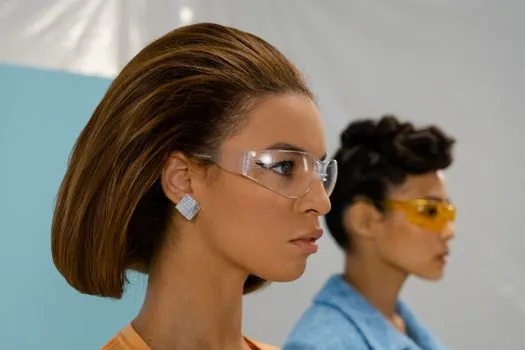
CSA Z94.3 requires side protection on every spectacle in the standard, regardless of impact rating; ANSI Z87.1 only requires side protection on spectacles that carry the "+" Impact mark [S3]. For a U.S. plant shipping product into Canada, or a Canadian contractor working under U.S. OSHA jurisdiction, that asymmetry drives the SKU: a non-impact ANSI spectacle may be compliant in the U.S. but non-compliant in Canada because the side-shield is absent.
High-velocity impact tests under ANSI use a 0.25 in (6.35 mm) steel ball at 45.72 to 91.44 m/s depending on the device, and high-mass impact uses a 500 g pointed projectile dropped from 127 cm; CSA does not reproduce those exact test parameters on its side-protection dimensioning, so an ANSI "+" mark is not a 1:1 substitute for CSA certification [S3]. For Canadian sites, only CSA-certified (or equivalent accredited agency) product may bear the CSA mark, per the certification clause in [S3].
Limits, Failure Modes, and Audit Pitfalls
The most common failure mode for Class 1A spectacles in the field is not lens breakage but perimeter bypass: a splash or projectile entering from above the frame, around the side shield, or through the lower air gap, all of which are open by design [S2]. Comfort-driven removal, lens fogging on indirect-vent goggles, and field-of-view tunneling on 2A are the usual reasons workers downgrade protection mid-task; all three are documented as preventable-injury contributors in occupational eye-injury surveillance [S2].
Audit pitfalls include specifying "safety glasses" generically when the hazard inventory calls for splash sealing, accepting ANSI Z87.1 "+" marked product in a Canadian jurisdiction without verifying the CSA mark, and treating 2C/2D/2E goggles as drop-in upgrades for 2A when the hazard class is actually different (radiation, laser, arc-flash) and the supporting standard changes [S1][S3]. For related PPE-side spec decisions, see this hard-hat voltage-class comparison, which uses the same hazard-class-to-CSA-standard mapping pattern.
Stacking PPE: When Glasses Go Under Goggles

Prescription wearers and high-dust task workers commonly stack Class 1A spectacles inside a Class 2B indirect-vent goggle, which preserves impact correction at the lens plane and adds a sealed perimeter at the face plane [S1][S4]. CSA Z94.3 covers this stacking pattern as long as each device carries its own valid marking; mixing a non-CSA spectacle under a CSA goggle does not pull the inner device into compliance.
For high-heat, molten-metal, or arc-flash work, the spec stack typically moves from goggles to a face shield (Class 6) or welding helmet (Class 4) over the spectacle/goggle base layer, because the energy and radiant-heat load exceed what a goggle lens is rated to dissipate [S1]. Picking the wrong base layer in that stack is a frequent spec error; the goggle is the splash and dust seal, the face shield is the energy and mass barrier, and they are complementary, not substitutes.
Track the next revision of CSA Z94.3 against any new side-coverage dimensional changes for spectacle side-shields, and against any field-of-view number revisions for Class 2 goggles, since those are the two CSA-specific requirements that have no direct ANSI counterpart [S3].
Detailed specification references: measurement test 3, measurement test 2, and electronic test measurement 2.