
Deadweight testers (also called pressure balances) remain the primary standard for industrial pressure calibration, generating reference pressure from calibrated masses loaded on a precision piston-cylinder, with force divided by effective area [S1][S2].
The 2026 vendor pool listed on DirectIndustry covers 11 manufacturers and 33 product models, with working-pressure ranges spanning 0.05 bar pneumatic floats to 5,000 bar hydraulic benches [S1]. Electronic deadweight testers from Fluke Calibration (model E-DWT, published 2026-08-10) now eliminate physical weight handling entirely, generating set points with a servo-driven pressure controller and delivering real-time pressure readback [S3].
Three operating variants, three different buying decisions
The market cleanly splits into three execution styles, and the wrong choice wastes both capital and bench footprint. Pneumatic deadweight testers (e.g., WIKA CPB5000 at 0–400 bar, Mensor PK II at 0–30 psi/0–2 bar) use gas or filtered air as the pressure medium, float-ball or piston designs, and dominate low-range gauge and absolute work [S1]. Hydraulic deadweight testers (WIKA CPB5000HP at 0–5,000 bar, CPB5800 at 0–1,400 bar, Ashcroft 1305 series at 15–10,000 psi, the Type T at 0–15,000 psi, and the YUNYI7000 at 0.6–2,500 bar) use oil or deionized water and handle the mid- to high-pressure range where pneumatic units physically cannot reach [S1]. Electronic deadweight testers (Fluke E-DWT) sit in the middle: they read differential pressure across a piston-cylinder pair without swapping mass sets, but the underlying reference element is still a primary pressure standard [S3].
Operationally, a conventional deadweight tester needs you to add or remove individual weights to step the pressure, which limits practical resolution to the discrete mass steps. The Fluke E-DWT removes the manual weight set, lets you set and read any pressure value in range, and avoids the piston/cylinder swap typically required when changing measurement ranges in a hydraulic bench [S3]. For a working definition of how the technology relates to other pressure references, the deadweight tester encyclopedia entry covers the force/area principle and primary-standard role.
Selection criteria that actually drive model choice
Five parameters govern the spec sheet, and the order matters: pressure range, accuracy class, media compatibility, physical format, and certification. Pressure range is the first gate: pneumatic units are uncompetitive above ~40 bar because the required piston area grows and mass handling becomes impractical, while hydraulic units are the only option above ~700 bar [S1].
Accuracy class on a primary-standard pressure balance is normally expressed as a percentage of reading (often ±0.015% to ±0.05% of indicated pressure) plus a zero/head-correction term for local gravity and media column [S2]. The quoted class is only valid when the instrument is supplied with traceable mass calibration, piston-area calibration, and the local gravity value is entered; most OEM datasheets assume the user is operating under reference conditions of 20 °C, standard gravity 9.80665 m/s², and the supplied media [S1][S2].
Media compatibility is the second gate, not a footnote. Hydraulic units running on petroleum oil are not acceptable for oxygen or pharmaceutical skids where contamination or reactivity matters, which pushes the spec toward water hydraulic, pneumatic, or a sealed-system electronic DWT [S1]. Physical format (bench, portable, or field) drives the next decision: a 5,000 bar hydraulic bench in CPB5000HP class is a two-person lift and lives in a calibration lab, while a CPB5800 at 0–1,400 bar is explicitly described as a portable unit for on-site maintenance and service [S1].
Comparison: pneumatic vs hydraulic vs electronic at a glance
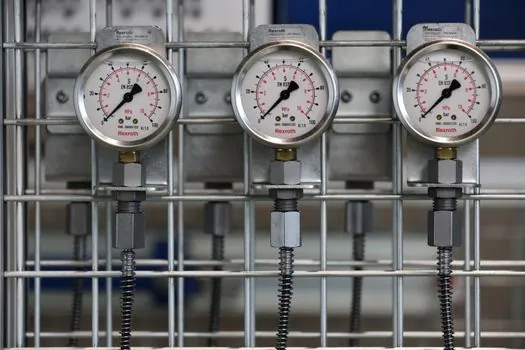
Side by side on four buying criteria, the three variants separate cleanly. Pneumatic: pressure range 0–2 bar up to 0–400 bar in the current WIKA CPB5000 class, accuracy class comparable to hydraulic, media is clean air or nitrogen, portability is excellent, and weight handling stays manageable because forces are small [S1]. Hydraulic (CPB5000HP, CPB5800, Ashcroft 1305D/DH, Type T, YUNYI7000): pressure range 15–10,000 psi up to 0–5,000 bar, accuracy class is the same primary-standard tier, media is oil or water which constrains cleanliness, portability is limited at the top of the range, and weight handling becomes a two-operator task at high pressures [S1]. Electronic (Fluke E-DWT): pressure range covers a wide gas-over-hydraulic sweep without mass changes, accuracy class inherits the piston-cylinder reference, media is the same hydraulic fluid in a sealed system, portability is bench-scale but lighter than a comparable mass-loaded unit, and weight handling is eliminated by the electronic pressure controller [S3].
For a related process-instrument context where deadweight testers feed calibration of flow, level, and pressure transmitters, the Vortex flowmeter 2026 buying guide covers how a DWT ties into a flow lab, and the TDR level meter vs level transmitter decision guide shows the same calibration chain on the level side.
Who needs a DWT, and who absolutely does not
A deadweight tester is the right tool for a calibration lab, a primary-standard traceability path, an ISO/IEC 17025-accredited facility, and any bench where 0.05% or better of-reading uncertainty is required across a wide pressure band [S2]. It is also the right choice for on-site work in oil and gas, hydraulic skid testing, and aerospace where the working pressure of the device under test pushes the spec beyond a typical digital pressure calibrator's rated range [S1].
A DWT is the wrong tool for a maintenance technician who needs to verify a single 4–20 mA pressure transmitter in the field once a quarter: a hand-held digital pressure calibrator is faster, cheaper, and traceable enough for that duty cycle. It is also the wrong tool for very high cycle-count production-line test where the physical mass handling and piston spin-up time become a throughput bottleneck, and an electronic pressure controller or a comparison-type calibrator will be more productive. For metrology, dimensional, and shop-floor precision tooling outside the pressure domain, the gauge block 2026 buying guide and the dial indicator 2026 buying guide walk the same spec-first logic for length and displacement references.
Calibration chain, traceable weights, and known limitations
The deadweight tester's accuracy floor is set by three things you do not own: the piston-cylinder effective area, the mass set calibration, and local gravity correction. The OEM normally supplies a piston-area certificate (typically traceable to a national institute such as NIST, PTB, or NIM) and a mass-set certificate at the same tier; you must enter local gravity (often 9.78–9.83 m/s² across continental sites) and apply the head correction for the difference between the test port and the piston reference plane [S2]. Skipping the gravity term alone can introduce several hundred ppm of error at 1,000 bar, which is larger than the instrument's class.
Known limitations to plan around: the reference is not free of temperature sensitivity (the piston-cylinder and mass set expand with temperature, and the OEM specifies a 20 ±2 °C operating window for full class), the media must be clean (a 5 µm filter is standard on hydraulic units), and the piston must be rotated during measurement to average out friction and seat effects, which the operator or an automated handler does in the Fluke E-DWT [S2][S3]. At very high pressure (above ~2,500 bar), seal life and operator ergonomics become the binding constraint, not the metrology class.
How to shortlist a model in 2026
Start with the pressure range. If your maximum test pressure is below 40 bar and the media is gas, a pneumatic deadweight tester in the Mensor PK II or WIKA CPB5000 class covers it without hydraulic fluid handling [S1]. If your maximum test pressure is 100–1,400 bar and the work is on hydraulic skids, valves, and transmitters, the WIKA CPB5800 (portable) or a CPB5000HP-class bench unit is the working answer, with the Ashcroft 1305D/DH as the common North American portable alternative [S1]. If you are calibrating above 1,400 bar into the 5,000 bar range, the WIKA CPB5000HP and YUNYI7000 (0.6–2,500 bar class) bracket the realistic hydraulic options, with the YUNYI7000 adding servo-controlled pressure generation and automatic binary weight loading for unattended operation [S1].
Then decide physical format. Bench: any of the high-accuracy hydraulic or pneumatic units. Portable: CPB5800, Ashcroft 1305D/DH, PK II. Mass-free automated: Fluke Calibration E-DWT (E-DWT-HV) for sites that want the primary-standard reference without handling individual weights, accepting that the metrology tier is inherited from the on-board piston-cylinder rather than a physical mass set [S3]. For broader flow-instrument context, the flow meter 2026 buying guide and the electromagnetic flowmeter 2026 spec-first selection cover how a DWT bench ties into the rest of a process-metrology lab, while the optical comparator 2026 buying guide and the dial indicator 2026 price guide cover the dimensional side of the same calibration lab.
Final shortlist logic: pick the variant by pressure range and media, fix the accuracy class to the OEM certificate you will receive, and confirm the piston-area, mass-set, and local-gravity documentation are part of the quote. Anything else, such as dual-piston or automated weight loading, is a productivity option on top of that base spec, not a substitute for the primary-standard class.
Spec-level background on the components involved: linear guide, and crossed roller guide.