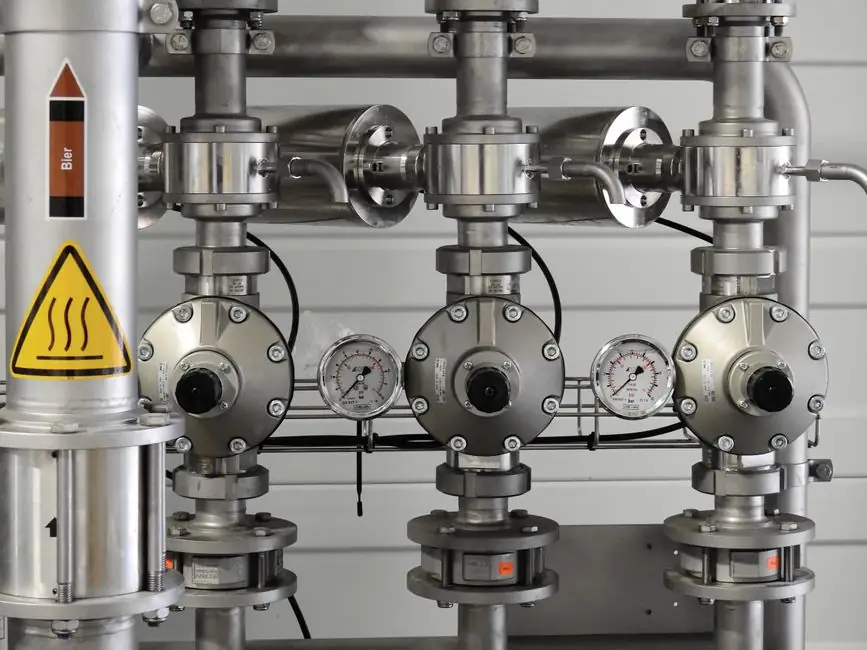
An electromagnetic flowmeter is a volumetric flow meter for conductive liquids that uses Faraday's law of electromagnetic induction: a coil-driven magnetic field and two wetted electrodes produce a sensing voltage proportional to average flow velocity, with no moving parts and no pressure drop beyond a straight-pipe bore [S2][S3].
Spec-first selection in 2026 hinges on five datasheet fields: minimum liquid conductivity, liner/electrode material pair, process temperature and pressure envelope, nominal diameter (DN), and output protocol. The Azbil MGR series, for example, specifies a 50 µS/cm minimum conductivity floor, 0–140 °C process temperature, 0.1–1.0 MPa process pressure, and a compact form factor aimed at filling machines running at 50–300 L/s [S2].
Working principle and conductivity threshold
Faraday's law requires the process fluid to be electrically conductive, with OEM datasheets setting the practical lower bound at roughly 5 µS/cm for general-purpose meters and 50 µS/cm for compact, high-speed filling variants like the Azbil MGR [S2]. Hydrocarbons, deionised water, oils, and high-purity condensate fall below this floor and must use Coriolis, ultrasonic, or vortex meters instead, a tradeoff mapped in the broader flow meter selection landscape. The non-magnetic flow tube and the absence of moving parts mean magmeters are bidirectional, have a turndown ratio typically 100:1 or better, and are unaffected by density, viscosity, or temperature drift, provided the conductivity threshold is cleared [S3].
Four common magmeter types and where each fits
Process-spec readers encounter four practical magmeter variants: (1) wafer/compact flanged meters such as Endress+Hauser Proline Promag 10L, designed for cost-sensitive water and utility duty, available with HART output and a DTM dated 2026-07-07 for DeviceCare 1.07.06, Field Xpert SMT70 1.07.00, and FieldCare 2.17.00 [S1]; (2) high-speed filling variants such as Azbil MGR/MagneW 3000 Hyper-Fill, with 94 mm minimum side-by-side centre-to-centre spacing, 50 µS/cm conductivity floor, and up to 1.0 MPa pressure rating for PET, can, and bag-in-box lines [S2]; (3) slurry and mining-duty meters with rubber or polyurethane liners and abraded-resistant electrodes for ore pulp, pulp stock, and raw sewage; (4) sanitary/hygienic CIP-capable meters with PEEK or PTFE liners, polished internals, and EHEDG/3-A process connections for food, beverage, and pharmaceutical skids. Selection logic: pick type 1 for utility and water; type 2 for filling lines below 1.0 MPa and 140 °C; type 3 whenever solids content exceeds 3% by volume; type 4 whenever clean-in-place temperature exceeds 85 °C.
Key specifications to demand on the datasheet
Engineers reviewing 2026 datasheets should lock in at least seven numbers: nominal diameter (DN15 to DN2400 is the Endress+Hauser Proline Promag L range, with material load diagrams published as special documentation DN 300 and DN 1400–2400 [S1]); minimum/maximum process temperature; minimum/maximum process pressure (Azbil MGR is published as 0.1–1.0 MPa [S2]); minimum liquid conductivity in µS/cm; liner material (PTFE, PFA, ETFE, hard rubber, soft rubber, polyurethane); electrode material (316L, Hastelloy C, titanium, tantalum, platinum-rhodium); and accuracy class, normally ±0.3% to ±0.5% of rate for premium meters and ±1.0% for economy units. Output options in 2026 are predominantly HART 7 over a 4–20 mA loop, with PROFINET, EtherNet/IP, Modbus RS485, and Foundation Fieldbus on premium lines; buyers comparing these to Coriolis flowmeter offerings should note that Coriolis adds mass-flow and density measurement at a 2–4× price premium and cannot be specified on a purely volumetric duty.
Comparison: four magmeter variants against four decision criteria
A side-by-side helps buyers avoid line-item mismatches. (a) Compact/utility (e.g. Promag 10L): low cost, PTFE/rubber liner, 4–20 mA + HART, ±0.5% typical, suited to DN25–DN300 water and chemical duty [S1]. (b) High-speed filling (e.g. Azbil MGR): compact body, 50 µS/cm floor, 50–300 L/s range, 94 mm side-by-side install pitch, optimised for beverage filling at 0.1–1.0 MPa and 0–140 °C [S2]. (c) Slurry/heavy-duty: thick rubber or polyurethane liner, hardened electrodes for abrasion, DN50–DN1200 typical, suited to mining and pulp/paper [S3]. (d) Sanitary/CIP: PTFE or PEEK liner, polished 316L internals, EHEDG/3-A documentation, suited to food, beverage, and pharmaceutical CIP loops above 85 °C. On conductivity floor: (a) and (c) are most permissive (~5 µS/cm); (b) is locked at 50 µS/cm. On temperature: (d) leads at typically 130–180 °C peak; (a) and (c) cap near 80–130 °C; (b) caps at 140 °C. On solids tolerance: (c) leads; (a) and (b) are not specified for abrasive slurries. On unit cost: (a) is the economy tier; (b), (c), (d) command premiums of 1.5–3× depending on liner/electrode stack.
Limitations and failure modes buyers must plan for
Electromagnetic flowmeters fail or misread in five well-documented ways: air entrainment or partially filled pipe, where the electrode pair sees a gas pocket and the meter reads low or noisy; lined-pipe liner collapse under vacuum, which calls for a separate vacuum specification on the datasheet; electrode fouling or coating in oily, scaling, or biological service, addressed by adding a periodic electrode-cleaning cycle or a mechanical wiper option; liner/electrode material mismatch with the process fluid, such as using 316L electrodes with hydrochloric acid (use Hastelloy C or tantalum) or with oxidising slurries; and external electrical noise from VFDs, requiring proper grounding rings, reference electrodes, and bonding to a low-impedance earth. Sizing is also a common failure: a meter installed in a line where minimum operating flow is below 0.5 m/s will read unstable, while oversize above 3 m/s sustained will erode the liner over service life. A related spec discipline across instrumentation is covered in the DP vs AP pressure transmitter spec-driven selection for 2026 reference, where grounding and loop isolation follow the same logic. [S2]
Who should NOT pick a magmeter, and what to pick instead
Specifying an electromagnetic flowmeter on the wrong duty is one of the most expensive mistakes in liquid metering. Walk away from a magmeter when the fluid is hydrocarbon, deionised water, high-purity condensate, or a non-conductive solvent, because conductivity will sit below the OEM floor and Faraday sensing returns a near-zero signal [S2]. Walk away when the duty is steam, superheated steam, or high-temperature gas: a vortex or differential-pressure meter handles gas service cleanly; for steam-cost-driven projects the Differential Pressure Transmitter Pricing and Cost Drivers in 2026 reference lays out the alternative path. Walk away when the duty is custody-transfer hydrocarbon, where a Coriolis meter is required by OIML R117 / API MPMS chapter for mass or volume proving. Walk away when the line is gravity-fed open channel: magmeters require a full pipe, so flumes and weirs with an ultrasonic level sensor are the right tool. A broader cross-technology view, including turbine, vortex, and Coriolis, is mapped in the flow meter buying guide 2026 reference, and downstream cost benchmarking is covered in the pressure sensor price 2026 cost drivers guide where flow loops share wiring and commissioning cost with pressure loops.
Standards, certifications, and ordering checklist

Buyers should not accept any 2026 magmeter quote without confirming four compliance items: PED (Pressure Equipment Directive) compliance for line sizes above DN25 in European service, with Endress+Hauser Proline publishing explicit PED supplementary documentation for the L, 10L, 50L, L 400/800 lines [S1]; drinking-water approvals (ACS, WRAS, KTW, NSF/ANSI 61) for potable duty; ATEX/IECEx zone ratings (1/21 or 2/22) for hazardous-area chemical and refinery service; and a HART Device Type Manager current to within 12 months, which for the Proline Promag 10 means DTM build 1.03.00 or 1.04.00 released 2026-07-07 paired with DeviceCare 1.07.06, Field Xpert SMT70 1.07.00, and FieldCare 2.17.00 [S1]. The EAC TR CU certificate EAEC N RU D-CH.AD07.B.03271/20 also covers the Promag 10 family for Russia and Eurasian Customs Union projects as of the 2020 issue still referenced in 2026 datasheets [S1]. For the spec-first comparison of magmeter against alternative flow technologies including the linear-guide instrument-mounting side of the panel, the linear guide and crossed roller guide encyclopedia entries are adjacent, since magmeter body alignment on a calibration bench uses the same precision slide logic. Final pre-order checklist: minimum/maximum DN, liner code, electrode code, process temperature and pressure windows, accuracy class with reference calibration, output protocol version, PED/ATEX/IECEx/drinking-water certificate numbers with expiry date, and a 1-year baseline DTM build date.
Two signals to track into Q4 2026: (1) PROFINET over Ethernet-APL adoption in chemical and water projects, with new DTM releases for magmeter families expected to follow the same 2026-07-07 cadence as the Promag 10 HART line [S1]; (2) tighter ±0.2% of rate accuracy classes on DN50–DN300 flanged lines, driven by the same calibration-stack improvements already used in compact filling variants such as the Azbil MGR [S2].