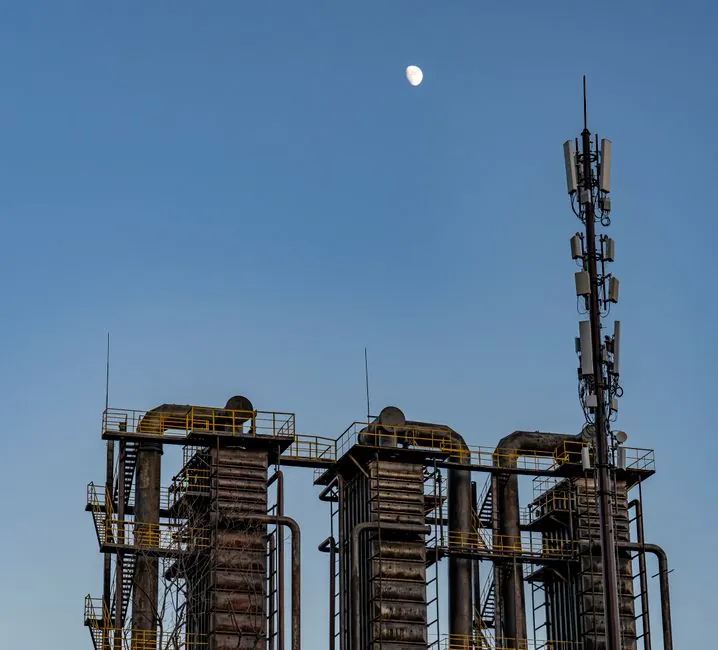
Argon degassing consistently outperforms nitrogen in aluminum melt refining, delivering lower final hydrogen content and fewer inclusions, while nitrogen remains the dominant choice in high-volume foundries at a reported 60% to 80% lower cost per cubic meter [S1]. A well-executed cycle using either inert gas can pull hydrogen from a typical pre-treatment band of 0.30 to 0.50 cc/100g down to 0.08 to 0.15 cc/100g, with final values driven by rotor speed, gas flow, and treatment duration [S1].
Equipment scale varies sharply by application: casthouse rotary degassers handle batch or in-line melt treatment at the launder, while refinery tank degassing during turnarounds mobilizes vapor-control trains capable of sustained multi-week operation. For context on how this choice sits inside broader energy-equipment purchasing, the polycarbonate selection for energy equipment guide covers enclosure materials, and the degassing and refining unit selection for agricultural-machinery castings piece shows how the same hardware decision pivots in different sectors.
Gas Selection: Argon vs Nitrogen, with the Hybrid Middle Path
Argon is chemically inert toward all aluminum alloys at casthouse temperatures, while nitrogen reacts with certain alloys to form aluminum nitride (AlN) inclusions, a defect mechanism documented in the AdTech deep comparison [S1]. The same source records that argon-fed cycles reach final hydrogen levels in the lower half of the 0.08 to 0.15 cc/100g range more reliably, whereas nitrogen-fed cycles often land near the upper end of that band on the same equipment [S1].
The economic counterweight is the unit gas price: nitrogen at 60% to 80% lower cost per cubic meter than argon, a gap that compounds across the thousands of cubic meters a 30 to 120 ton furnace cycle consumes per shift [S1][S3]. For foundries running 5 to 25 tons/hour melt rates through reverberatory furnaces, the per-ton gas bill becomes the dominant operating variable, which is why many high-volume operations stick with nitrogen on standard alloy series and switch to argon or Ar/N₂ blends only on aerospace, can-stock, and foil-grade heats where hydrogen must sit below 0.10 cc/100g [S1][S3]. The hybrid approach is now common: blended supply through the same rotor, with flow ratios tuned to the alloy being treated [S1].
Rotary Degasser Hardware: Rotors, Flux Injection, and Process Envelope
Most casthouse rotary degassing units rely on a graphite or refractory-coated rotor spinning inside a treatment box, dispersing the inert gas into a fine bubble plume whose partial-pressure differential drives dissolved hydrogen out of the melt [S3]. The same rotor shaft can carry powdered or granular flux, so chloride-based or fluoride-based cover and cleaning compounds enter the bath with the purge stream, allowing simultaneous hydrogen removal and inclusion flotation in one station [S3].
The practical envelope is shaped by holding-furnace capacity (typically 20 to 80 tons), melt rate (5 to 25 t/h for gas-fired reverberatory melting furnaces), and the hydrogen target band on the casting side [S3]. A 30 to 120 ton casthouse with 700 to 1,200 kWh/ton energy consumption pairs with inline degassing positioned in the launder between the holding furnace and the casting station, where a 10 to 20 minute treatment window is typical for each batch [S3]. Rotor speed, gas flow, and treatment time are the three independent knobs the operator uses to hit a target hydrogen number, and the data shows that pushing any one of them too hard delivers diminishing returns above roughly 0.08 cc/100g final [S1].
Hydrogen Targets and the Inclusion Side of the Problem
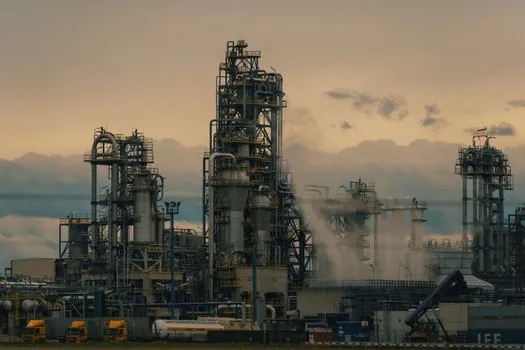
Hydrogen thresholds are quantified in the AdTech reference at 0.10 cc/100g for aerospace and pressure-tight castings, 0.10 to 0.15 cc/100g for structural automotive work, and 0.20 to 0.30 cc/100g as the threshold where visible microporosity starts to appear [S1]. The porosity risk is asymmetric: aluminum absorbs hydrogen readily in the molten state, then rejects it sharply at solidification, where solubility drops and the gas nucleates as porosity inside the casting [S1].
Degassing addresses hydrogen, not inclusions, so a complete refining line pairs the rotary unit with a filtration stage downstream, typically ceramic foam filter (CFF) bowls or deep bed filters (DBF) sized to the flow rate from the holding furnace [S3]. Rotary degassing + CFF is the baseline configuration for most can-stock and extrusion billet operations, while DBF is reserved for foil, aerospace, and high-purity applications where inclusion counts must drop by an additional order of magnitude beyond what a CFF delivers [S3]. For molten-metal handling on the upstream side, including launder design, degasser positioning, and casting-machine interfaces, the full casthouse integration map is laid out in the casthouse equipment reference.
Refinery and Petrochemical Vapor Control: Different Scale, Different Constraints
Refinery tank degassing is not a metallurgy problem; it is an emissions control problem with safety overlay. The Houston Ship Channel corridor alone concentrates more than 25% of total U.S. refining capacity within a 30-mile radius, and turnaround campaigns typically run 20 to 60 days with simultaneous multi-tank work [S2]. The equipment scale is correspondingly larger: Envent's Houston facility houses the EMECS 77, described as North America's largest mobile thermal oxidizer at 34,000 SCFM capacity and 77 MMBTU/hr thermal rating, deployed for vapor control during tank degassing and process-unit depressurizing [S2].
Regulatory pressure comes from Texas Commission on Environmental Quality (TCEQ) rules together with EPA Region 6 oversight, and the equipment fleet must run continuously through the June 1 to November 30 Atlantic hurricane season without shutdown [S2]. For energy-equipment buyers, the comparison against casthouse work is instructive: a casthouse rotary degasser is a 20 to 80 ton batch asset, while a refinery vapor-control train is a multi-week, multi-tank system rated in SCFM rather than cubic meters per hour. Energy and emissions footprint on the casthouse side is governed by energy management programs tied to the 700 to 1,200 kWh/ton furnace figure, while on the refinery side it is governed by energy meter-grade instrumentation on the oxidizer stack and by lighting equipment and electric lamps classifications for hazardous-area zones around the working tanks.
Selection Criteria Comparison: Four Configurations Against Decision Axes
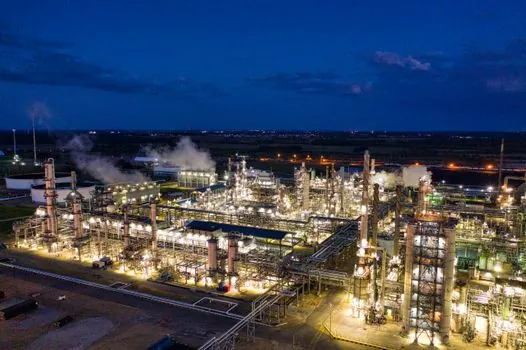
For an energy-equipment buyer choosing a degassing and refining package, the four common configurations can be lined up against four decision axes. (1) In-line rotary degasser with nitrogen on a reverberatory furnace: lowest gas cost, suits 5 to 25 t/h throughput, holds 0.15 to 0.20 cc/100g, does not suit aerospace or can-stock grades. (2) Same hardware with argon: highest gas cost, hits 0.08 to 0.10 cc/100g, suits aerospace, foil, and pressure-tight castings. (3) Same hardware with Ar/N₂ blending: intermediate gas cost, hits 0.10 to 0.15 cc/100g on most alloy series, suits can-stock and extrusion billet. (4) Refinery-class mobile thermal oxidizer train at 34,000 SCFM: not a melt-treatment device, suits 20 to 60 day turnarounds with simultaneous multi-tank degassing under TCEQ and EPA Region 6 oversight [S1][S2][S3].
For casthouse work, the alloy series is the single most important discriminator: 2xxx, 6xxx, and 7xxx series, plus can-stock 5xxx, are the grades where the cost-versus-quality gap between nitrogen and argon is widest and where the decision tree from the AdTech source should be applied directly [S1]. For refinery and tank-farm work, the decision pivots on permit envelope, mobilization distance to the Gulf Coast corridor, and whether the facility can accept 34,000 SCFM oxidizer capacity or needs a smaller paired unit [S2]. Equipment safety zoning around any of these systems, including any anti-static equipment and NDT equipment used to verify refractory condition on the upstream furnace, is specified separately under the relevant hazardous-area standards.
Trackable signals for the next procurement cycle: (1) nitrogen versus argon price spread in 2026 contracts, since the 60% to 80% cost gap is the single largest lever on casthouse operating cost and any compression or widening of that ratio shifts the breakeven point for switching gas [S1]; (2) TCEQ and EPA Region 6 rulemaking on refinery vapor control during turnarounds, which sets the demand floor for 34,000 SCFM-class mobile oxidizers on the Gulf Coast [S2]; (3) emergence of higher-purity nitrogen supply (99.999% versus the typical 99.9% merchant grade), which can narrow the metallurgical gap between nitrogen and argon on standard alloy series [S1].