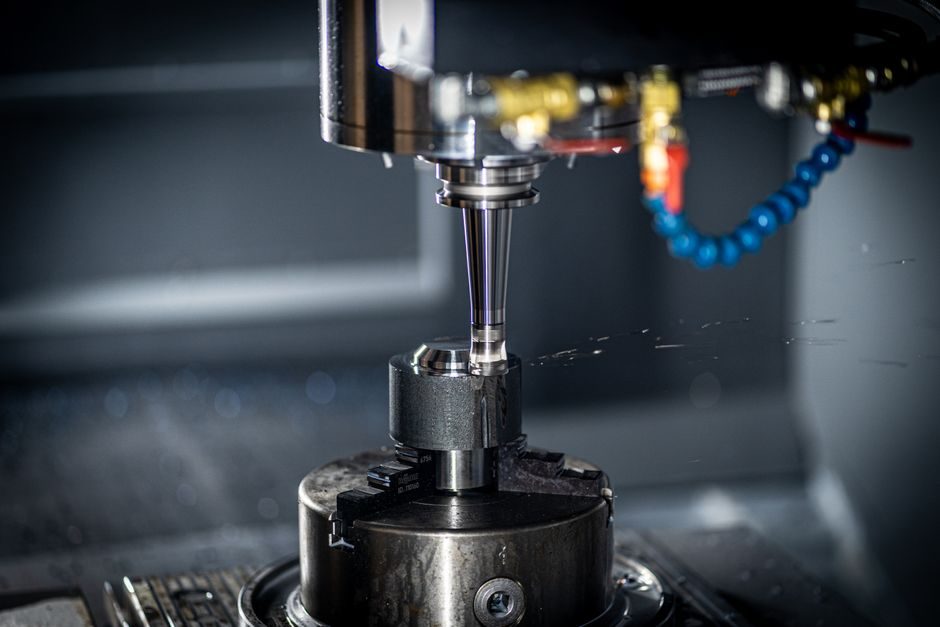
Tooling life is governed less by the machine's tonnage rating than by the match between shot process (hot-chamber vs cold-chamber), clamp profile, and the die steel grade [S5]. On a general die casting machine cell running both zinc and aluminum, dies are routinely pulled at 80,000-150,000 shots; on an aluminum-dedicated cold-chamber aluminum die casting machine cell the same die geometry typically clears 100,000-200,000+ shots before the first soldering crack reappears [S1][S7].
Most custom job shops run mixed fleets: Bardane in Jermyn, PA, lists 23 die casting machines on its ISO 9001:2015 floor, all set up to swing between A380-class aluminum and Zamak zinc depending on part mix [S1]. Sena Diecasting in Malaysia reports high-pressure aluminum cells from 280 t to 1,000 t with vacuum assist specifically for long-run automotive structural parts [S7].
Why the same die lasts longer on an aluminum-dedicated cold-chamber
Aluminum melt charges the shot sleeve at roughly 640-680 °C, and the die face sees thermal cycles from ~250 °C (post-spray) back to ~350-400 °C at steady-state — a narrower delta-T than a hot-chamber zinc cell operating at 420-450 °C melt with die surface excursions above 500 °C [S5].
Intensification pressure matters too: cold-chamber aluminum HPDC machines commonly fire at 60-100 MPa hydraulic intensification versus 25-40 MPa on a hot-chamber zinc unit, so the same die cavity in a shared frame is either over-clamped (cracking inserts) or under-clamped (flash, soldering) [S5]. Aluminum-dedicated cells are plumbed for the higher specific pressure and can therefore hold tighter shutoff clearances, which in turn cuts flash-induced die-edge erosion [S4].
Die steel and insert strategy that actually moves the number
Job shops that quote long tooling life on aluminum typically pair a hot-work die steel such as H11 or H13 with a vacuum-assisted vacuum die casting machine configuration, and route the cavity through nitriding plus a PVD coating once the geometry is stable [S3][S7]. Sena's 280-1,000 t high-pressure line is sold as a vacuum system specifically to suppress gas porosity and the attendant soldering that ends die life early [S7].
For larger structural castings — think EV battery housings, inverter enclosures — Chinese suppliers such as Bengbu Longhua ship 1,250 t cold-chamber aluminum cells with two-plate toggle locks and shot weight above 20 kg, and buyers in that segment routinely demand the die be quoted against IATF 16949 PPAP and 100,000-shot life targets [S4][S6]. The same die, dropped onto a general die casting machine on a mixed alloy schedule, is unlikely to clear that threshold.
Magnesium, thin-wall and gravity-die branches

Magnesium sits in its own thermal band: melt ~650 °C, lower density, higher chemical reactivity with water-based die lubricants, so magnesium die casting machine cells use inert cover gas, steel-shot shot sleeves and dedicated flux handling, none of which a general die casting machine shares with its aluminum cousin [S5]. For large, lower-volume housings where porosity tolerance is loose, a gravity die casting machine with a permanent steel or iron die trades cycle time for a much longer die life measured in years rather than shots [S3].
Thin-wall aluminum — sub-2 mm sections in phone frames, laptop chassis, LED heat-sinks — is a separate tooling problem: high velocity at the gate (40-80 m/s) accelerates insert erosion, so the die casting die is built with hard inserts and replaceable slides, and the machine must hold vacuum under 100 mbar to keep porosity out of the thin sections [S3][S7].
Use cases: when to spend on a dedicated aluminum cell
Choose an aluminum-dedicated aluminum die casting machine when the program is ≥100,000 parts/year, the alloy is fixed as A380/ADC12/A360, cosmetic surfaces are present, and the die budget is significant (a four-slide automotive die commonly runs into six figures USD) [S2][S9]. Lamar Tool & Die Casting in the US and Parison in Ningbo both market in-house tool design as a way to lock in die life before the first shot [S8][S9].
Stay on a general die casting machine when volumes are under ~20,000 parts/year, alloy swings between zinc and aluminum are routine, or the parts are non-cosmetic industrial components where some flash and porosity are accepted [S1][S5]. Diecasting-mould OEM suppliers in Guangdong quote custom aluminum tooling in a $1,000-20,000 USD band per piece, which is the segment where general-frame cells make economic sense [S2].
Decision matrix: machine class vs die-life outcome

On four criteria — typical die life to first rework, best-fit alloy, capital cost per clamp ton, and acceptable cosmetic tolerance — the comparison reads as follows: (1) General die casting machine gives ~80,000-150,000 shots, handles zinc and aluminum, lowest capex per ton, accepts visible flash lines; (2) Aluminum-dedicated cold-chamber HPDC gives ~100,000-200,000+ shots, aluminum only, mid capex, holds tighter shutoff; (3) Vacuum-assisted vacuum die casting machine gives 120,000-250,000 shots, aluminum or magnesium, mid-to-high capex, supports structural/cosmetic parts; (4) Gravity die casting machine gives 50,000-200,000 cycles measured in years, aluminum/copper alloys, lowest per-part machine cost but slowest cycle [S3][S5][S7].
Process engineers specifying a new line should size the cold-chamber shot weight to ≥70% of the rated capacity to keep intensification in the operating window, and budget for vacuum if the part is structural or welded post-casting [S6][S7]. For programs that cross into functional-safety-relevant electronics enclosures, the broader machinery-safety context is covered in our Machinery Directive 2006/42/EC risk assessment checklist.
Failure modes and sourcing pitfalls
The three killers of die life are heat-checking (from poor die-temperature control), soldering (from excessive intensification or vacuum loss), and erosion at the gate/restrictor (from high-velocity aluminum oxide films) [S3][S5]. Sourcing risks concentrate in the mold package: a low-cost Guangdong toolroom quote at $1,000-20,000 USD looks attractive, but the underlying steel, heat-treat cert and EDM surface finish will dictate whether the die clears 100,000 shots or fails at 30,000 [S2]. Rajshi Industries in India and Lamar in the US both publish in-house tool-room capability as a differentiator for exactly this reason [S3][S9].
Trackable signals for the next 6 months: (a) OEM disclosures of die-life shot counts on new EV structural programs from Sena, Parison and Chinese Tier-1 cell builders; (b) revised pricing bands on 1,250 t cold-chamber aluminum cells, currently listed around $258,750-258,950 USD/set on Made-in-China for Longhua-brand machines [S6]; (c) any IATF 16949 audit deltas for foundries running mixed-alloy general-frame cells versus dedicated aluminum lines [S4][S8].