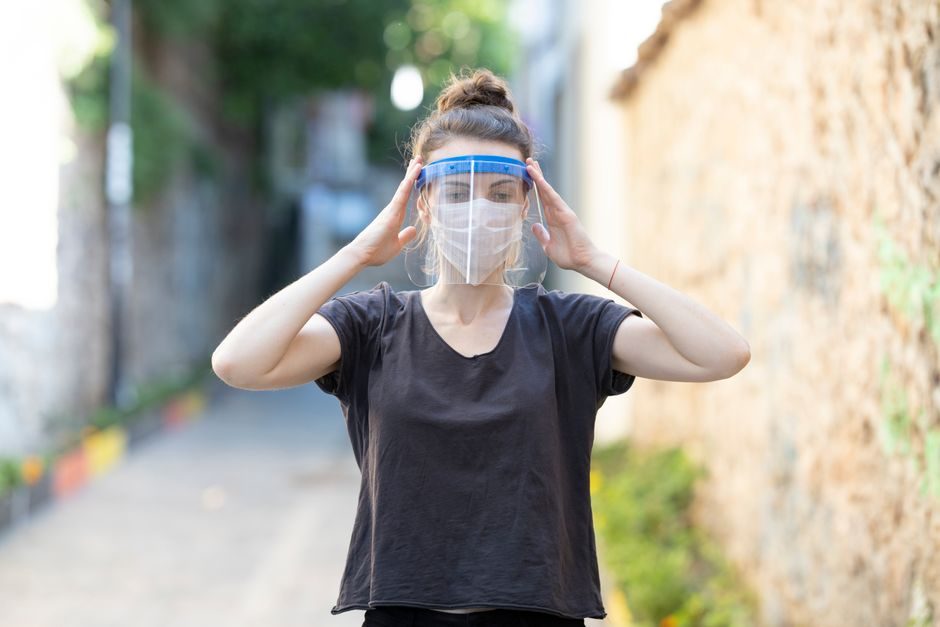
A correctly installed face shield locks the visor pivot into the headgear retention slot with a single audible click, sets the crown band 10-15 mm above the eyebrows, and survives a 90-minute LG steam sanitization cycle between users at the Stanford Nanofabrication Facility [S3]. Disposable PET face-shield facemasks from Anji Hengfeng Sanitary Material Co., Ltd. ship in flat-packed cartons at US$ 0.01-0.012 per piece with a 1,000-piece MOQ on Made-in-China.com [S2].
On bench, the install is a five-step sequence: headgear selection, crown adjustment, pivot engagement, visor angle lock, and post-fit verification. The parts count is small — a headband with ratchet, a visor with pre-punched pivot slots, and a replaceable sweatband — but the tolerances on the pivot pin diameter and slot width decide whether the assembly will click shut or free-spin under impact. The 90-minute sanitization cycle is the operational benchmark for shared lab use [S3].
Headgear and Crown Adjustment: Set the Geometry Before the Visor
The crown band must sit 10-15 mm above the brow line to keep the visor pivot axis co-linear with the wearer's temple, per reusable face-shield OEM guidance; misalignment by more than 20 mm forces the wearer to tilt the head forward to clear the lower visor edge [S3]. Ratchet-style headbands adjust in roughly 5 mm increments and lock at a peak torque of about 0.5-0.8 N·m on most adjustable PPE frames; over-torque strips the ratchet pawl and the band slips under sweat load.
For shared-lab programs, Stanford's Nanofabrication Facility marks each user's personal face shield with a name label and stores it on the chemical-passthrough rack, while communal shields cycle through the LG steamer at 100 °C saturated steam for 90 minutes per batch, holding up to 6 shields per rack [S3]. Specifying a personal shield is the cleanest way to drop the steam-cycle workload to zero for power users; the trade-off is per-user capital cost versus shared-shield sanitization labour.
Visor Pivot Engagement: Slot Width, Pin Diameter, Click Verification
The pivot slot on a standard reusable visor measures 5.0-5.2 mm wide by 12-14 mm long, and mates with a 4.8-5.0 mm retaining pin pressed into the headgear fork [S3]. Insertion is straight-in along the pin axis, not angled; a 5° off-axis push shears the slot lug on polycarbonate visors. The auditable install test is one firm thumb press until a single click is heard, followed by a vertical lift of 5 N on the visor — any free rotation or lift-off means the pin has not seated. Replacement visor thickness for PET and polycarbonate falls in the 0.5-1.0 mm range, with polycarbonate specified where chemical splash or grinding particulate is present.
Disposable face-shield facemasks on the Made-in-China.com 2026 product list are typically 0.18-0.30 mm PET, anti-fog coated both sides, with a 0.5-1.0 cm foam headband and elastic strap; price points from Anji Hengfeng Sanitary Material Co., Ltd. sit at US$ 0.01-0.012 per piece at 1,000-piece MOQ [S2]. These single-use shields skip the pivot hardware entirely — the foam band welds the visor directly to the strap — so the "installation" is a strap-over-head step, not a mechanical click. Procurement should not cross-reference disposable and reusable headgear; the spec differs by an order of magnitude on the pivot hardware.
Cleaning Cycle and Reuse Boundaries: Steam, Wipe-Down and Replacement Triggers
The 90-minute LG steam cycle at the Stanford SNF runs the "Sanitary" program (display reads "1:28") at saturated steam close to 100 °C, holding up to 6 face shields on three internal shelves [S3]. Pre-cycle steps are mechanical: empty the left-side drain tank (lift the white cap, pour into the emergency shower drain), refill the right-side supply tank with city water — never DI water — to the MAX line, close the door, then press the power button and the "Hold to Start" pad. After cycle end, the operator moves the Clean/Dirty sign to "Clean", off-loads all shields to the chemical-passthrough rack, and flips the sign back to "Dirty" [S3].
Reuse boundaries on reusable shields are: (1) visor surface haze or pitting that drops light transmission below roughly 85% — replace; (2) pivot slot elongation visible as free-spin without a click — replace headgear fork or full unit; (3) foam sweatband compression set — replace the band only. Wipe-down with 70% isopropyl alcohol is acceptable for spot decontamination between users, but isopropyl will craze polycarbonate over 50+ cycles; steam is the lower-stress option for polycarbonate, which is why the SNF specified the LG steamer over a chemical wipe-down [S3].
Selection Criteria: Disposable vs Reusable vs Powered Air
Three face-shield archetypes compete on the 2026 procurement shelf, and the install procedure tracks the architecture: disposable PET strap-on (single-use, 0.01-0.012 USD/piece, no pivot), reusable ratchet-headband with replaceable visor (pivot click-install, multi-user after steam), and powered air-purifying respirator (PAPR) face shield with integrated blower and head harness. The reusable ratchet unit is the default for lab, light-industry and healthcare splash protection; the disposable unit is the default for visitor PPE, short-cycle tasks, and infection-control isolation rooms. PAPR is out of scope for a basic install guide but reuses the same pivot geometry with a brow-mounted blower bracket. [S1]
The decision matrix is tight: cost per use (disposable wins below ~10 uses), cleaning labour (reusable wins above ~25 uses with shared steam), optical clarity over time (reusable with replaceable visor wins, polycarbonate 0.5-1.0 mm holds impact grade better than PET), and chemical compatibility (polycarbonate is the only choice for organic-solvent splash; PET crazes on acetone and MEK). For a shop running 100 shields/week, the break-even between disposable and reusable (with a 90-minute shared steam cycle [S3]) lands around week 4-6, after which reusable wins on cost per use even with weekly visor replacement.
Pre-Use Inspection: Four Checks Before Every Don
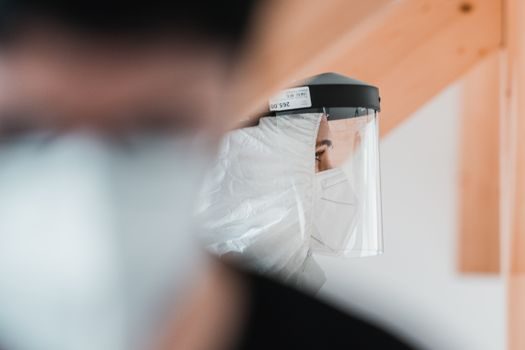
Four checks gate every don on a reusable shield: (1) pivot pin seated — vertical lift test, 5 N; (2) ratchet holds under shake — no band slip over a 3-second lateral shake; (3) visor surface — no haze, no pits, no chemical craze; (4) sweatband — uncompressed foam, no tear. Any single failure routes the unit to the维修 queue rather than into service. On disposable shields, the gate is a single visual check for visor flatness, foam bond integrity, and elastic stretch — failed units go straight to scrap at roughly 0.01 USD per unit, so the labour cost of inspection is the gate, not the part cost [S2].
For lab environments, Stanford's protocol layers two more checks: a name label on every personal shield, and a Clean/Dirty sign on the steam station, flipped in lockstep with each cycle [S3]. The sign is a low-tech token but it is the single most cited failure mode in shared-PPE programs — a "Dirty" shield returned to the rack because nobody flipped the sign. Physical tokens beat software for this step.
Standards and Sourcing: What the Spec Sheet Must Show
Procurement specs on reusable shields should call out ANSI Z87.1-2020 (or the year-stamped current revision) for impact and optical clarity, and EN 166 for European chemical-splash duty. Disposable shields typically ship without an impact rating and are specified to FDA 21 CFR 878.4040 (surgical apparel) or the equivalent regional medical-device class. The 2026 Made-in-China.com listing for disposable face-shield facemasks publishes only the trade price (US$ 0.01-0.012) and the MOQ (1,000 pieces) for Anji Hengfeng Sanitary Material Co., Ltd. — no ANSI/EN marks are visible on the listing, so importers must request the test certificates before shipment [S2].
For the cleaning side, no ISO standard governs the LG steamer cycle directly; the SNF runs a 90-minute saturated-steam program at approximately 100 °C as its internal decontamination benchmark [S3]. Buyers replicating this should validate the cycle with a biological indicator (e.g. Geobacillus stearothermophilus spore strip) before going live, since steam-cycle efficacy varies with shield mass loading and rack packing density. Track the next node on the Stanford SNF page for any program-time revision, and watch the Made-in-China.com supplier listing for new entrants priced below the 0.01 USD/piece floor that Anji Hengfeng set in April 2026 [S2][S3].
Field signal worth tracking in 2026: a second disposable price tier under 0.008 USD/piece would force a re-look at the reusable break-even math, and a revision to the SNF steamer cycle time would re-rank shared versus personal shield ownership cost across the entire lab-PPE procurement block.
For component-level specifications, see linear guide, and shield machine.
For related coverage, see Signal Isolator Buying Guide 2026: Loop-Powered, Active and Ex-Rated Compared.