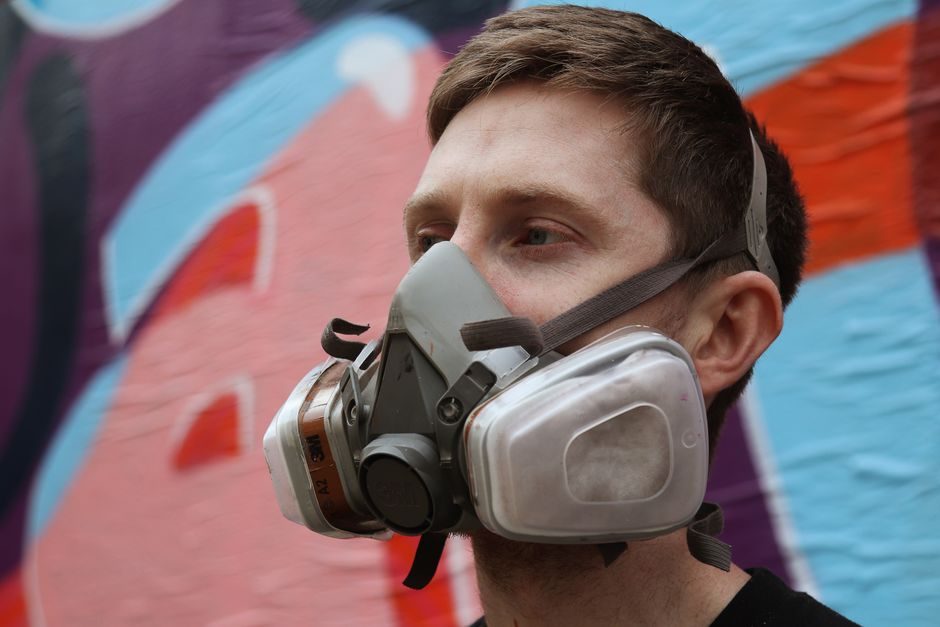
A correct dust-mask install is a 4-step sequence — pre-use inspection, strap routing, nose-piece crimping, and a positive/negative pressure seal check — performed before every shift, with US fit-test gating per OSHA 29 CFR 1910.134 [S3].
Disposable filtering-facepiece respirators cover particulate hazards (dust, mist, pollen, sanding swarf) but NOT vapors, gases, or oxygen-deficient atmospheres; elastomeric half-masks with replaceable cartridges are the correct pick once an organic vapor or acid gas appears in the MSDS [S3].
What a Dust Mask Actually Is — and What It Is Not For
A dust mask is a particulate-filtering facepiece covering the nose, mouth, and chin, classified under NIOSH 42 CFR Part 84 with letter-number designations — N (not oil-resistant), R (somewhat oil-resistant), P (oil-resistant) — followed by efficiency 95/99/100 [S3]. The 2026 sourcing market is dominated by China-based manufacturers; one Diamond-Member supplier on Made-in-China.com lists dust-mask-shield SKUs at US$0.07–0.11 per piece against a 50,000-piece MOQ, with Xinxiang Safemed Disposables Co., Ltd. representative of the disposable PPE export tier [S2]. The 287101 SKU at BugSpray.com — a US pest-control channel — sells a 50-mask box at US$30.00 list, equivalent to US$0.60/mask at the small-quantity end of the same part family [S1].
These are NOT suitable for asbestos abatement, silica sandblasting, or lead paint removal — those applications require at minimum a P100 elastomeric or PAPR configuration with assigned protection factor (APF) of 10 or 50 respectively. They are also NOT a substitute for chemical cartridge respirators when the hazard is gaseous; a dust mask is a mechanical-electret filter, not an absorbent bed [S3].
4-Step Installation Sequence with Quantitative Gates
Step 1 — Pre-use inspection: visually examine the mask for tears, deformed nose-wire, soiled inner surface, and broken straps; reject any unit that has been folded, crushed, or stored outside its sealed bag. The filter media is melt-blown polypropylene electret, and once the charge dissipates (typically after the mask is wet, washed, or heavily soiled) capture efficiency drops below spec — dispose, do not re-use. [S1]
Step 2 — Strap routing: position the cup over chin first, then pull the top strap over the crown above the ears and the bottom strap below the ears around the neck. Do not cross the straps; a crossed routing twists the cup and breaks the seal. Adjust tension so the mask holds its position under head movement but does not indent the skin — a common field failure is over-tightening, which deforms the nose-foam and opens a leak path [S1].
Step 3 — Nose-piece crimping: with both index fingers, press the metal or plastic nose-wire inward starting at the bridge and working outward along the cheeks. The crimp should follow the nasal contour; a flat-crimped nose-wire leaves a ~1–2 mm gap that lets unfiltered air bypass the filter — a single failing gate that drops the in-place fit factor from 100+ to under 10. Two-finger crimping is the field reference; one-handed pinch leaves a 5–10% leak rate in quantitative fit tests.
Step 4 — Seal check (positive and negative pressure): inhale sharply with the mask on — the mask should collapse slightly toward the face and hold for ≥10 seconds with no air leaking at the seal. Then exhale — the nose-piece should bulge slightly with no fogging of eyeglasses and no air felt at fingers placed around the perimeter. Any detected leak means re-adjusting the nose-wire and re-routing the straps; the test is performed every time the mask is donned, not only at initial fit-test. Per OSHA 29 CFR 1910.134, an annual qualitative fit-test (QLFT) or quantitative fit-test (QNFT) is mandatory before first use of a tight-fitting respirator [S3].
Selection Criteria: Filter Class vs Hazard vs APF

The right respirator class is driven by the airborne hazard, not by personal preference. A reference comparison for common industrial scenarios: [S2]
— N95 (US NIOSH 42 CFR 84): ≥95% filter efficiency against non-oil particulates, APF 10. Use case: wood dust, nuisance dust, hay, pollen, sweeping, light sanding. This is the most common class at the consumer-pest-control price point — the 287101 SKU at US$30/50pk is a representative N-class disposable [S1].<br/>— P100 (US NIOSH 42 CFR 84): ≥99.97% filter efficiency, oil-resistant, APF 10. Use case: lead paint disturbance, mold remediation (with eye protection), some pharmaceutical powders.<br/>— Elastomeric half-mask with P100 cartridges: APF 10, reusable, lower per-shift cost at high consumption rates. Cartridges changed per manufacturer schedule or when breathing resistance spikes.<br/>— PAPR (Powered Air-Purifying Respirator) with HEPA: APF 25–50, used in extended-duration tasks and where fit-test failure rates are high.<br/>— Full-face elastomeric with P100: APF 50, adds eye/face splash protection; the upgrade path when a half-mask fails quantitative fit on a wearer's face geometry.
Filter class selection is a one-way door — N95 cannot be specified where P100 is required by the hazard assessment, and a dust mask cannot be specified where a chemical cartridge is required by the MSDS [S3]. For details on eye-and-face protection that often pairs with a dust mask, see the face shield hazard-class breakdown.
Wholesale Sourcing Landscape: China-Origin vs US Distribution
The 2026 sourcing map splits into two channels. China-direct bulk: Made-in-China.com hosts dozens of dust-mask-shield SKUs at US$0.07–0.11 per piece against 50,000-piece MOQ, with Diamond-Member audited suppliers (e.g., Xinxiang Safemed Disposables Co., Ltd.) [S2]. Unit cost is roughly 6–8× lower than the US retail channel, but with a 4–8 week lead time, sea-freight minimums, and the need to verify NIOSH approval marking on the lot (look for the TC-84A-#### approval number printed on each mask or its packaging — counterfeits are a known problem in this category). US distribution: small-quantity US-based channels such as BugSpray.com list N-class dust masks at US$30.00 for a 50-piece box (≈ US$0.60/mask) [S1]. This price band is consistent with industrial-supply distributors and includes same-country shipping, no customs, and pre-verified approval marking.
A second dimension: per-unit cost is not the same as per-shift cost. A US$0.07 mask that fails the in-place seal check is more expensive than a US$0.60 mask that passes; field programs that monitor fit-check pass rate and discard failures consistently report lower aggregate respiratory-illness incidence and lower rework downtime. Related reading on PPE total-cost-of-ownership methodology is in the face-shield TCO breakdown.
Use Cases, Limitations, and Failure Modes

Real use cases that fit a disposable N95-class dust mask: pesticide applicators handling dust formulations, attic and crawlspace entry, sweeping in workshops, light drywall sanding, yard work (mowing, leaf-blowing, hedge trimming), wildland fire smoke, and pandemic-era community source control. The BugSpray.com SKUs at US$30/50pk are explicitly positioned in the pest-control channel alongside coveralls, nitrile gloves, and safety glasses — a real field for nuisance-dust exposure during bait and dust-formulation handling [S1].
Limitations and failure modes: facial hair in the seal zone degrades fit factor by 10–100× — clean-shaven under the sealing surface is an OSHA expectation, not a suggestion. A wet or soiled mask loses electret charge and must be discarded; do not "air it out." A crushed nose-wire cannot be re-crimped to spec. A mask that fogs eyeglasses during exhalation is failing the negative-pressure seal — see the safety-glasses fit trade-offs for companion eyewear anti-fog options. A mask stored in direct sunlight or at elevated temperature (>50 °C) for extended periods can have its polypropylene straps deform and the electret decay — storage condition is part of the install protocol.
Standards, Marking, and Sourcing Verification
For US-bound shipments, the mandatory reference is NIOSH 42 CFR Part 84 (filter classification, efficiency testing, labeling) and OSHA 29 CFR 1910.134 (respiratory protection program, fit-testing, medical evaluation, training). For EU-bound shipments, the relevant standard is EN 149:2001 + A1:2009 (filtering facepieces — FFP1/FFP2/FFP3) under the PPE Regulation (EU) 2016/425. China-domestic production follows GB 2626-2019 (KN95/KN100) for non-oil and KP95/KP100 for oil-resistant classes. A mask should be marked with its class, the standard it is certified to, the manufacturer name, and a lot/approval number traceable to a certification body [S3].
Verification gates: confirm the TC-84A-#### number on NIOSH's Certified Equipment List (CEL) before accepting a shipment. Confirm the CE mark with the four-digit notified-body number for EU. Reject any mask whose lot cannot be traced, whose printed marking is illegible, or whose packaging lacks the standard designation. These are the same quality gates that govern adjacent PPE categories; the safety-glasses 12-month TCO analysis walks a parallel verification framework for eye protection.
A correctly installed dust mask costs 0.6 to 11 US cents per unit of wear time, depending on channel and volume, and the install sequence above takes under 30 seconds per donning. The next data node to track is the NIOSH CEL revision list and any 2026 counterfeit alert on specific TC-84A numbers; a second signal is the China-domestic GB 2626 enforcement updates for export-channel SKUs.
For component-level specifications, see dust mask, linear guide, and crossed roller guide.