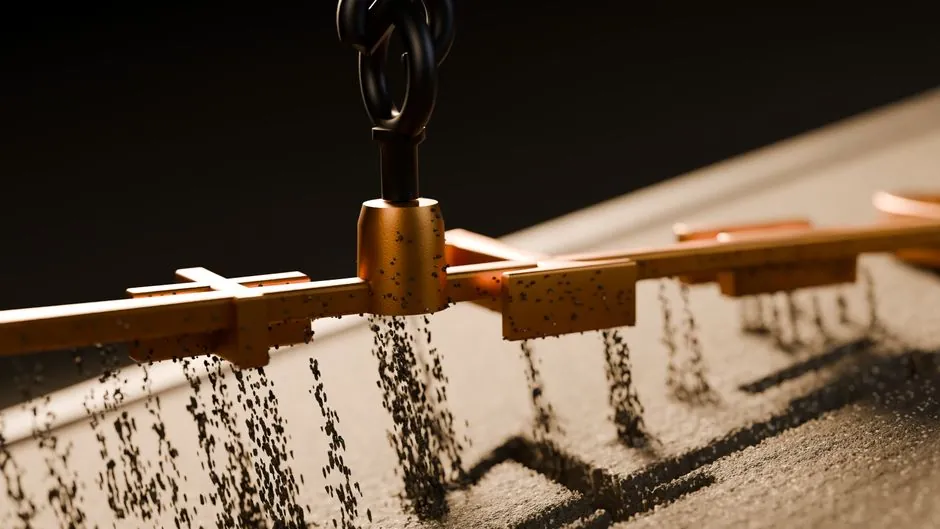
Dissolvable support interfaces preserve cleaner contact surfaces because water or solvent removes them without tools, while breakaway interfaces trade surface finish for faster removal.
The decision depends on support access, allowable post-processing, material compatibility, cost, and cycle time; a mixed strategy often combines dissolvable interfaces with inexpensive breakaway bulk support.
Choose by Access and Surface-Critical Geometry
Dissolvable support is the stronger choice when support occupies a closed cavity, internal channel, captured hinge, delicate lattice, or any location where pliers cannot safely reach the contact area. Breakaway support is usually better for exposed overhangs, broad flat interfaces, and prototypes where every support can be reached with a tool [S4].
Breakaway supports are faster to remove and generally less costly, but manual separation can leave visible marks on overhang faces, particularly where cutting or pulling contacts the finished surface [S1]. Dissolvable support removes contact damage by eliminating the peeling step, making it preferable where cosmetic surfaces, thin walls, pins, text, or mating faces cannot tolerate repair [S4].
The practical decision rule is straightforward: if a tool can reach the support without loading the part, compare breakaway against dissolvable support on cost and cycle time. If access is restricted or the interface is surface-critical, use a dissolvable interface and accept the dissolution cycle.
Compare the Options Against Four Decision Criteria
Against removal access, dissolvable support wins for trapped geometry, while breakaway wins for exposed geometry because it can be pulled away immediately after cooling [S4]. Against cosmetic quality, dissolvable support avoids the scratches, tool marks, and retained fragments associated with manual removal; breakaway support can still deliver a good finish when the interface is accessible and carefully separated [S1][S5].
PVA takes several hours to dissolve, with temperature and time guidance depending on the specific filament, nozzle, printer, and slicer, while breakaway support removal requires no soaking stage. Against material cost, PVA is usually more expensive than common breakaway support materials, making breakaway the economical option where support volume is high and access is good [S3][S4].
This comparison does not make dissolvable support universally better. A dense PVA structure in a large production part can cost more in material and labor than a locally designed breakaway interface. The correct comparison is support volume times material cost plus removal labor and inspection time, including the cost of rejected cosmetic parts.
Use a Two-Material Support Architecture
A two-material architecture separates the sacrificial function from the surface-critical interface: print an inexpensive bulk support in a mechanically removable grade and a thin dissolvable interface against the part. The user experience of using dedicated support filament for the interface is reported to improve appearance compared with ordinary supports, although the dissolvable and dedicated interface approaches can produce similar results where the interface is mechanically accessible [S2].
The dissolvable approach retains one decisive benefit: it can be removed from regions that cannot be reached by pulling or tooling. Dedicated support filament can detach or be removed with a gentle tug, while soluble material remains necessary where no physical removal path exists [S2].
For a dual-material FFF workflow, pair the support with the model material rather than selecting on surface finish alone. PVA is documented for use with PLA, PETG, and TPU, while BVOH is reported to bond with PLA, PETG, Nylon, ASA, ABS, and TPU [S1]. Chemical compatibility, nozzle temperature, moisture exposure, and purge behavior must be verified for the exact filament grades [S3].
Control the Interface Rather Than Assuming Chemistry Fixes Geometry
The support interface determines whether dissolution can proceed cleanly, but layer construction determines whether the interface remains accessible to the liquid. A recommended 0.1 mm setting is used for a soluble-support interface in one documented workflow; it does not affect the quality of the first object layer and makes the interface easier to dissolve [S6].
Zero-separation layers can create a dense contact between support and model, while one separation layer can provide a defined break line [S8]. The practical benefit of one separation layer is access for water or solvent along the interface. Its cost is a less dense contact surface and a greater risk of contamination if the separation is too large or if liquid cannot circulate.
Do not treat the 0.1 mm value as a universal process setting. It belongs to a specific soluble-support workflow, and the printed result depends on the filament, nozzle, printer, and slicer [S3]. For production, qualify the interface gap, support density, dissolution medium, agitation, and drying cycle as one process rather than changing them independently.
Budget Dissolution Time and Moisture Control

PVA takes several hours to dissolve, with temperature and time guidance depending on the specific filament, nozzle, printer, and slicer. These are grade-level operating references, not guaranteed part-cycle times. Deep cavities dissolve more slowly because water must penetrate the support and saturated solution must be replaced by fresh liquid [S3].
Process controls should include agitation, warm water, water changes, or pressure flushing where geometry permits. PVA is hygroscopic and can degrade after moisture uptake, so the spool must be dried and stored under controlled conditions before printing [S1][S3]. This adds equipment and handling requirements that a breakaway workflow can avoid when support access is satisfactory.
PVB and HIPS introduce solvent-handling constraints rather than eliminating them. PVB uses isopropanol, while HIPS uses limonene, so ventilation, operator exposure control, compatibility with coatings or seals, and waste handling belong in the process review [S1][S4].
Match the Process to the Application
Breakaway support suits rapid prototypes, exposed overhangs, broad interfaces, and production parts where operators can reach the support and inspect the result immediately [S4]. Dissolvable support suits closed cavities, internal channels, delicate lattices, print-in-place mechanisms, and cosmetic surfaces that cannot tolerate tool contact [S3][S4].
Breakaway is not suitable where support is mechanically trapped, where thin features could fracture during extraction, or where a support-contact face must remain pristine. Dissolvable support is not the best choice when a short turnaround outweighs surface protection, when the support volume makes material cost excessive, or when the printer cannot reliably handle moisture-sensitive materials, nozzle switching, and purge control [S3][S4].
Use a mixed architecture when bulk support volume is high but one cosmetic interface matters. Print the bulk in breakaway material and the contact layer in PVA or another compatible soluble grade. Validate adhesion, separation behavior, and solvent exposure on the actual model-support pair before production release.
Qualify Release on Surface and Removal Criteria
A production trial should measure the variables that determine acceptance: support-contact surface condition, removal time, residue, dimensional deviation at supported features, trapped fragments, and post-processing labor. The comparison should include at least one accessible breakaway case and one geometry that cannot be removed mechanically; otherwise the test will not reveal the actual advantage of dissolution. [S4]
For the first qualification, record printer model, nozzle, model filament, support filament, layer height, interface gap, support density, bed and nozzle temperatures, dissolution medium, bath temperature, agitation method, water-change interval, and drying duration. A successful dissolvable result requires more than material solubility: it requires a qualified interface geometry and a complete fluid path through the support cavity.
The next actionable step is to classify each supported feature as accessible or trapped and cosmetic or noncritical. Select breakaway for accessible, noncritical areas and a dissolvable interface for trapped or cosmetic areas, then validate the complete material and removal cycle on representative geometry.