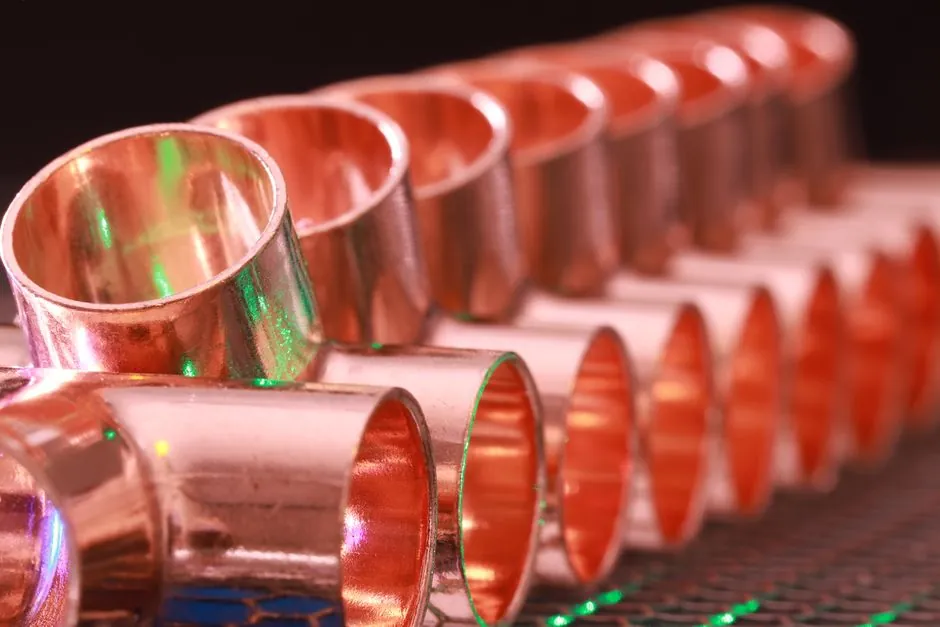
C12200 DHP copper is the stronger specification for field-brazed plumbing tube because phosphorus deoxidation removes free oxygen and reduces hydrogen-embrittlement risk [S1].
ETP C11000 provides about 100–101% IACS conductivity, while C12200 DHP is suited to plumbing, brazing, and heat-exchanger applications [S1][S2].
Material Choice: DHP or ETP for Water Tube?
C12200 DHP contains at least 99.90% copper with phosphorus added to remove oxygen, while ETP C11000 also contains at least 99.90% copper but retains a small quantity of residual oxygen, generally a few hundredths of one percent [S1][S2].
DHP is the normal engineering selection for brazed potable-water, heating, and refrigeration installations. ETP has no conductivity advantage that benefits a water tube, because pressure capacity is governed principally by tube geometry, material temper, test pressure, and applicable code rather than electrical conductivity [S1][S3]. The broader copper material data should therefore be interpreted as a starting point, not as a purchase specification for plumbing tube.
ETP remains appropriate for busbars, conductors, wire, and strip where conductivity is the controlled property. Its residual oxygen can react with hydrogen during brazing in a hydrogen-bearing atmosphere, producing water vapour inside the copper and internal cracking [S1][S2]. DHP avoids that specific weakness because oxygen has been chemically removed with phosphorus [S1][S5].
Decision Matrix: Joining, Conductivity, and Formability
For brazed plumbing, DHP wins on joining reliability, while ETP wins only where electrical or thermal conductivity dominates [S1][S2]. ETP C11000 is also easier to obtain for electrical applications, but that advantage does not transfer into measurable plumbing-system value unless the installation includes an electrical bonding function that has been specified separately.
DHP therefore retains substantially greater ductility in half-hard tube, while the hard-state values are close enough that temper must be checked against the installation method.
For a practical procurement comparison, specify DHP for brazed or welded plumbing, ETP for electrical components, and oxygen-free copper only when a separate resistance to hydrogen pickup or high-purity requirement justifies its higher material complexity [S1][S2][S5].
Tube Specification: Standard, Type, Size, and Temper
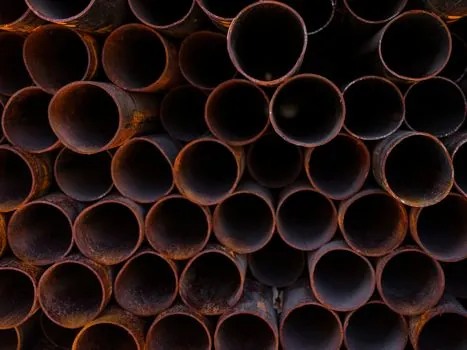
ASTM B88 is the relevant family for seamless copper water tube, ASTM B280 covers air-conditioning and refrigeration tube, and ASTM B111 covers condenser and heat-exchanger tube [S1]. For a plumbing application, state ASTM B88, nominal size, wall type, temper, and the required joining method instead of asking only for “copper tube” [S1].
Within ASTM B88, Type K has the heaviest wall and is used for underground service lines, buried mains, and higher-pressure duty. Type L has a medium wall and is the general-purpose interior water-distribution selection. Type M has the thinnest pressure wall for low-pressure interior water lines where the code permits. Type DWV is for non-pressure drainage, waste, and vent service [S1].
Temper affects formability, so it should be considered when selecting copper tube [S1].
Installation and Service Constraints
Copper tubing is used in drawn and annealed tempers across plumbing, heating, and air-conditioning systems, and the Copper Development Association identifies copper as a prime water-conveying material because of its corrosion resistance, strength, and light weight [S3]. That material advantage applies to both DHP and ETP plumbing stock, so it does not reverse the DHP preference.
The installation method is decisive. Field brazing and welding favor C12200 DHP because deoxidation reduces the risk of embrittlement during heating [S1][S2]. If a design uses mechanical press fittings, the specification still needs the tube type, temper, wall thickness, and fitting-system compatibility because those variables control installation and pressure performance rather than UNS designation alone [S1][S4].
That is an indicative durability range, not a universal design life, because water chemistry, installation quality, operating temperature, cyclic pressure, soil conditions, and fitting practice affect the actual system life [S3][S4].
Failure Modes and Avoidable Specification Errors
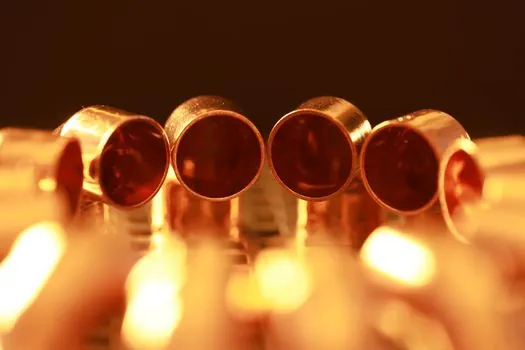
The principal ETP failure mechanism during brazing is hydrogen embrittlement: oxygen retained in the copper reacts with hydrogen, and the resulting steam creates internal cracking [S1][S2]. DHP is not failure-proof, but its phosphorus-deoxidized structure directly addresses this mechanism [S1][S5].
A second error is confusing electrical-grade nomenclature with plumbing suitability. C11000’s conductivity of about 100% IACS, or approximately 101% IACS in the cited tube-grade data, is not a plumbing pressure or joining criterion [S1][S2]. A third error is treating C12200 as a substitute for a complete tube specification: grade must be combined with the applicable standard, nominal size, Type K, L, M, or DWV classification, and temper [S1].
Do not substitute DLP C12000 or oxygen-free C10100/C10200 casually. DLP uses minimal phosphorus to preserve conductivity, while oxygen-free grades provide hydrogen resistance and very high purity at a different material cost and application profile [S1][S2]. The detail on forming trade-offs in Copper Soft Temper vs Hard Temper for Forming is relevant when the installation requires coils, bends, or limited field forming.
Procurement Specification and Acceptance Checks
Write the purchase requirement as “seamless C12200 DHP copper tube, ASTM B88, Type L, 1/2-inch nominal size, half-hard temper, suitable for brazed potable-water service.” Change size, type, and temper to match the design rather than copying that example. For refrigeration, replace ASTM B88 with ASTM B280 and confirm actual outside-dimension sizing; for condensers and heat exchangers, use ASTM B111 where applicable [S1].
For European procurement, EN 12449 covers seamless round copper tubes for general purposes, EN 12735 covers seamless round tubes for air conditioning and refrigeration, EN 12451 covers heat-exchanger tubes, and EN 13600 covers electrical-purpose copper tubes [S5]. Require the supplier to state the UNS grade, product standard, temper, dimensions, and applicable national or local approval rather than accepting only “copper tube.”
The final technical check is straightforward: C12200 DHP for ordinary brazed plumbing, C11000 ETP for electrical duty, and an ASTM B88 type and temper matched to pressure, installation method, and forming need. Verify markings and test documentation against the order before installation, because material grade alone does not establish code compliance or pressure capacity [S1][S3].