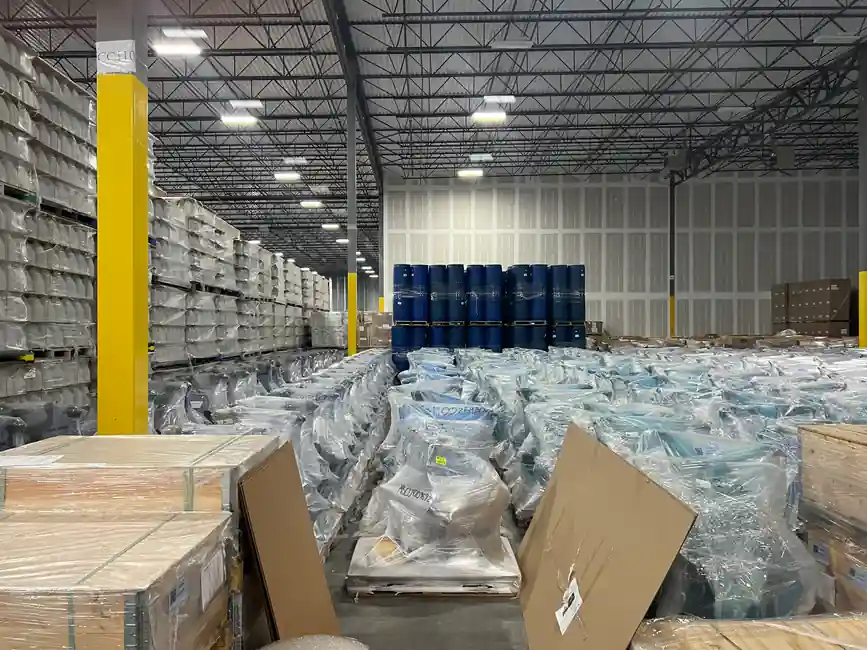
A wrapping machine needs a top sheet dispenser when the stored load requires a separate waterproof cover rather than side containment alone.
The decision depends on exposure duration, weather sensitivity, load geometry, and whether the packaging system uses stretch film, shrink film, or both.
What a Top Sheet Dispenser Changes
A top sheet dispenser applies a sheet over the pallet after the side wrap, creating a separate horizontal barrier against rain, dust, dirt, and moisture deposited from above [S2]. It does not replace the side wrap: that layer still handles containment and load security, while the top sheet addresses upward weather exposure [S3].
The available equipment architecture makes this distinction practical. Orion describes an in-process top sheet dispenser [S2]. Acme Pac identifies the AST30 as an automatic pallet wrapper and the ASD30 as a top sheet dispenser [S5].
A top sheet is therefore an added packaging layer, not a universal requirement of a wrapping machine. It is most useful when rain can reach the pallet top, when the product is sensitive to dust or dirt, or when the top of the load is exposed without another protective cover [S2][S3].
Outdoor Packaging: Stretch Film Versus Shrink Wrap
Stretch film is LLDPE film applied under tension and it clings to itself without adhesive, while shrink wrap is applied loosely and heated until it contracts around the load [S4]. This distinction affects outdoor suitability because ordinary stretch film provides some moisture resistance but is not waterproof, and standard film can degrade under sunlight unless UV-stabilized [S4].
The comparison below separates four procurement variables rather than treating one packaging method as universally superior [S4].
For long outdoor exposure, the process should be selected around the actual failure mechanism. Waterproof shrink packaging suits loads requiring full enclosure, while a stretch-film system becomes more defensible when the load needs tension-based containment, rapid handling, or breathability and the top sheet is specified for the upper surface [S4].
When a Dispenser Is Justified
Specify a top sheet dispenser for exposed pallets, long-duration storage, sensitive products, and loads with an upper surface that cannot tolerate rain or dust [S2][S3]. Outdoor storage exposes loads to moisture, ultraviolet radiation, wind, and contaminants, and these hazards can damage both the product and the load's stability [S4].
Machine specifications must be checked against the actual pallet rather than selected from cycle speed alone.
The covering system is similarly dimensional. These figures should be compared with the largest pallet, top-sheet overhang, line clearance, and compressed load height at the point of procurement.
When the Dispenser Adds Little Value
Do not add a dispenser automatically if the pallet remains indoors, receives a separate roof or enclosure, or is protected by a complete shrink-wrapped package. Standard stretch film can be adequate in shaded or short-term outdoor storage when UV-protected material is used [S4].
A top sheet also does not solve every load-security problem. Corner boards may still be required to reinforce vulnerable edges, and the complete pallet needs adequate stretch coverage, adequate film tension, and a stable load before the top sheet is applied [S4][S7]. A dispenser cannot compensate for a leaning, shifted, or poorly stacked pallet.
Fully enclosed packaging introduces its own constraint: trapped moisture can become an issue, so vents or desiccant may be needed for products sensitive to condensation [S4]. Breathable or vented stretch film can reduce condensation, which makes the top-sheet decision part of a complete moisture-management calculation rather than a simple waterproof yes-or-no choice.
Integration, Controls, and Throughput
An automatic wrapper can reduce manual walking around the pallet and release workers for other activities, while built-in shutdown functions can respond to a completed pallet or an detected obstacle [S1].
For equipment selection, the shrink-wrapping machine should be considered only when the enclosure process actually includes heat-shrink equipment. A stretch wrapper with an integrated top-sheet applicator is a different configuration, designed to combine tension-based side wrapping with a separate upper cover [S5].
Film Selection and Outdoor Durability
Do not treat a top sheet as a substitute for UV-resistant packaging materials. Standard stretch film can deteriorate in sunlight, whereas UV-stabilized stretch film is intended for outdoor exposure [S4]. The specified side film for the AST30 system includes LLDPE machine stretch film from 17–35 µm and PE stretch film from 50–60 µm, with stated widths of 500 mm and 1,800 mm respectively [S5].
Use the supplier's consumable limits as equipment constraints, not as a general recommendation for every outdoor load. The ASD30 specification allows the operator to set top-foil length from the HMI, and the machine offers wrapping only or wrapping plus top-cover modes according to the actual packing requirement [S5].
No supplier specification can establish the service life of an outdoor package without exposure data. Duration, direct sun, temperature cycling, wind-driven rain, pallet exposure, and product sensitivity all belong in the purchase specification. Where wind-driven rain can reach the sidewall, a top sheet alone is not a complete waterproof enclosure.
Procurement Decision Checklist

Require the top sheet when the acceptance criteria include protection of the pallet top from rain, dust, dirt, or surface moisture during outdoor storage [S2][S3]. Do not require it merely because a stretch wrapping machine is being purchased.
A defensible specification records 5 decisions: storage exposure duration, whether the load needs full enclosure or only a protected top, the maximum pallet dimensions and weight, the production rate in loads per hour, and the available 380 VAC, 50/60 Hz, 3 kW and 0.4–0.6 MPa services for the cited automatic configuration [S5].
The final check is the packaging result on the actual product. Confirm that the top sheet covers the intended upper surface without blocking vents or access points, that side containment remains effective, that the package survives its defined outdoor exposure, and that the cycle rate matches the warehouse flow. For a sensitive or long-term load, those acceptance tests are more informative than the word “waterproof” on a brochure.