Frozen products generally need a different film from ambient-temperature packs because the film must remain flexible and sealable through cold storage, transport and retail handling.
Polyolefin and polyethylene are the principal shrink-film choices for frozen food, while PVC is unsuitable because low temperatures can make it brittle; film and machine must be qualified as one system [S1][S3].
Polyolefin and Polyethylene Fit Frozen Food
Polyolefin film is the standard choice for many frozen-food lines because it retains physical integrity in freezer environments and is suitable for food contact [S1]. It conforms closely to irregular shapes such as pizzas, tray meals and multipacks, creating a moisture barrier intended to reduce freezer burn [S1].
Polyethylene is another practical option. LDPE is commonly used for shrink packaging, while the broader polyethylene family includes LDPE, LLDPE and HDPE [S4]. Polyethylene can be used as either shrink film or stretch film, so the required converting method must be stated before comparing grades [S4].
One frozen-food packaging reference identifies a packaging failure at -10°F as capable of creating a substantial loss of product value and brand damage, illustrating why low-temperature performance cannot be separated from line performance [S1]. That figure is an example of pack failure consequences, not a universal storage-temperature specification [S1].
Why PVC Is the Wrong Default
PVC becomes hard and brittle when sufficiently cold, and it softens and wrinkles at excessive heat, making it unsuitable for the temperature swings encountered in frozen-food distribution [S1][S4].
The comparison is decisive for ordinary direct-food packs. POF generally carries a higher purchase cost than PVC but provides better low-temperature flexibility, less odour during sealing and suitability for food contact [S4].
Stretch Film Is an Alternative System
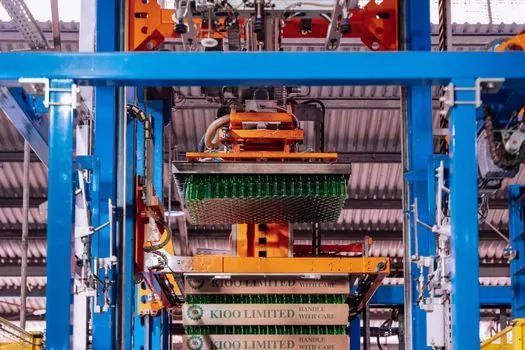
A freeze-rated stretch film can be appropriate for cartons and transport bundles where the pack does not need to shrink tightly around an irregular food surface [S2]. Stretch wrap film remains flexible and retains its integrity at low temperatures, making it suitable for chilled or frozen food packaging [S2].
The operating principle differs from a heated shrink tunnel. A pre-stretched film is wrapped tightly around the product, with an adjustable stretch ratio, and a servo-driven cutting device separates the finished bundle [S2]. The Meypack FW stretch-wrapping machine system can handle folding boxes up to 300 per minute and create a formation bundle wrapped in pre-stretch film [S2].
This route suits products already held in folding boxes or cartons. Direct, close-fitting packs around frozen food generally remain a shrink-film application, while transport-stable carton bundles can justify the change to stretch wrapping [S2].
Match Film to Product and Equipment
Frozen-food film selection depends on product dimensions, sealing performance, shrink characteristics, production speed, storage conditions and applicable food-contact requirements [S3]. There is no universally suitable shrink film for every poultry or prepared-food application, so the film supplier specification and the machine maker’s operating window must both be checked [S3].
A shrink wrapping machine should be selected around the pack format rather than by throughput alone. Hood or L-bar sealers suit lower-to-medium output, while continuous-motion side sealers are intended for industrial, high-volume lines [S1]. Equipment selection also requires the package size, film type, bundle pattern, output target and finished appearance [S5].
Film runs through the sealer before entering the shrink tunnel, so seal temperature, dwell, tunnel temperature and conveyor speed have to be balanced against the specific film. A machine capable of handling POF or polyethylene does not prove that every construction will seal properly at the same settings [S3][S9].
Primary and Secondary Packs Need Different Decisions
Shrink wrap accommodates both tray and trayless formats, while poultry shrink wrap provides a close-fitting outer layer around poultry products [S1][S3]. Shrink-wrap machine selection depends on volume: hood/L-bar sealers suit low-to-mid output, while continuous-motion side sealers suit industrial lines [S1].
For multipacks, the case packer versus shrink wrapper decision depends on whether the requirement is a rigid shipping case or a flexible film bundle.
Freezer-grade packaging can reduce exposure to moisture movement, dust, abrasion and physical contamination, and it can keep individual products or multipacks together during handling [S3]. It cannot compensate for poor temperature control, unsuitable handling or an incorrectly selected film [S3].
Validate the Packaging Before Scale-Up
The first validation should cover the intended freezing, storage and distribution temperature profile, not merely an ambient seal test. At minimum, confirm seal integrity, film flexibility, shrinkage around the product, package appearance, line speed and rejection rate at production output [S3][S7].
For poultry and other temperature-sensitive foods, the practical test is whether the film remains intact and close-fitting after cold exposure, transport handling and retail display [S3]. Food-contact suitability should be confirmed from the film specification rather than inferred from the words “polyolefin” or “polyethylene” alone [S3].
Equipment planning should also account for infeed, sealer, shrink tunnel and bundler interaction, since a mismatch can increase rejects and interrupt throughput [S7]. The trackable decision points are the approved film construction and thickness, the frozen seal test result, and the machine settings demonstrated at the specified package dimensions and output rate [S5][S7].