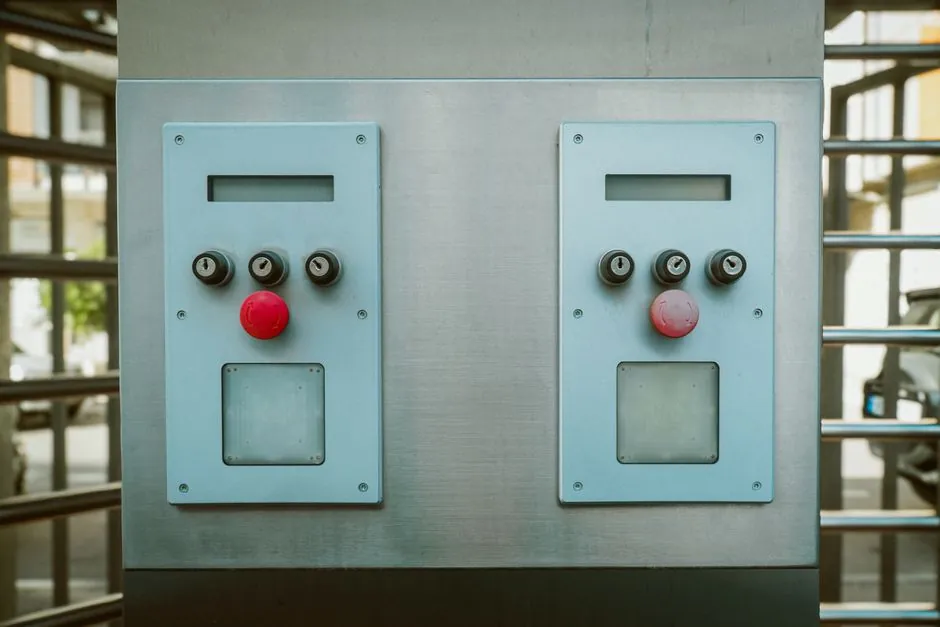
Door controllers sit between credential readers, locking hardware, and the management software that defines who gets in, and channel capacity is the spec that decides how many readers, locks, and supervisory inputs a single panel can drive before it needs a peer or sub-panel [S4].
In practice, capacity is not a single number. It is the product of reader ports (commonly 1, 2, 4, 8, or 16 per controller), lock relay outputs, request-to-exit (REX) inputs, and door-position switch (DPS) inputs, all sharing finite processor cycles, onboard memory, and a single PoE power budget [S3][S4]. A 1-door PoE panel that powers one reader, one strike, one REX, and one DPS from a 15.4 W PoE Class 3 feed is a fundamentally different design load than a 16-reader network controller fed by a 60–90 W PoE+ or PoE++ source and backed by a separate UL 294 listed power supply for the locks [S3][S2].
What channel capacity actually counts: readers vs doors vs supervised inputs
Single-door PoE controllers are the most common form factor for small offices, with one reader port, one or two Form-C relay outputs, one REX input, and one DPS input, all packaged to mount above the door or in a nearby secure cabinet [S1].
Multi-door controllers aggregate 2, 4, 8, or 16 reader channels on a single board, with each channel sharing a common authentication database and event log, and a network uplink replacing dedicated reader-to-panel wiring [S3][S7]. Axis specifies that its network reader architecture supports up to 16 readers per door controller over PoE while still managing the door lock, REX, and door position sensors from the same panel [S3]. The capacity ceiling is set less by raw I/O count and more by event throughput, typically expressed in credentials-per-second that the controller can evaluate against its permission database before latency becomes user-visible at the reader.
Power, PoE class, and the lock-side budget
SDC's 2020 power guide states that 75-85% of access control operating problems and technical support calls are caused by power issues, with dirty DC, transients, and brown-outs from a 90-120 V utility feed disabling control panels and connected locks [S2]. The same guide notes that power transients cost U.S. companies an estimated $26 billion annually in damage to electronic equipment, and that roughly 60% of transient events originate inside the facility rather than on the utility side [S2].
For a PoE single-door controller drawing 7-15 W from a Class 3 switch port, the budget still has to cover the reader electronics plus the inrush of the electric strike or maglock, and the panel must coexist with surge suppression sized to the lock coil's inductive kickback [S2]. SDC's practical guidance: electric strikes draw roughly 0.25-0.5 A at 12 or 24 VDC, maglocks draw 0.3-0.9 A held and 1-2 A inrush, and motorized locks can spike higher still, so the lock-side supply is almost never the same feed as the controller logic [S2].
Reader protocols: OSDP vs Wiegand and what they do to channel design
Open Supervised Device Protocol (OSDP) from SIA replaces legacy Wiegand wiring with a polled, encrypted RS-485 bus that supports up to 32 devices on a single daisy-chained trunk, supervised line monitoring, and 128-bit AES between reader and controller [S4]. Wiegand remains ubiquitous in installed bases but offers no encryption and no supervision, so a multi-door retrofit using Wiegand typically needs a home run per reader rather than a shared bus.
From a channel-capacity standpoint, an OSDP channel on a 2-reader or 4-reader controller behaves very differently from two Wiegand ports: OSDP lets a single RS-485 trunk fan out to multiple readers across a door bank, while Wiegand ties a dedicated conductor pair to each reader port and caps practical distance around 150 m with 18 AWG shield twisted pair [S4]. This is one reason controller datasheets that advertise "16 readers" are rarely deployed at 16 with Wiegand, but routinely hit 16 with OSDP.
Standalone, networked, and cloud-managed: how architecture changes capacity
Standalone controllers hold the full credential database, schedules, and audit log in onboard memory, meaning the channel count you buy is the channel count you keep, and offline operations are limited to whatever the panel can resolve locally [S4]. Networked controllers push decisioning to a server but still buffer events and rules locally, so a 4-door or 8-door panel can ride out a network outage for hours to days depending on event volume.
Cloud-managed controllers shift the credential store and rule engine to a vendor-hosted platform, with the local panel functioning as a network-edge device that buffers and forwards events; the capacity question here is less about raw reader count and more about bandwidth, latency to the cloud, and how many simultaneous API calls the panel can service during a morning peak [S4][S7]. For a multi-tenant or multi-site deployment, this shifts the design problem to a comparison between on-premise and cloud platforms that mirror the trade-offs in Access Control Audit Trail Retention, where retention rules and uptime SLAs drive the architecture choice as much as channel count does.
Sizing matrix: 1-door, 4-door, 8-door, and 16-door compared
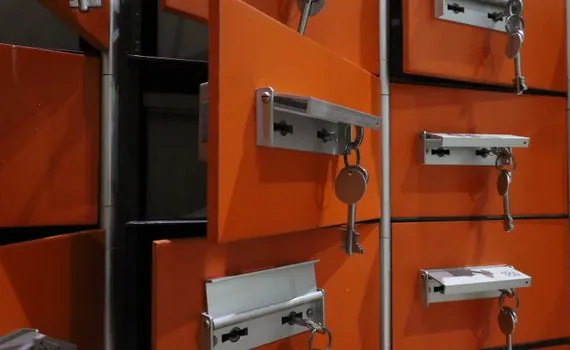
The decision grid below lines up the four common controller sizes against four criteria that move the engineering choice: reader-port count, lock-output count, typical PoE class, and the credential-throughput band at which the panel is comfortably below saturation. [S1]
1-door PoE controller: 1 reader port, 1 Form-C lock relay, 1 REX + 1 DPS input, PoE Class 3 (≈7 W for the panel plus reader), best fit for offices under 10 doors where each opening gets its own panel and a 10-25 ms credential decision is invisible to the user [S1][S3]. 4-door controller: 4 reader ports, 4 lock relays, 4 REX + 4 DPS, PoE Class 4 or a dedicated 12/24 VDC supply, suitable for small commercial floors with 25-50 ms latency at modest event rates [S3]. 8-door controller: 8 reader ports, 8 lock outputs, paired REX/DPS, often PoE+ or a 24 VDC 4-8 A supply sized for a 16-32 lock-load with surge suppression per SDC guidance [S2][S3]. 16-door controller: 16 reader ports, 16 lock outputs, often 32 supervised inputs, PoE++ or a 60-90 W dedicated supply, throughput typically 5-15 authentications per second before queueing shows at the reader [S3].
For comparison at a glance: at 8 readers per controller, an OSDP-bus deployment can usually reuse one RS-485 trunk per 4 doors; at 16 readers, the same trunk architecture scales linearly while Wiegand requires doubling the home-run count, which is why 16-reader OSDP panels are common and 16-reader Wiegand panels are rare in new design [S3][S4].
Failure modes and constraints that bound channel capacity
Three constraints cap how many channels a single controller can really carry in the field: power budget, event-throughput, and life-safety override behavior [S2][S4]. On the power side, inductive kickback from a maglock or strike can return 30-60 V spikes into the panel output and damage the relay or motor-driver board if the lock and controller are not on separate, surge-suppressed feeds [S2].
On the throughput side, each credential read, decision, lock command, and audit write consumes processor time, and a 16-door controller running OSDP at 9600 baud will queue reads differently than the same panel at 115200 baud; the same controller running mobile credentials over BLE or NFC adds cryptographic handshakes that can multiply decision time by 3-10x versus a 26-bit prox card [S3][S5]. On the life-safety side, fire code typically requires a fail-safe or fail-secure behavior tied to a fire alarm relay, and that relay must bypass the controller for free egress during an alarm, meaning the controller's channel capacity is irrelevant during a fire event because the lock is being released by the fire panel, not the access panel [S4].
Selection criteria: who a 16-door controller is for, and who it isn't

A 16-door network controller is the right spec for a single building or campus floor with 12-20 doors, a homogeneous reader protocol (OSDP preferred), 24/7 staffing or a managed service contract, and a structured cabling plant that can deliver PoE++ or a dedicated 24 VDC supply to the equipment room [S3][S4]. It is the wrong spec for a 4-door tenant suite, a remote site with no IT closet, or any installation where the Authority Having Jurisdiction (AHJ) requires the lock-release path to be physically separate from the access decision path, which is a common reading of NFPA 101 for high-occupancy egress doors [S4].
The honest split: standalone 1-door panels for under-10-door offices and retrofits; 4-door and 8-door network panels for typical commercial floors with mixed credential types; 16-door panels only when the cabling, power, and IT integration work has already been done, because at that scale the controller is no longer the bottleneck, the system window and door hardware schedule and the fire door listing are.
Standards and sourcing for the spec sheet
Channel-capacity claims should be cross-checked against the controller's UL 294 listing for access control system units, which rates line security, endurance, attack, and standby power, and against the panel's NEMA enclosure rating if it lives in an unconditioned space [S4]. Reader-channel counts above 4 should reference the OSDP v2.2 specification from the Security Industry Association for the bus-level channel behavior, while Wiegand-only designs should be flagged as legacy in any 2026 spec [S4].
For lock-side power and surge, SDC's 2020 power guide remains the most-cited practical reference, with its 75-85% power-related service call figure and its 60% inside-the-facility transient statistic both standing as the baseline numbers to put in a design narrative when justifying a separate lock power supply rather than a shared PoE feed [S2]. When the system architecture is finalized, channel capacity needs to roll up into a single line item per door, including reader, lock, REX, DPS, and the access control credential count, not just the panel headline.
Two signals worth tracking through the rest of 2026: OSDP v2.3 ratification with secure channel default-on, and PoE++ 90 W Type 4 adoption in access hardware, both of which will push the practical per-panel channel count above 16 and force a fresh look at the 1/4/8/16 sizing matrix used here. A useful baseline is the current Acre, Axis, and Avigilon Alta controller datasheets, where 16-reader PoE panels are already shipping and the next refresh is likely to standardize on 24- or 32-reader configurations over a single OSDP trunk [S1][S3][S5].