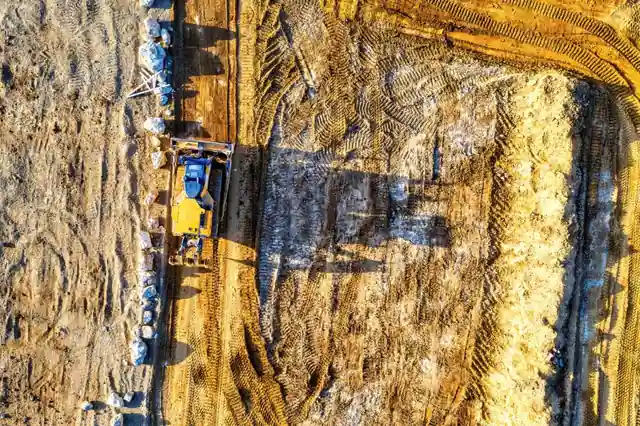
A rotary grade laser with a single- or dual-axis slope function is the standard tool for laying drainage fall, and the working window most contractors dial in sits between 0.5% and 2% grade for pipes, slabs, and landscape drainage [S4]. Outside that band, the same instrument is used at 0.3% (absolute minimum for drainage on local roads), at 1% to 1.5% (natural turf fields), and up to 8.33% (ADA 1:12 ramps) [S2][S3][S5].
Concretely, a 1% slope drops 0.12 inches per foot, a 2% slope drops 0.24 inches per foot, and over a 50-foot run at 2% the total fall is 1.0 foot (2 x 50 x 0.01) [S2]. Those numbers are the field-verification target that the grade rod at the far benchmark has to read, which is why a laser level with a working slope override and a detector is the right instrument rather than a standard self-leveling unit.
What the slope function actually does inside a grade laser
A standard self-leveling laser holds its beam at true horizontal through a pendulum or servo-driven gimbal with a compensation range of typically ±3° to ±5° from level [S3]. A grade laser adds a secondary tilt mechanism that disengages or overrides the compensator and projects the reference plane at a user-defined angle instead, commonly settable as percent grade, degrees, or mm/m across an operating range that runs roughly 0° to 25° and sometimes up to 90° on pipe-laser variants [S3].
Single-axis units tilt only the X-axis and are suited to driveways, parking lots, and any single-direction drainage run; dual-axis units let the operator dial in independent X and Y slopes at the same time, which is what enables compound grading like a sports field crowned from the center or a trench layout falling two ways from a midpoint [S1][S4]. The Spectra Precision UL633N goes one step further, adding automatic Z-axis control through a fan beam alongside the X/Y tilt, which is the only construction laser on the public spec sheet to claim all three axes under automatic control [S1].
Spec window by application: 0.3% to 8.33%
The slope percentage a contractor actually dials in is driven by the application, and the spec bands are tighter than most catalog copy suggests. For drainage and trenching (storm sewers, utility runs, stormwater laterals) the consistent target is 0.5% to 2% grade, with dual-axis machines favored when pipes need to fall in two directions from a single setup [S4]. On local roads the longitudinal minimum is 0.3% and the practical maximum sits at 6% to 8%, while capped highway longitudinal grade is held to 3% maximum [S3].
For buildings, the IRC R401.3 code line is a 2% minimum slope away from the foundation (0.24 in/ft) to keep water from pooling against the wall, and ADA Standards 4.8.2 cap wheelchair ramps at 8.33% (1:12, or 1.0 in/ft) [S2]. A typical shower pan needs at least 0.25 in/ft (1/4 in/ft) per IRC P2709.1, residential decks run 1% to 2%, and parking-lot surface drainage spans 1% to 5% under ASCE 7 surface drainage guidelines [S2]. On athletic fields the Sports Turf Managers Association guidance is 0.5% for a skinned infield and 1% to 1.5% for a natural grass field, tight enough that laser grading is preferred over conventional methods because of the residual 0.25 to 1 inch of undulation a tractor-towed box blade leaves behind [S5].
Single-axis vs dual-axis vs three-axis: which one to pick for drainage
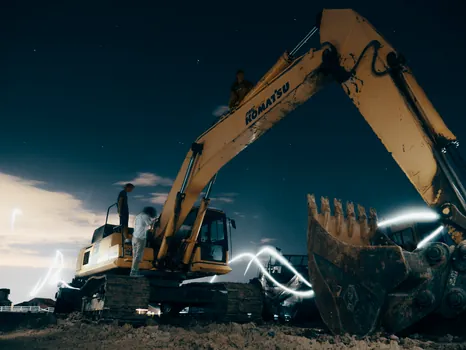
For a straight run of pipe or a single-fall parking lot, a single-slope rotary is enough and the operator only has to set one axis [S4]. The moment the job has two fall directions meeting at a low point (a tennis court, a baseball skin, a compound drainage swale), the spec needs a dual-slope unit, and the dual-slope vs single-slope grade laser decision turns on whether the second fall can be approximated with a string line or whether it has to be machine-controlled.
Selection criteria line up cleanly. First, slope range: rotary grade lasers with slope function can be deliberately tilted to specific angles within their operating range (typically 0° to 25°, and sometimes up to 90°), which is more than enough for any drainage job but borderline for an 8.33% ADA ramp. Second, accuracy: detector readings should land within ±1/16 inch of on-grade for concrete drainage work and ±1/8 inch for site grading, per current rotary grade-laser guidance [S2]. Third, working range and detector pairing, because the outdoor rotary laser receiver range is what limits how far the slope reference can be carried before the rod reading loses confidence. Fourth, IP rating, since drainage work happens in wet, muddy conditions and an IP66 or better housing is the practical floor.
Field verification and the failure modes that show up first
Slope setup is unforgiving in a specific way: if the compensator is not actually overridden, the laser silently self-corrects back to level and the grade rod reads horizontal, so a 0.8% slab that should have been 2% will pool water against the foundation within one wet season [S2]. The mitigation is a written pre-pour verification: convert the dialed percentage to inch-drop-per-foot (slope % divided by 100, multiplied by 12), write that number on the rod, and check it at the far benchmark before the concrete truck shows up [S2].
The other common failure is reading the wrong axis. A single-slope unit only tilts X, so if the operator assumes Y is also at grade and shoots a perpendicular rod, the Y reading is just true level and the cross-fall is whatever the tripod happens to be sitting at. Dual-axis units eliminate that ambiguity by displaying both X and Y slopes independently, which is why trenching layouts that run two directions from a central point are the canonical dual-slope use case [S1][S4]. For longer pipe runs the laser screed and pipe-laser categories carry the same slope logic into a beam aimed down the pipe bore, but the percentage window is identical.
Standards, codes, and what to cite on the plan sheet
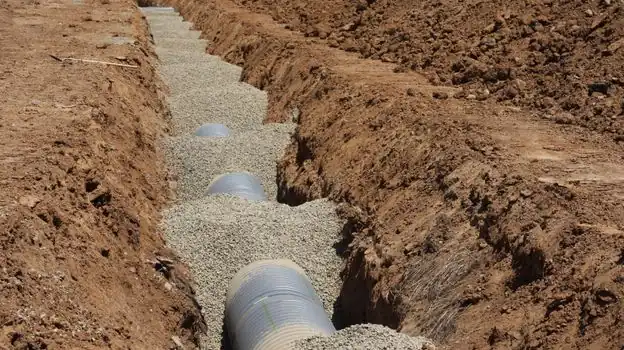
The slope numbers above are not catalog copy; they are tied to specific code lines. IRC R401.3 sets the 2% minimum for foundation drainage, ADA Standards 4.8.2 sets the 8.33% (1:12) maximum for ramps, IRC P2709.1 sets the 1/4 in/ft shower-pan minimum, and ASCE 7 surface drainage guidelines cover parking-lot fall between 1% and 5% [S2]. Highway and local-road longitudinal grades of 3% maximum and 0.3% minimum respectively are the civil-engineering baseline that a road subgrade laser has to match [S3].
For the survey-grade instrument itself, rotary grade lasers with a dial-in slope mechanism are the category that physically supports these percentages, and the override of the ±3° to ±5° self-leveling range is what makes the slope reference stable instead of drifting back to horizontal [S3]. Cross-line lasers with pendulum lock can do 1% to 2% deck or shower work, but the moment the job exceeds about 3% or needs long outdoor range, the spec moves to a rotary grade laser with a matched receiver, not a cross-line unit. Track, going into Q4 2026, whether dual-axis automatic units continue to displace single-axis machines on residential drainage work, and whether pipe-laser adoption keeps pulling slope-function demand out of the general rotary segment.
For component-level specifications, see function generator.