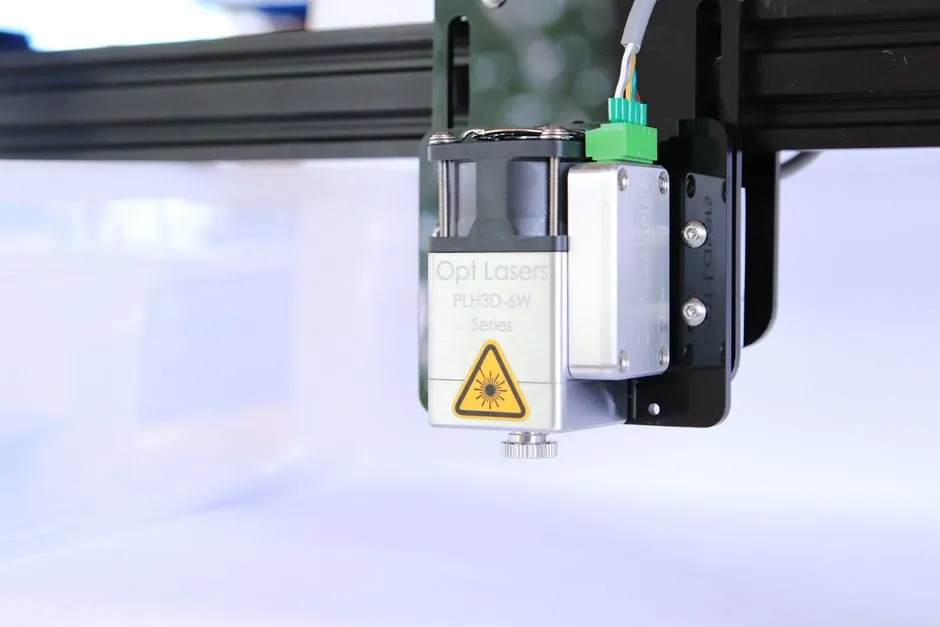
A line laser receiver is useless unless the laser it is hunting actually transmits a pulse-mode (modulated) beam, and receiver/transmitter pairings in 2025–2026 product listings still break into incompatible silos based on pulse frequency, diode color, and form factor [S1][S2][S3].
Line-laser pulse receivers now on the market, including the Huepar LR-8RG (USD 52.99, ±1/17 in, up to 200 ft range, dual-sided LED, red/green detection) and a near-identical Firecore unit, are explicitly designed to read only pulse-modulated line lasers with green or red diodes, not rotary-laser receivers and not continuous-wave (CW) beams [S1][S5][S7].
Why pulse mode is the gatekeeper, not a feature toggle
Line-laser diodes produce a thin, fan-shaped beam that the human eye sees as a continuous line, but a photodiode inside a receiver needs a stronger, repeating signal to lock onto in daylight; pulse mode re-modulates the diode output at a fixed carrier (commonly 10 kHz on Dovoh gear, with other vendors using 1 kHz to 5 kHz depending on model) so the receiver can reject ambient light with a band-pass filter [S3][S6].
The practical result, called out plainly in the 2016 Laser Level Review receiver guide, is that a line laser must have a pulse mode for a line-laser receiver to detect it; pulse mode is therefore a hard prerequisite, not an optional add-on [S6]. The Dovoh DR1 step-by-step procedure reiterates this: the user is told to switch the laser into pulse mode before powering the receiver, and the receiver is specced to a 10 kHz carrier to match Dovoh line lasers [S3].
Three failure modes that pass the datasheet check but fail on site
Frequency mismatch is the most common silent killer: a 1 kHz pulse laser and a 10 kHz pulse receiver will both power up, the receiver will scan, and it will simply never trigger on the beam [S3][S6].
Color (wavelength) mismatch is the second: a red 635 nm line and a green 520–525 nm line are at different optical frequencies, so receivers are typically built for one band or the other; the Huepar LR-8RG and Firecore clones list both red and green as a feature, but a green-only receiver (e.g. the Firecore unit marketed for green lasers) will ignore a red beam and vice versa [S1][S5][S7].
Form-factor mismatch is the third and is the one that costs the most wasted trips: a rotary-laser receiver is engineered to chase a rotating 360° beam at long range and will not lock onto the static fan of a line laser; conversely, a line-laser receiver has a narrow, often 10–50 mm reception window optimised for a stationary plane, so it will miss most of a rotating beam unless it is parked at a fixed elevation [S3]. Dovoh states this incompatibility directly: rotary and line-laser receivers are not interchangeable [S3].
Decision matrix: which receiver family fits which laser

Cross-vendor compatibility, as sold in 2025–2026 catalogues, sorts cleanly by laser class and pulse profile [S1][S2][S3][S5][S7]:
Line-laser pulse receivers (Huepar LR-8RG, Firecore, Dovoh DR1, generic 10 kHz units) require a line laser with pulse mode output, run ±1 mm fine to ±3 mm coarse, and are specified for indoor and short outdoor range (typical 30–60 m, 100–200 ft); rotary-laser receivers (the bulk of the Tiger Supplies detector catalogue) require a rotary laser with pulse mode, run ±0.5 mm to ±1.5 mm accuracy and are spec'd for 100–800 m working range with machine-control models; green-only versus red+green is a separate axis, and the green-only Firecore receiver is a warning sign that a vendor has optimised the photodiode for the 520 nm band, so a red beam should not be expected to trigger it [S1][S3][S5][S7].
A second axis is mounting and power: Huepar and Firecore both ship with magnet and clamp, and claim up to 200 ft (≈60 m) detection, while the Vxb-branded receiver pushes the same envelope at USD 114.95 retail with the same ±1/17 in accuracy spec, hinting that the cost spread is packaging and warranty rather than fundamental receiver sensitivity [S1][S2][S7].
Field procedure: pairing the LR-8RG (or equivalent) to a Huepar / Firecore / Dovoh line laser
Set the laser to pulse mode (the same key that turns the receiver-friendly emission on), power both units, and place the receiver at least 5 m from the source before sweeping; this is the 5 m minimum stated by Dovoh to avoid the near-field saturation zone where pulse detection is unreliable [S3].
Use Fine mode (±1 mm) when setting forms, cabinets, or finished floor heights, and switch to Coarse (±3 mm) when roughing out grade, sub-base, or rebar chairs; both bands are user-selectable on the Dovoh DR1 and on the Huepar / Firecore two-sided LED receivers [S1][S3][S7]. A magnetic mount or rod clamp lets the receiver ride a grade rod, while the dual-sided LED window lets the operator read on-grade from either side of the stick, an underrated feature when a wall or a battery box blocks the front face [S1][S2].
Who needs a pulse receiver, and who can skip it
A pulse-mode laser receiver is mandatory for outdoor work beyond 10–15 m in daylight, for any interior layout where the beam is broken by ductwork or steel, and for any line-laser-plus-grade-rod workflow; it is also mandatory on grade-laser applications where the laser level is being used as a one-person level instead of a tripod-mounted instrument [S3][S6].
It is wasted money for purely indoor cabinet work under 5 m in dim conditions, for survey-grade control carried by a laser tracker or total station, and for any application where a laser profiler or laser displacement sensor is the right instrument rather than a hand-held line laser; the pulse-receiver market and the profiler / tracker / displacement-sensor market solve different problems, and the receiver form factor should not be repurposed to non-existent roles [S3].
Limitations and failure modes worth flagging to procurement
Detection range drops 30–60 percent on a green beam in bright direct sun versus the same receiver indoors, because the photopic response of silicon is not matched to the 520 nm peak the way it is to 635 nm red, and the same logic is why laser marker and engraving optics do not translate into receiver range claims [S1][S6].
Cheap aftermarket pulse receivers sometimes claim 5 kHz or 8 kHz compatibility, but the OEM pulse frequency in a Huepar or Firecore line laser is fixed and proprietary, so the safe procurement rule is to match the receiver brand to the laser brand (or buy a vendor that explicitly states a frequency and a model cross-list); the Dovoh DR1's stated 10 kHz / Dovoh-only spec is the cleanest example in the public data set [S3].
No public listing, including the Huepar and Firecore Amazon pages, claims an IP rating above IP54, so outdoor users should expect splash resistance only and should pull the unit when rain is sustained; battery life is the other quiet limit, with most pulse receivers rated for 20–40 hours on two AA cells, less if the audio beeper is left on at full volume [S1][S2][S7].
Signals to track before specifying
Watch for an OEM frequency-disclosure spec sheet from Huepar, Firecore, or Dovoh, because the 10 kHz Dovoh number is the only carrier frequency stated in the public 2025–2026 research and it is the kind of figure procurement needs to lock in before mixing brands [S3].
For adjacent applications, the laser screed and concrete-flatness side of the same family of pulse-modulated tools uses a different receiver class (machine-mounted, higher accuracy, lower frequency), so any cross-spec between hand-held line-laser receivers and screed receivers is a documented failure pattern worth raising with the vendor before purchase [S3][S5]. Cross-reference to the TOF vs phase-shift distance-meter logic is also useful, because receivers, distance meters, and laser screed pickups all sit on the same modulated-light stack but with very different bandwidth budgets.
