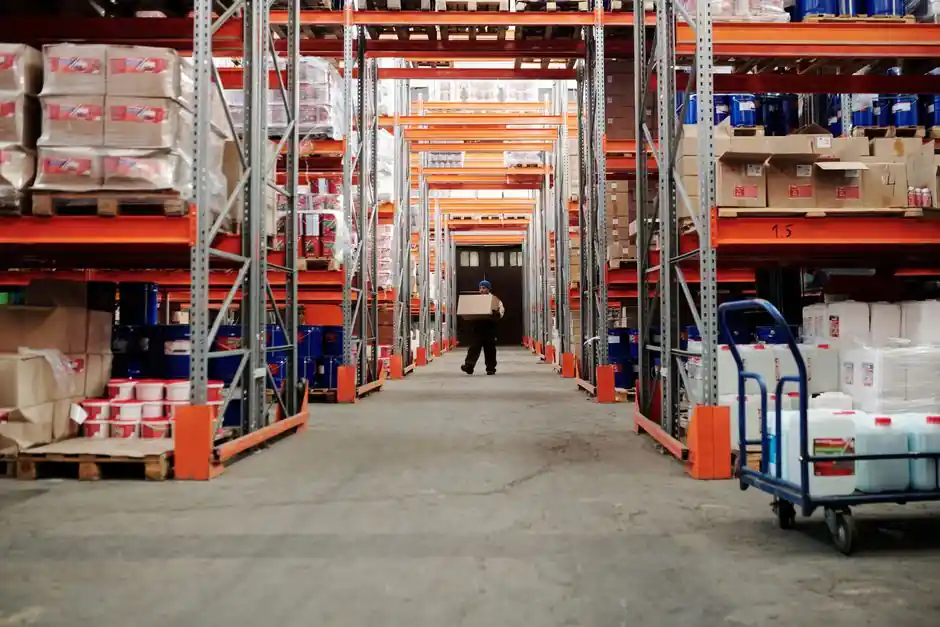
Drive-through pallet racking supports FIFO inventory rotation because pallets enter at one end and leave at the opposite end, while drive-in racking uses a single access point and produces LIFO retrieval by default [S1][S2].
Both systems store pallets several positions deep in forklift-accessible lanes, but they apply to different inventory rules: FIFO for dated or age-controlled stock, and LIFO for homogeneous, non-expiring bulk inventory [S3][S4].
How Access Geometry Creates FIFO or LIFO
Drive-through racking is open at both ends. A forklift loads a pallet from the loading aisle, advances it into the lane, and a second aisle permits removal from the opposite end [S2][S3]. The oldest pallet can therefore travel forward through the lane without being blocked by pallets that entered later.
Drive-in racking has one entry and exit face. Pallets are loaded toward the rear of the lane, and the pallet nearest the face is normally retrieved first [S2][S4]. The last pallet stored is therefore the next pallet accessible, which defines LIFO operation [S1][S6].
The distinction is geometric, not merely a software inventory setting. A FIFO workflow requires a physical route for the oldest pallet to leave without removing later pallets ahead of it. Drive-through provides that route; conventional drive-in does not [S3][S8].
Selection Criteria: Rotation, SKU Count, and Access
Choose drive-through when lot rotation, age control, expiration sequencing, or first-in-first-out dispatch is operationally required [S4][S5]. Its separate loading and extraction aisles preserve product order while retaining deep-lane storage [S5].
Choose drive-in when each lane can hold one SKU and the oldest pallet does not need to leave before later receipts [S3]. It suits raw materials, packaging, seasonal goods, beverages, and other homogeneous inventory where strict FIFO rotation adds no value [S4]. Standard drive-in retrieval remains LIFO even if a company assigns FIFO labels in its inventory system, because the physical access sequence controls which pallet can be reached first [S1][S9].
Compare the options across four controls. For FIFO access, drive-through wins because it has two ends and drive-in has one. For same-aisle handling, drive-in wins because loading and retrieval occur at one face. For maximum density, both remove the need for a selective-rack aisle at every pallet position, but drive-through consumes access space at both ends. For mixed-SKU selectivity, both are weak because every position behind the front position is constrained by the pallets ahead of it [S3][S4].
Density Versus Selectivity in Deep Lanes
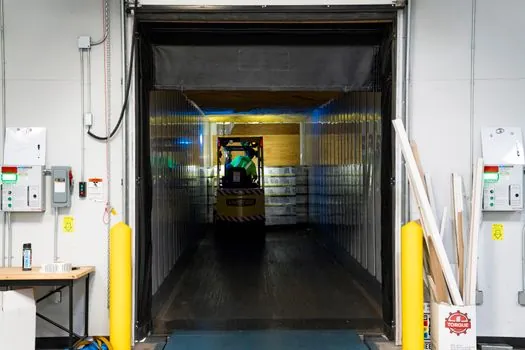
Published product guidance describes drive-in and drive-through systems as 8+ pallets per lane.
The density gain comes from continuous pallet rails and fewer intermediate access aisles. One supplier comparison states that drive-in and drive-through layouts can provide 40–60% more pallet positions than selective rack in the same footprint [S3].
That density is purchased by accepting lower selectivity. A forklift must pass and position at deeper locations, and a partially filled lane creates gaps, known as honeycomb space, that cannot store pallets [S3][S4]. These constraints make deep-lane systems more suitable for few SKUs with large quantities than for fast-moving, mixed-SKU inventory.
Operating Method Changes the Work Sequence
Standard drive-in racking supports LIFO inventory rotation, while drive-through racking can support FIFO operations.
Drive-through loading still places pallets into the lane, but the removal path is at the opposite end. Pallets enter from the loading side and are withdrawn from the extraction side, allowing the first loaded pallet to be removed first [S1][S8]. This arrangement is suited to production-to-shipping staging and dated products [S3].
The loading equipment must be suitable for deep-lane work. Forklifts enter the structure and place pallets directly on rails, so truck clearances, mast height, turning radius, pallet dimensions, and lane alignment determine whether a position can be reached safely [S4][S5]. A comparison of handling equipment and aisle constraints is also covered in Pallet Stacker vs Manual Pallet Jack: Aisle Width.
Structural, Fire, and Damage Controls
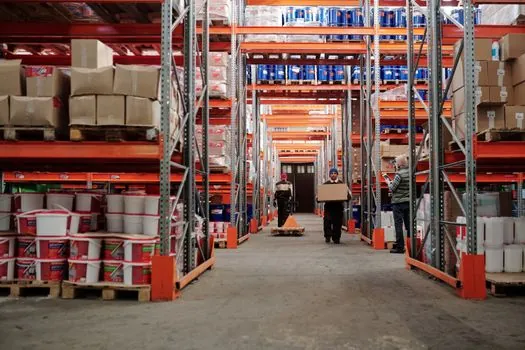
Drive-through configurations require more than opening the rear of a standard lane. A central supporting beam can add stability to a dual-access design [S5]. Drive-through racking includes a central supporting beam for added stability and dual-side access.
Dense storage also requires fire-code review. Product guidance notes that commodity and rack height can affect whether in-rack sprinklers are required [S3]. The structural design must be evaluated for pallet loads and forklift impact forces, with rail depth, bracing, anchoring, and floor conditions verified rather than copied from a generic lane table [S3].
Where FIFO and LIFO Designs Fail
Drive-in fails as a strict FIFO solution because later pallets block earlier pallets within the same lane [S9]. It can still be paired with FIFO software, but only if the operation deliberately reverses loading and unloading from opposite faces, a design identified as drive-through rather than conventional drive-in [S5].
Drive-through can also fail to deliver practical FIFO. If the oldest pallet is blocked, damaged, missing, or positioned outside the planned loading sequence, operators may have to unload later pallets or use another aisle. FIFO therefore requires disciplined loading, lane assignment, and inventory records rather than merely installing a second access face [S1][S8].
Neither system is a universal substitute for selective pallet racking. Drive-in performs poorly when many SKUs must be accessed independently, while drive-through adds the cost and aisle requirement of working from both ends. For conventional pallet layouts and less restrictive rotation, pallet rack remains the relevant comparison baseline; drive-in racking should be evaluated against deep-lane density and retrieval order, not aisle width alone.
The trackable decision signals are SKU count per lane, FIFO age or lot requirements, inbound-to-outbound volume balance, required lane depth, available aisle width on both ends, and whether one-aisle LIFO handling is acceptable [S3][S4].