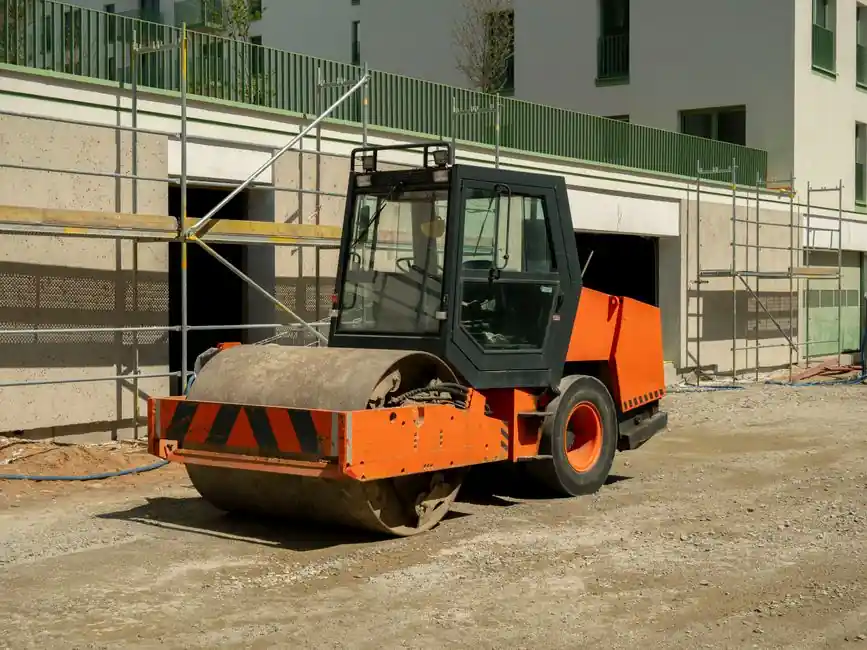
Drum dead weight supplies static pressure, but vibration delivers most of the energy responsible for deep granular compaction.
A smooth-drum compactor applies the drum's static weight together with vibration generated by a spinning weight inside the drum [S2].
What Deep-Lift Compaction Actually Depends On
Deep lift compaction is governed by four measurable elements: static drum load, vibration amplitude, vibration frequency, and the time each point remains under compaction [S5]. Static pressure is always present because the machine weight acts continuously on the substrate. Added vibration changes the contact pattern: a rotating unbalance moves the drum through rapid circular motion, directs most compaction energy vertically into the material, and allows impacts to penetrate below the surface [S3].
Vibration therefore matters more than dead weight for deep densification of granular material, but neither parameter works alone. A heavy smooth drum can be ineffective if its vibration settings, working speed, number of passes, or lift thickness are unsuitable. Conversely, strong vibration cannot compensate for an unsuitable drum configuration or material condition. The Pennsylvania Department of Transportation study evaluated five compaction machines, four lift thicknesses, two moisture conditions, roller speed, operating duration, and number of passes because density depends on the combined process [S1].
Drum Weight: Role, Limits, and Practical Meaning
Static drum weight matters at three points: it provides continuous contact pressure, it contributes to material movement under the drum, and it increases resistance to drum lift-off during vibration. A smooth-drum compactor applies static weight together with a fast hammering force generated by vibration [S2].
Weight is particularly useful on hard or heavy fill where greater pressure may be required, and it remains continuously present with oscillation. With an oscillating drum, two synchronously rotating unbalance shafts are offset by 180 degrees, creating alternating forward and backward motion. Because the drum remains in ground contact, the machine contributes a constant static load throughout the pass [S3]. Deep penetration is therefore a vibration-led function, while constant contact and surface shear are associated with oscillation.
Drum diameter also changes the operating result. Larger-diameter drums provide a larger contact area than smaller drums, which can improve compaction performance and reduce drum wear [S7]. This means operating weight alone is an incomplete machine comparison. Drum diameter, drum width, machine configuration, and excitation settings determine how that weight is transferred to the layer.
Vibration Settings That Control Effective Depth
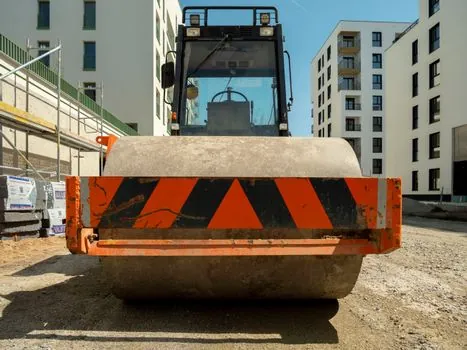
Deep compaction requires a matched combination of amplitude and frequency, not the highest available setting. Amplitude defines vertical movement of the drum, while frequency defines the number of vibration cycles per minute. Thick lifts and difficult materials generally require greater amplitude; thin lifts and soft materials require less [S4]. A Pennsylvania Department of Transportation research report titled "Equipment and Lift Thickness Optimization for Structure Backfill Compaction Operations" was issued in February 2024 [S1].
Compaction depends on the interaction of vibration, force, and material behavior [S4]. Vibration power should match the job rather than exceed it, because excess vibration can waste fuel, accelerate roller wear, and damage the material [S6]. These values are operating guides, not a universal acceptance specification.
The practical selection sequence is to set lift thickness first, choose drum type for the soil, select amplitude for that lift, set frequency and speed to achieve suitable impact spacing, then verify the resulting density. More vibration is not a substitute for correct lift thickness or an appropriate number of passes.
Deep Lift Versus Shallow Lift: Material and Drum Type
For granular fill, including rock, sand, and gravel, smooth-drum compactors are the usual choice because vibration rearranges particles and reduces voids. Vibratory compactors come in smooth-drum and pad-foot types [S5].
That depth is not permission to place an excessive lift over every material.
Pad-foot drums also add manipulative force, which smooth drums do not generate in the same way. The feet concentrate load into small contact points, penetrate the upper part of cohesive lift, break particle bonds, and help mix or knead the material [S2][S5]. For very thick granular lifts, a heavy vibratory smooth drum can outperform a smaller machine because it combines static load, impact, and vibration without relying on pad penetration.
Comparison: Smooth Drum, Pad-Foot Drum, and Oscillation

The main drum options are not interchangeable. Smooth drums favor granular, non-cohesive material and deep vibration penetration. Pad-foot drums favor cohesive or fines-rich soil because their feet add manipulative action and penetrate the lift. Oscillation favors continuous contact and tangential shear, including asphalt applications where excessive vertical vibration may be undesirable [S2][S3][S5].
Vibration and oscillation can also be combined in one earth-work drum. HAMM describes its VIO arrangement as allowing vibration for deeper compaction and oscillation for the upper layer, with switching from the operator platform while the roller is moving [S3]. This is a more controlled solution than applying maximum vibratory force throughout the full lift.
Failure Modes and Field Limits
A firm-looking surface does not prove that the bottom of a lift has reached the required density. A smooth drum can consolidate the top of cohesive soil while leaving the lower portion soft, while excessive vibration can produce over-compaction, material displacement, fuel waste, and accelerated wear [S2][S6]. Field verification must therefore evaluate the full specified lift rather than relying on drum appearance.
Moisture is another limit. The Pennsylvania study varied moisture content because aggregate compaction response depends partly on the material’s ability to move under load [S1]. The same study used a non-movement condition as a practical endpoint and produced recommendations by aggregate type, equipment, lift thickness, roller speed or duration, passes, and moisture condition. Those recommendations cannot be transferred automatically to a different aggregate gradation, drum, or operating speed.
One example machine can illustrate why machine mass alone is misleading: 3,700 lb of static weight and roughly 15,000 lb of centrifugal force belong to the same roller configuration [S2]. Equipment selection should instead use the material, lift depth, required density, working space, and measurement method as the controlling criteria [S5].
How to Specify and Verify the Compaction Process

A workable specification should define the material, maximum lift thickness, roller type, operating speed, vibration frequency and amplitude, number of passes, and acceptance test for the completed lift. For granular material, record the drum configuration, lift thickness, moisture condition, machine working speed, and vibration settings rather than specifying “heavy roller” or “maximum vibration.” For cohesive material, include the pad-foot configuration and its typical 150–460 mm working range, adjusted for the field program [S5].
For deep granular work, smooth-drum vibration remains the primary mechanism because the rotating unbalance directs most of the compaction energy vertically into the substrate [S3]. Static weight remains relevant, but it should be treated as a supporting input rather than the sole measure of compaction capability. Verification should be tied to lift thickness, passes, operating speed, impact spacing, and measured density, with the field program recording the conditions under which the target was achieved [S1].
Track three signals on each placement section: the actual lift thickness, the machine settings and speed used for each pass, and the density result through the specified depth. A change in aggregate, moisture condition, drum configuration, or working speed can alter the result, so successful production data should be retained for the next lift rather than reduced to machine weight alone.