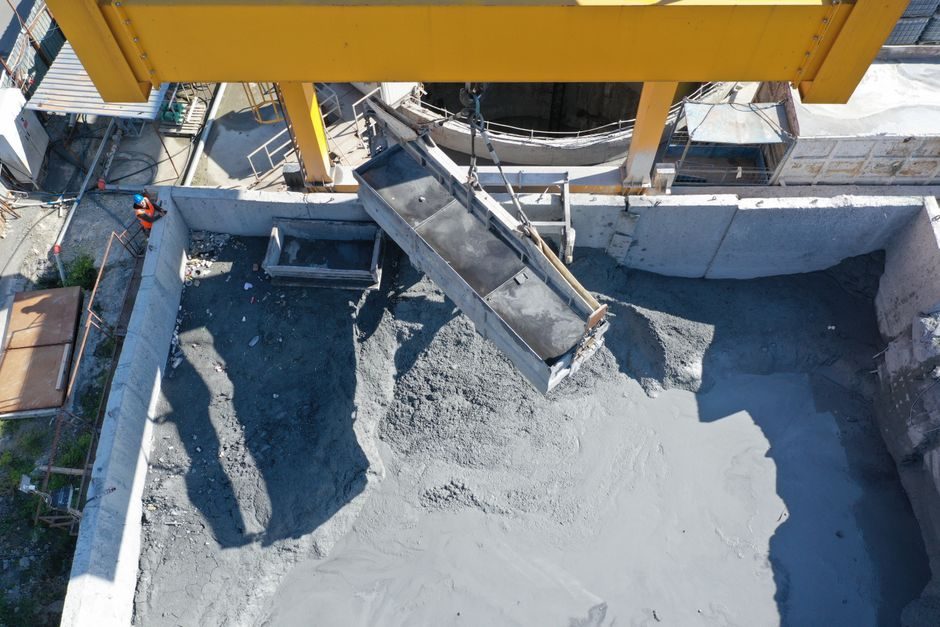
Dry-mix mortar is a factory-blended, bagged formulation of Ordinary Portland Cement, graded 0–4 mm sand and tailored additives dosed to a target performance class, while bagged cement is a single binder requiring on-site blending with sand and water by the tradesman [S6].
The category has matured into named product lines such as KG SKIM BASE (B10/WB10) skim coat, KG SPRAYCEM TEXTURE (T10), KG S-BOND TILE ADHESIVE (S10) and KG LEVELPRO (L70) self-leveling, with the Malaysia-based manufacturer KG-Mix reporting 2,000+ projects supplied across the Asia Pacific region as of 5 July 2026 [S1]. For the full definition and category breakdown see the dry-mortar reference, and for a binder-side comparison see ready-mix concrete and special cement.
What "dry-mix mortar" actually is on a bag
A factory-controlled dry blend is the key technical differentiator: cement content, sand grading curve, polymer redispersible powder (RDP) and cellulose-ether thickener are weighed in a dry-mortar plant, then packed in 5 kg, 10 kg or 20 kg retail bags or 25–40 kg trade bags [S1][S5].
The retail 5/10/20 kg "Home Pack Mortar Mix" format sold on European e-commerce at GBP 10.99 in June 2025 is the same factory-blend model scaled down for DIY channel [S5]. Pack-and-go convenience translates into a 1:1 volume yield at the job site — 1 kg of dry mix plus the spec'd water gives roughly 0.6–0.7 L of fresh mortar, which is the figure contractors use for material take-off. A binder-only bag cannot offer that yield guarantee because the sand side is variable.
Cement alone: scope, limits and where it still wins
Ordinary Portland Cement in 25 kg or 50 kg bags is a single-component binder; the contractor carries the sand, additives and QA burden, and ratios vary by site. The standard mortar mix ratio of 1:3 to 1:6 cement-to-sand by volume is a jobsite decision, not a factory specification, and consistency depends on labour skill. [S1]
Bagged cement still wins where the project is large, the spec is open, raw sand is cheap and labour is skilled — bulk-cement silos, concrete batching plants, and large-scale masonry. For everything else — skim coat, tile adhesive, self-leveling underlayment, patch repair, EIFS base coat — factory dry-mix dominates because each square metre of finished surface is QA-tested by the manufacturer, not by the trowel. The cement silo and batching equipment used to back-stop the bulk side are still built by the same Chinese cluster that supplies the dry-mix plants, including Shandong Quanhua, BHM and Fujian NanAn H-TEC, all active in 2026 [S2][S3][S4].
Decision matrix: dry-mix mortar vs bagged cement
Four criteria separate the two on real project economics: (1) Quality control — dry-mix is factory-blended to a published class (C1/C2/C2TE tile adhesive, CT-C30 self-leveling, GP/CS mortar); bagged cement is a single variable. (2) Site labour — dry-mix needs mixing water only; bagged cement needs sand sourcing, sieve, gauging and rework on failed ratios. (3) Waste — dry-mix bags are consumed in 5–20 kg lots matched to area, while bulk cement spills across 25–50 kg lots [S5]. (4) Price per finished m² — dry-mix is 2–3× the cement-only price but eliminates the sand purchase, the additive purchase and the rework rate, so the installed cost gap is closer to 1.2–1.5× on a like-for-like scope.
For procurement teams buying cement and concrete mixing stations or a dry-mortar production line, the matrix flips: a 30–60 t/h tower dry-mortar plant is CAPEX-heavy but the per-tonne margin on a named-product bag (skim coat, tile adhesive, self-leveling) is 2–4× the margin on bulk OPC, which is why the China cluster is adding capacity in 2026 [S2][S3][S4].
Product taxonomy seen on 2026 manufacturer catalogues
Reading three live 2026 catalogues side-by-side gives a real product map: KG-Mix (Malaysia) lists Skim Coat, Texture Coat, Tile Adhesive and Self-Leveling flooring as its four hero SKUs [S1]; BHM (Henan, China) breaks a dry-mortar plant into grinding, sand drying, mixing, packing, silo, dust collection and palletising as the equipment side [S3]; Fujian NanAn H-TEC (Fujian, China) sells the tower-type production line and bulk-cement silo as a matched pair, and is a Committee Member of the China Bulk Cement Association of Dry-mixed Mortar Specialty Council [S2]. Shandong Quanhua (Jinan, China) layers a block-making line and drilling rig on the same equipment base, exporting into North America, Southeast Asia and the Middle East [S4].
The common product classes across all four catalogues are: skim coat (wall putty, 1–3 mm), tile adhesive (C1/C2, polymer-modified), self-leveling underlayment (CT-C25 to CT-C40), masonry mortar (M5/M10), EIFS adhesive and base coat, and decorative texture coat. Each class is a different additive package on the same cement-sand backbone.
Standards, sustainability and the SCM substitution trend
EN 998-1 governs factory-made rendering and plastering mortar in Europe, EN 12004 governs tile adhesive classes C1/C2/C2TE, and EN 13813 governs cementitious screed classes CT-C25–CT-C40; the 2024 review of sustainable dry-mix mortars confirms that supplementary cementitious materials (SCMs) — Fly Ash, Rice Husk Ash (RHA) and Ground Granulated Blast Furnace Slag (GGBFS) — are now standard partial OPC replacements in factory dry-mix to cut CO₂ per tonne [S6].
Spec teams should require the EN class and the SCM replacement ratio on every technical data sheet. Eco-friendly mortars can be produced by partially replacing Ordinary Portland Cement with Ground Granulated Blast Furnace Slag (GGBFS) as a supplementary cementitious material [S6].
Real failure modes if you spec the wrong one
Three failure modes hit the job site when the wrong product is chosen. (2) Bagged cement + site sand used as a self-leveling underlayment: the sand grading cannot meet the EN 13813 flow requirement, so the floor cracks within 28 days even if the water ratio is right. (3) Skim coat applied as EIFS base coat: a GP-class skim coat lacks the polymer and fibre loading to bridge an EIFS insulation board, and finishers see cracking on the first thermal cycle. [S2]
Each failure mode is a procurement error, not a labour error, and is best prevented by matching the EN class on the technical data sheet to the application — a discipline that bagged cement alone cannot deliver because it carries no class.
Cluster, pricing and where the 2026 supply is concentrated
The 2026 supply chain for both bagged cement and factory dry-mix is concentrated in the same Chinese equipment cluster: Henan (BHM) for full dry-mortar plants, Fujian (NanAn H-TEC) for tower lines and cement silos, Shandong (Quanhua) for block and packing lines, with retail bagging operations in Malaysia (KG-Mix) and other Asia Pacific countries feeding downstream demand [S1][S2][S3][S4].
For procurement teams comparing the equipment side, the expansion anchor market follows a similar Chinese-cluster-to-global-distributor pattern, and the conveying side of cement handling is a direct input cost into a dry-mix plant's CAPEX. Track new tower-line commissioning announcements from NanAn H-TEC, BHM and Quanhua in H2 2026 as the leading supply signal.