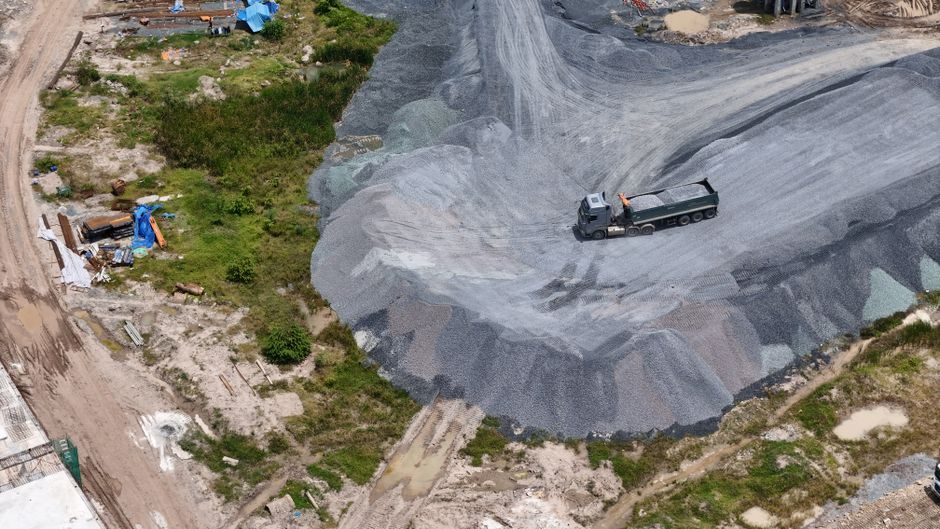
A 6×4 dump truck and a 6×4 truck-mounted concrete pump share the same cab-axle vocabulary but solve opposite problems on a construction site. The dump truck is a haulage unit — payload, body steel thickness, and tipping-cycle time define it. The truck-mounted concrete pump is a placing unit — boom reach, hydraulic pumping pressure, and output in m³/h define it [S1][S2].
This 2026 spec cut lays the two machines side-by-side on chassis, drivetrain, body/boom geometry, hydraulic envelope, and operating economics, so a project engineer or fleet buyer can pick the right asset — or justify having both. For a broader haulage reference, the 2026 Dump Truck Buying Guide: Chassis, Body and Price Bands covers dump-truck selection in depth.
Chassis, Drivetrain and Class Boundaries
A standard on-road dump truck is built on a 4×2, 6×4 or 8×4 on-road chassis with a gross vehicle weight typically between 18 t and 31 t for the European/Chinese 6×4 segment, paired with a forward-tipping or reversed-cab-over-engine layout. The mining dump truck is an off-highway non-road machine — payload class 40 t to 363 t, rigid-frame, mechanical or AC electric drive, and not licensed for public roads. A mining dump truck sits in a separate regulatory and operating class from a highway dump truck. [S1]
A truck-mounted concrete pump rides on a similar on-road 6×4 or 8×4 chassis (CIFA's K38L uses a 6×4 layout with 4,750 mm wheelbase for tight-site manoeuvrability) but the rear module is a placing boom and hopper, not a tipping body [S2]. Engines for both classes are usually diesel; the pump truck's diesel often needs to drive a high-pressure hydraulic pump in addition to the truck, while the dump truck's power package is sized for rolling mass and grade.
Body Geometry vs Boom Geometry
The dump-truck body is a welded steel trough — floor plate 8–14 mm, side walls 6–10 mm, HARDOX 450 or equivalent wear steel for the aggregate-haul segment — pitched by a front- or under-body hydraulic hoist, with a tailgate that swings or lifts for controlled discharge. Body volume is rated in cubic metres of struck or heaped capacity (commonly 8–14 m³ for a 6×4 on-highway unit). [S2]
The concrete-pump truck replaces that body with a multi-section folding boom — 4-section Z-fold on the CIFA K38L, 5-section RZ-fold on the XCMG HB56 with a 55.7 m placing height — mounted on a pedestal above the rear axles, plus a hopper and an S- or flapper-valve pumping cylinder [S2][S4]. A truck-mounted concrete pump is sized by reach in metres, not by payload in tonnes. The boom envelope is the asset; the truck is the carrier.
Hydraulic Envelope and Operating Limits
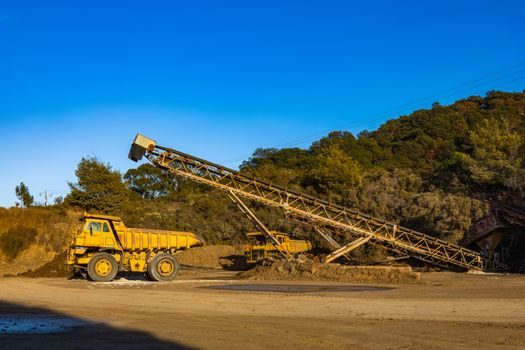
Dump-truck hydraulics are simple: a single front- or under-body telescopic hoist cylinder, typically rated around 100–200 bar, lifting the body to a 45–55° dump angle. The cycle is gravity — material leaves the body as the floor pitches past its angle of repose. There is no pumping pressure in the spec sheet. [S3]
A truck-mounted concrete pump's hydraulic envelope is several orders of magnitude more demanding. The CIFA K38L is rated at 160 m³/h output (5,650.3 ft³/h) and 53–80 bar (768.7–1,160.3 psi) pumping pressure, with multi-stage differential cylinders driving concrete through the boom pipeline [S2]. The boom itself runs on proportional hydraulics for slewing, luffing, and section articulation. A concrete pump truck operator's daily limits are boom reach, pipeline wear, and concrete-slump behaviour — not body-tip angle.
Daily Throughput and Cycle Time
On a quarry-to-site haul, a single 6×4 dump truck typically runs 8–14 loads per 10-hour shift at 20–40 minutes per cycle (load, haul, dump, return). Throughput is tonne-kilometres, governed by payload × trips × haul distance. [S4]
On a high-rise pour, a 50 m-class boom pump places 80–160 m³/h continuously, often 600–1,000 m³ per shift when supplied by a steady feed of concrete mixer trucks. The pump truck does not haul the mix; it places what the mixer trucks deliver. Substituting one for the other is the single most common spec error on mid-rise builds.
Selection Criteria: Which Asset Fits the Scope
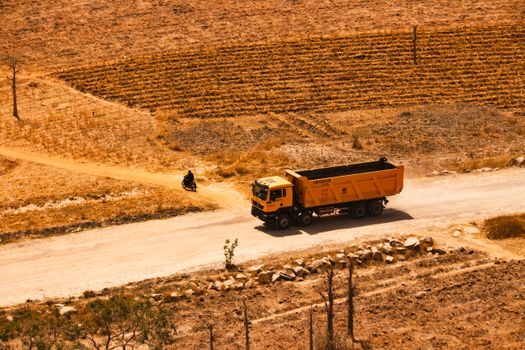
Pick a dump truck when the work is bulk haul over distance — earthworks, aggregate supply, quarry-to-plant, demolition muck-away. The decision criteria are payload (tonnes), body volume (m³), tip-cycle time, and on/off-road duty cycle. On a 2026 fleet-buy, the dump truck line-up is usually a multi-unit volume play. [S5]
Pick a truck-mounted concrete pump when the work is vertical or constrained-site concrete placement — high-rise cores, bridge decks, tunnel portals, foundations in tight footprints. Decision criteria are boom reach (m), pumping pressure (bar), output (m³/h), and ability to feed the boom with mixer trucks. The XCMG HB56's 55.7 m reach and the CIFA K38L's 160 m³/h / 80 bar envelope bracket the operating envelope that most 2026 mid-to-high-rise pours actually need [S2][S4]. For Chinese-market sourcing, SANY, XCMG, Zoomlion, Shantui and Lovol dominate the active product index [S4].
Limitations, Failure Modes and Misuse
Dump-truck failure modes are body wear, hoist-cylinder seal failure, tipping-cylinder overload on uneven ground, and chassis-frame cracking from off-road cycles. For a mining-class unit, the dominant failure is the dump-body floor and tires — a mining dump truck spec'd to haul coal will fail prematurely in hard-rock shot-rock service. [S6]
Concrete-pump truck failure modes are pipeline blockages, boom-section pin wear, S-valve wear-ring replacement, and hopper grate overload from oversize aggregate. A boom pump asked to handle 63-mm minus mix when the line is plumbed for 40-mm will choke. A dump truck asked to place concrete directly will simply not — the body is not air- or watertight, and the tip-cycle is too slow to maintain a continuous pour.
Standards, Sourcing and the 2026 Market Signal
Both classes are governed by on-road type approval for the carrier chassis (country-specific GVW and axle-load rules), with the dump body and the pump/boom module each carrying their own CE or equivalent conformity for the working equipment. The 2026 truck-mounted concrete pump market is tracked as a distinct segment from stationary and specialized concrete pumps, with forecast horizons to 2034 covering industrial, commercial, and domestic verticals [S6]. Active 2026 manufacturer lists include SANY, XCMG, SCHWING, CIFA, and Henan's YCZG, with chassis most commonly configured as mobile, loader-fed, or trailer-mounted variants [S1].
Trackable signals through the rest of 2026: the boom-reach ceiling keeps climbing (XCMG's HB56 at 55.7 m is a reference point, not a ceiling [S4]), while CIFA's K38L-class 38 m machines remain the workhorse for mid-rise urban pours where 6×4 manoeuvrability outweighs raw reach [S2]. A fleet running 6×4 dump trucks for aggregate haul and a 38–56 m boom pump for placement is the standard 2026 mid-to-large-site pairing — they are complements, not alternatives.