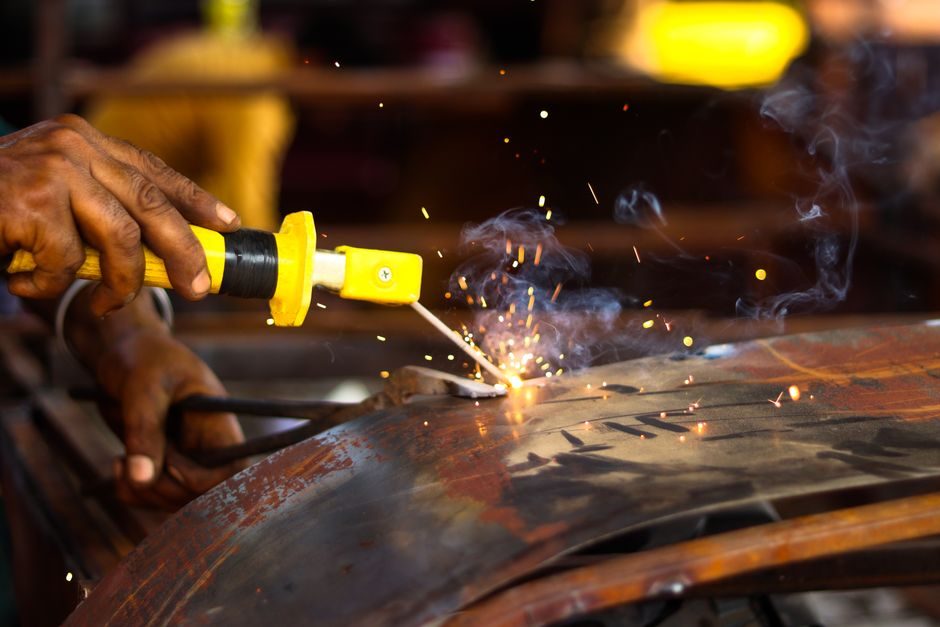
Welding fume is rarely explosive, but it is combustible, and the metallic constituents (chromium, nickel, manganese, amorphous silica) carry GHS hazard codes H317, H350 and H372, which sets the detection brief [S1][S2].
Across gas metal arc (GMAW) stainless and flux-cored stainless wire lines, fume composition shifts with the consumable: AWS A5.9 GMAW/GTAW stainless wire decomposes into complex oxides plus carbon monoxide, carbon dioxide, ozone and nitrogen oxides from the arc, so a detector that only flags mass concentration is incomplete [S2].
What a dust detector on a welding cell actually has to do
The instrument is not just a filter-loading gauge. On a welding bay it has to (1) confirm capture at the source hood or extractor arm, (2) flag combustible-dust accumulation in ductwork before transport velocity drops, and (3) sense a hot spark that survived the spark arrestor before it reaches the filter cartridges [S3].
A dust accumulation sensor mounted on the isolation valve of the dust collector is a practical early warning: it tells maintenance that dust is bridging between scheduled inspections, not after a filter goes into fire mode [S3]. Process-grade particulate monitors such as the DT400G family combine a converter, detector head and integral sensor in one housing and are used as in-stack solid-in-gas detectors on collector outlets [S5]. For background on generic instrument classes, see the dust detector reference page and the dust particle meter entry, which separate point optical/laser scattering sensors from full process analysers.
Welding-specific hazards the detector must respond to
Stainless steel and flux-cored stainless wire fume is classified as GHS Skin Sens. 1 (H317), Carc. 1B (H350) and STOT RE 1 (H372), which means the detector does not just protect equipment, it also drives the engineering case for keeping airborne respirable mass and PM2.5 below occupational exposure limits [S1]. A 2025 occupational study of welding sites confirms PM2.5 and respirable dust as the two metrics that correlate with adverse worker outcomes, which is why photometric or gravimetric reference methods are preferred over simple optical particle counters when exposure assessment matters [S6].
Weld fume is combustible even where it is not explosive, and the dominant ignition vector is the spark that survives transport. AWS Welding Digest practice is to pair spark arrestance with a smoke detector and an appropriate fire-suppression system on the collector, and to opt for a centrifugal spark-arrestor stage where the operation produces a large number of sparks [S4]. On the operator side, capture velocity at the fume arm or hood has to be high enough to draw fume but low enough not to strip shielding gas off the arc [S3].
Sensor type vs. duty cycle: which technology fits

Three sensor families dominate welding-bay dust detection, and the choice is set by what you want to know. Inductively coupled or scattered-light point sensors (typical DT400G-class instruments) read mg/m³ in-stack on the collector outlet and are suited to trend monitoring and filter-loading alarm [S5]. Smoke/heat detection at the collector cabinet is a separate layer: AWS guidance specifically calls out a smoke detector plus fire suppression as a baseline, plus air-stream temperature monitoring where IoT is available [S3][S4].
A detect-and-suppress loop with a spark sensor plus water-mist injector is the third layer, used where spark loading is high, for example heavy fabrication, rail or structural welding [S4]. For worker exposure assessment rather than equipment protection, a dust particle meter sized for PM2.5 and respirable fraction is the correct class; for ambient breathing-zone screening on a different shift pattern, the gas detector family is needed in parallel to catch ozone, NOₓ and carbon monoxide, which a particulate-only sensor cannot see [S2].
Selection criteria engineers should run through
Run a four-criteria comparison before you buy: (1) measurement target, (2) mounting location, (3) ignition-risk environment, (4) data output to the plant SCADA or BMS. A point particulate sensor at the collector outlet scores well on (1) for filter management, weak on (4) unless it ships with 4-20 mA or Modbus. A smoke/heat detector on the cabinet scores high on (3) but reads nothing about worker exposure. A spark detect-and-suppress unit scores high on (3) for high-spark operations and is poor at quantifying fume mass. A breathing-zone PM2.5 monitor scores high on (1) for hygienist-grade exposure data but cannot trigger collector shutdown on its own [S3][S4][S6].
Welding-specific tuning beats generic datasheet specs. Set alarm thresholds from the SDS hazard statements of the actual consumable in use, not from a generic combustible-dust default: a cell running 308L stainless needs tighter chromium and nickel tracing than a cell running mild-steel solid wire [S1][S2].
What a dust detector cannot do for you
No sensor in this category replaces duct-velocity management. If transport velocity falls below the minimum for the dust being moved, material settles in horizontal duct runs and creates a smouldering layer that a downstream sensor will only see after ignition; the right fix is ductwork redesign or compressed-air pulsing, not another detector [S3]. Optical smoke sensors inside the cabinet can also miss a slow oxidative event in filter cake, which is why temperature trending on the air stream is the better early indicator in modern IoT-equipped collectors [S3].
Particulate sensors also do not see the gaseous arc products (CO, CO₂, ozone, NOₓ) or the amorphous silica fraction separately, so any risk assessment that uses particulate data alone understates the H350 carcinogen exposure for stainless consumables [S2][S6]. Pair the dust detector with a discrete oxygen detector or a multi-gas gas detector in confined-space welding to close the gas-phase gap, and add a dust mask programme for the operator regardless of the sensor reading.
Sourcing and standards to anchor the spec
Anchor the spec to the safety data sheet of the actual consumable in use. SDS for AWS A5.9 stainless wire (Harris Products Group E308LT/E316LT series and the Airgas Radnor A5.9 GMAW/GTAW stainless range) explicitly lists Skin Sens. 1, Carc. 1B and STOT RE 1 as the GHS outcomes, and the ACGIH capture-velocity guidance governs the air-engineering side of the installation [S1][S2][S3]. OSHA Hazard Communication 29 CFR 1910.1200 is the US compliance backbone for the SDS chain, and ISO 11014-1 / ANSI Z400.1 define the SDS format that the supplier will hand you [S2].
Two follow-on signals are worth tracking: revision dates on AWS A5.9 consumable SDS sheets (a new alloy in the wire range can shift the chromium and nickel fume profile), and updates to the ACGIH industrial-ventilation manual that drive capture-velocity setpoints for welding hoods. Either change will reset the alarm thresholds on the dust detector without you buying new hardware.
Related analysis: Power Mixer Selection for Road Maintenance: Spec Map.