
Work at height changes the oxygen-detection problem from a pure gas-dispersion question into a four-way trade between sensor mounting, sample-line adsorption, drop survival and compliance with BS EN 60079-29-2 / IEC 60079-29-2:2015 [S5].
The first hardware fact that drives every later choice is molecular weight: O2 sits at 32.0 g/mol against fresh air at 28.9, which puts a "near eye level / 48–60 inches" band on the standard mounting chart for O2 monitoring [S2]. That band is the same band a worker at height breathes through — so the sensor head, not the belt clip, has to be inside that envelope.
What "work at height" actually changes in the spec
Working above grade forces three design moves that a floor-level job does not: (1) the sensor is no longer strapped to the user's chest pocket, it is at the end of a boom, harness lanyard or sample line; (2) any drop is onto steel grating, concrete deck or rebar, not carpet; (3) the worker's breathing zone is offset from the unit's display, so a remote alarm is mandatory, not optional. [S3]
The portable-class reference drop test on the Figaro TGS4260 lead-free oxygen sensor drops the assembled portable detector 2 m onto a concrete plate for 30 impacts and checks response from 100 vol% N2 back to standard air, which is the kind of abuse a 6 m ladder drop or a scaffold mishap reproduces at full scale [S3]. Any unit spec'd for work at height should publish an equivalent drop test number, otherwise the rating is hand-waving.
Sensor mounting height by gas — with oxygen as the reference
The published gas mounting chart [S2] places O2 in the "eye level: 48–60 inches (122–152 cm)" band, which matches the EPA CO guidance of ~5 ft and reflects that O2 is only marginally lighter than air (molecular weight 15.9 vs the chart's reference 28.9, with the apparent contradiction resolved by the use of fresh-air molecular weight 28.9 as the comparator and by convective behaviour in real rooms) [S2]. The implication for work at height: an oxygen-deficiency sensor in a man-basket should be clipped to the basket rail at chest height, not on the boom head, because the worker is the oxygen sink.
For comparison the same chart places CO2, H2S, SO2, propane and most refrigerants at 12–18 in (30–46 cm) above floor, and NH3, H2, He, methane and N2 near the ceiling — which is why a single multi-gas cart used at the base of a tower is useless for a worker 8 m up unless the sample line is short and the pump is on the user's belt.
Sample-line adsorption: the silent failure mode
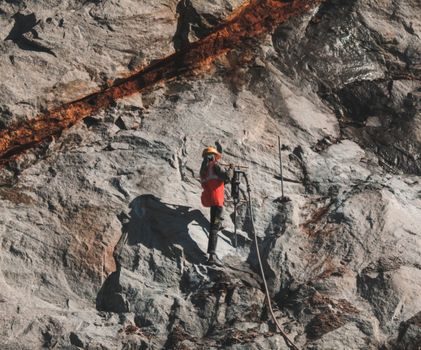
UK HSE bulletin CEMHD1-2020 documents a fatal incident in which a pumped gas detector with an extended sample tube failed to alarm on a flammable vapour; laboratory testing at 50% LEL showed the time to first non-zero reading was extended by more than 1 minute, and the time to reach 90% of final reading was over 15 minutes because the vapour adsorbed on the inner surface of the sample tube [S1]. The detector itself met its manufacturer's spec; the failure was the tube.
The transfer function to oxygen work at height is direct: an O2 sensor on a long PTFE or polyurethane sample line at sub-ambient flow can be slow to alarm on an O2-deficient atmosphere in the same way, especially if the line is wet or has been used with reactive gases. The defensible mitigations are (a) keep sample line ≤ 3 m where possible, (b) use low-adsorption tubing (FEP, PTFE, dedicated low-adsorption EPDM) and verify the line's response time at 50% LEL equivalent, and (c) add a remote pre-filter and water trap only if their dwell time is short relative to the alarm trip delay [S1].
Compliance placement rules (BS EN 60079-29-2 / IEC 60079-29-2:2015)
BS EN 60079-29-2:2007 and its successor IEC 60079-29-2:2015 are the recognised guide for selection, installation, use and maintenance of combustible-gas and oxygen detectors, and the widely cited BS EN 50073:1999 rule summarised by Crowcon is that "sensors should be located in positions determined by those who have knowledge of gas dispersion, the process and the plant" [S5]. For work at height, that means the person with the gas-dispersion knowledge — typically a process or HSE engineer — should sign off the basket-rail or harness mounting point, not the scaffolding supervisor.
For a process-side fixed reference, industrial units such as the EC920 / EC930 oxygen analyser are published at NEMA 4X / IP66 ingress, 15.5 kg weight, 380 mm × 160 mm × 460 mm dimensions and are intended for permanent gas-analysis duty rather than harness use [S4]; treat them as a baseline for the IP rating, weight envelope and warm-up behaviour that a portable-derived work-at-height unit should equal or exceed.
Selection criteria table: how the main options line up
The four options a specifier actually chooses between for work at height, lined up against the four criteria the standard implicitly calls out (drop survival, sample path, mounting envelope, compliance), are: [S2]
1. Compact portable (clip-on): best drop survival and smallest sample path; weakest compliance paperwork because it relies on the user's harness mounting. Typical drop spec 2 m onto concrete, 30 impacts, with response verified from 100 vol% N2 [S3].
2. Belt-mounted pumped with 1–3 m sample line: best combination of remote sampling and alarm unit ergonomics; the adsorption risk documented in [S1] applies in direct proportion to line length and reactivity of any previously sampled gas.
3. Fixed / process-grade analyser (e.g. EC920-class) mounted on the platform: highest IP / lowest compliance risk, but weight ~15.5 kg and footprint 380 × 160 × 460 mm rule out harness use and require mechanical mounting on a stable deck [S4].
4. Hybrid (harness-mounted head with belt-mounted pump and display): combines a 2 m-class drop-rated sensor head with a short sample line; emerging choice for IWELD and man-basket work but has the least published test data, so require a vendor drop test certificate per [S3] before acceptance.
Who this is — and is not — for
This spec map is for anyone buying or specifying a portable or semi-portable oxygen detector where the worker is off the ground on a scaffold, mast, man-basket, MEWP, ladder or rope-access seat — typically chemical, oil & gas, welding, tank cleaning and maintenance crews. It is NOT for fixed in-line O2 analysers on a process pipe (use process-grade units like the EC920-class [S4] with no harness requirement), and it is NOT for ambient CO monitoring in occupied buildings (use the EPA 5 ft / bedroom / every-floor CO layout from [S2] instead).
Operators who only need a single-gas O2 deficiency alarm in a pit or shaft, with no height offset, should default to a four-gas confined-space monitor instead — the trade-off on trip levels, sensor cross-sensitivity and pre-entry bump test gates is laid out in Confined Space Oxygen Detector: 4-Gas Spec Map and Selection Gates, and the mining variant with its methane-and-oxygen pairing is covered in Oxygen Detector Spec Map for Mining: Sensor Tech, Placement, Compliance.
Limits, failure modes and what to verify on receipt
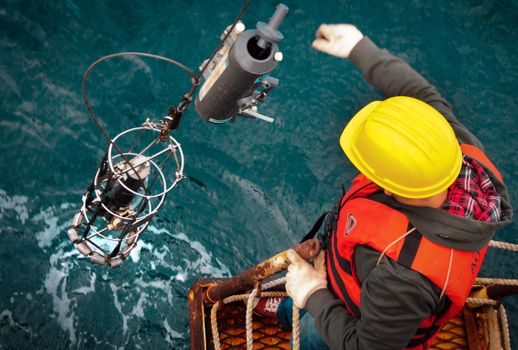
The published failure modes that should be on the acceptance test sheet are: sample-line adsorption delay (verify response time at 50% LEL or 18.0 vol% O2, whichever is the more conservative trip), drop impact (verify the 2 m / 30-impact figure, not "industrial grade"), pump stall on a kinked line, and sensor warm-up drift on a cold morning (TGS4260 specifies a 60-second power-on delay before response is within spec [S3]).
The hard limits to refuse on a submittal: any portable O2 unit with no published drop height, any sample line longer than 5 m without a published adsorption test for the gases in the work permit, and any mounting solution that places the sensor head outside the 48–60 in eye-level band from [S2]. For process-side reference the lower bound on environmental sealing is NEMA 4X / IP66 as published on the EC920 [S4], and the placement rule from [S5] is that the gas-dispersion-knowledgeable engineer — not the equipment vendor — picks the final sensor coordinates.
Trackable signals for the next buying cycle: harmonisation of BS EN 60079-29-2 and IEC 60079-29-2:2015 into a single cited standard in tender documents, the publication of low-adsorption sample-line response data by the major portable-detector vendors, and any new HSE bulletin triggered by oxygen-specific incidents at height. The two spec pages worth re-checking before any new purchase are the Confined Space Oxygen Detector selection gates for the cross-sensitivity logic and the Oxygen Detector Spec Map for Mining for the methane-paired alternative when the work at height is inside a pit or heading.
For component-level specifications, see height gauge, and aerial work platform.