
Dust masks and safety gloves sit in the same PPE procurement bucket but guard different exposure routes: airborne particulates versus skin, cut, chemical and thermal contact. Three China-based manufacturer listings on Made-in-China (2026-04-29, 2026-06-24) treat them as parallel product families — Shanghai Geniu Safety's main line-up lists work gloves, safety gloves and industrial PPE as a single category [S1], while Xi'an Personal Protective Equipment Co. bundles gas masks, electrically insulated gloves, safety harnets and dust masks under one catalogue with a 5.0/5 supplier rating [S3].
Respiratory masks are sold on Alibaba under a dedicated "safety dust mask respirator" category (2026-06-04), with consumer-pack disposables — including a 5-ply disposable face mask in a 20-pack format — listed on Amazon's Tools & Home Improvement safety-mask aisle (2026-06-07) [S2][S4]. The two product streams rarely cross-sell: respirators target inhalation exposure, gloves target dermal and mechanical exposure, and most site safety regimes spec them independently.
What Each Item Actually Protects Against
A dust mask is a respiratory PPE device covering the nose and mouth to filter airborne particulates — dust, mists and the like — typically built from non-woven melt-blown filter media layered between spun-bond facing layers. The basic component set on industrial respirators includes a facepiece, an exhalation valve on premium models, and adjustable straps; gas-mask variants add a filter canister and connecting hose [S6]. The hazard scope is the inhalation route only: particulates, droplets and, in canister-equipped units, specific gas/vapour families.
Safety gloves protect the hand and forearm. The product family covers cut-resistant, chemical-resistant, arc-flash, electrically insulated, rubber-coated and ergonomic-handle gloves [S1][S3]. Hazard scope is the dermal and mechanical route: cuts, abrasions, chemical splash, thermal burn, electrical contact and vibration. Selection pivots on EN 388 mechanical-rating digits and on permeation data for chemical handling — that is the part of the spec sheet that matters, not the brand logo.
Respiratory PPE and hand PPE are complementary, not substitutes. On a chemical-handling task with splash risk, both are worn together; on a purely dust-laden grinding job, only the respirator is mandatory; on a live-electrical task, the gloves are mandatory and the respirator is optional. The two products address different OSHA/EN hazard classes and are stocked separately by safety distributors [S1][S2][S3].
Spec Classes: FFP for Masks, EN 388 / EN 374 for Gloves
Disposable respirators in the European system are graded FFP1, FFP2 and FFP3 by filtration efficiency, with FFP2 the common minimum for healthcare and construction dust [S2][S4]. N95 / KN95 is the comparable US/China filter class (≥95% filtration of 0.3 µm particles) and is the spec most often quoted in the Alibaba and Amazon listings reviewed (2026-04 to 2026-06) [S2][S4]. Reusable half-mask and full-face respirators with replaceable cartridge filters are the step up for higher-dust environments and for gas/vapour exposure; Xi'an Personal Protective Equipment lists "gas mask" and "respirator" as separate catalogue entries with claimed ANSI/ESD-aligned manufacturing [S3].
Safety gloves are spec'd primarily on EN 388 (mechanical risks: abrasion, cut, tear, puncture) and EN 374 (chemical and micro-organism permeation), with category-III complex-design gloves requiring notified-body certification under EU PPE Regulation 2016/425. Electrically insulated gloves — a distinct sub-family — are class-rated for voltage exposure up to class 0 (1 kV) through class 4 (36 kV) on the common IEC 60903 framework, and Xi'an PPE lists "insulated gloves" alongside its "dust mask" line, indicating both are stocked as specialist items rather than commodity disposables [S3].
Fit and reuse also differ. Disposable filtering facepiece respirators are typically rated for one shift (around 8 hours) in dust environments, while reusable half-masks accept replaceable P1/P2/P3 particulate or ABEK gas cartridges with a defined service life. Gloves are similarly shift-limited for chemical permeation work, but many mechanical-handling gloves are reusable until the coating is breached — there is no equivalent cartridge change, just visual inspection.
Material and Construction Comparison

Dust mask construction: 3 to 5 layers of polypropylene non-woven — outer spun-bond, intermediate melt-blown filter (the electrostatic layer that captures sub-micron particles), inner comfort layer. The 5-ply disposable mask format shown on Amazon's 20-pack listing is a typical construction for the consumer/general-industry tier, with adjustable nose wire and elastic ear loops [S4]. Premium respirators add an exhalation valve to reduce heat build-up inside the facepiece — useful in hot, humid work but unsuitable for sterile/surgical fields because valve exhaust is unfiltered.
Safety glove construction varies by hazard class. Cut-resistant gloves use HPPE (high-performance polyethylene) or steel/fibreglass knit, often with a polyurethane or nitrile palm coating for grip; chemical-resistant gloves use nitrile, neoprene, butyl or natural rubber at thicknesses from 0.3 mm (splash) to 1.2 mm (immersion); arc-flash gloves use flame-resistant treated leather or Nomex; electrically insulated gloves use natural rubber with a voltage-class label and a leather over-protector [S1][S3]. The material and gauge are the actual selection levers — the spec sheet, not the marketing photo, is what to compare.
On a criteria-based comparison, dust masks and safety gloves diverge sharply: dust masks have a single dominant filter medium (melt-blown PP, graded by FFP/N/KN class), while safety gloves have at least four material families (HPPE, nitrile, rubber, treated leather) selected by hazard. Filtration efficiency is the mask's single number; cut, abrasion, tear and puncture are four independent EN 388 digits for the glove.
Selection Criteria: Match the Hazard, Not the Catalogue
For dust exposure: choose FFP2 (Europe) or N95/KN95 (US/China) for general construction and woodworking dust; step up to FFP3 or P3 cartridges for hard-metal welding fume, asbestos abatement (licensed) and similar very-high-dust tasks. Powered air-purifying respirators (PAPR) are the next step for extended-wear or high-exposure industrial hygiene scenarios [S2][S3].
For hand exposure: read the EN 388 four-digit mechanical code, and for chemical work also the EN 374 permeation letter list (which chemicals the glove has been tested against). Cut-resistant work gloves from manufacturers such as Shanghai Geniu Safety cover abrasion, cut and ergonomic-grip use cases [S1]; insulated gloves from Xi'an PPE cover electrical and arc-flash use cases with class-rated voltage protection [S3]. For chemical handling, nitrile is the default for fuels and oils, butyl or Viton for aggressive solvents, and natural rubber for dilute acids and bases — wrong material, wrong PPE.
For combined exposure — paint spraying, pesticide handling, dusty demolition with cut risk — both items are worn and the spec interaction matters: a half-mask with cartridge (not a disposable) is appropriate for solvent vapour, and a chemical-resistant gauntlet (not a thin nitrile examination glove) is appropriate for liquid splash. PPE-on-PPE interference (glove cuff breaking the respirator face seal) is a real-world failure mode and should be checked during fit-testing.
Failure Modes and Common Sourcing Mistakes
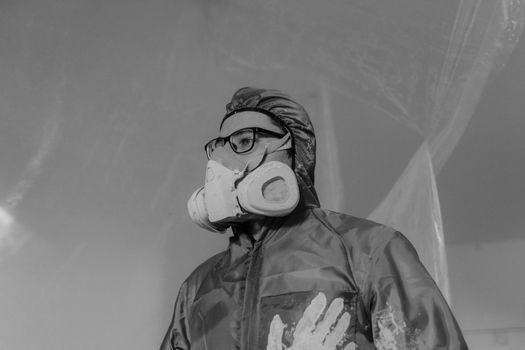
The most common dust-mask failure is wrong-class selection: an FFP1 / N95 disposable is sometimes issued where an FFP3 or PAPR is required by the exposure assessment. Fit-testing is mandatory under OSHA 29 CFR 1910.134 for tight-fitting respirators — facial hair under the face seal degrades fit factor dramatically. On Alibaba and Made-in-China, the filtration class is the only number worth checking; the brand name is not [S2][S3].
The most common glove failure is using a general-purpose mechanical glove where a chemical-rated glove is required, or substituting a thin nitrile examination glove for a heavier chemical-handling gauntlet. Permeation breakthrough time is the spec to compare — some chemicals pass through nitrile in under 30 minutes, and a glove that "feels fine" is already breached. EN 388 cut scores and EN 374 permeation tables are the verifiable numbers, not the price tier [S1].
Procurement-side mistakes include: (1) buying a kit-style "girl's safety kit" with a fashion dust mask and rubber gloves — sold on eBay at US $13.50 plus shipping [S5] — that has no FFP rating, no EN 388 code and is not industrial PPE; (2) specifying FFP3 and class-4 insulating gloves together as a "premium" bundle regardless of the actual hazard assessment, which adds cost without adding safety; and (3) skipping fit-testing on the respirator, which voids the spec regardless of mask class.
Cost and Lead-Time Bands from Active Listings
Disposable dust masks on Alibaba's "safety dust mask respirator" category (2026-06-04) and Amazon Canada's 20-pack 5-ply listing (2026-06-07) cluster in the consumer/light-industrial price tier, with unit pricing dependent on order volume and filter class [S2][S4]. Reusable half-mask respirators with replaceable cartridges are a step up in unit cost but lower in cost-per-wear when cartridges are reused across shifts [S3].
Safety glove pricing varies similarly by spec: coated mechanical work gloves are a commodity item with low per-pair cost, while cut-resistant HPPE, arc-flash and class-rated electrical-insulation gloves carry a 5-10x premium tied to the EN 388 cut score and the voltage class [S1][S3]. For electrical-insulation work, the IEC 60903 voltage class — not the gauge — is the line item that drives price. Minimum-order-quantity on Alibaba and Made-in-China typically runs 100-1000 pairs for coated work gloves, with full-container orders for OEM-branded industrial PPE.
Lead time for catalogue items (unbranded FFP2 disposables, standard nitrile-coated work gloves) out of Shanghai and Xi'an is typically 15-30 days for a stocked item and 30-60 days for OEM-branded or custom-spec orders, per the supplier profile data on the Made-in-China listings [S1][S3]. Plan accordingly — last-minute PPE procurement for a plant turnaround is the classic way to overpay for the wrong spec.
Sourcing, Standards and Verifiable Spec Checks

Spec checks that should appear on every quote: (1) for dust masks — the FFP1/2/3 or N95/KN95/KN100 class, the EN 149 / GB 2626 / NIOSH-42CFR84 certification number, and the type (with or without valve); (2) for safety gloves — the EN 388 four-digit mechanical code, the EN 374 letter-coded chemical permeation list, and for electrical work the IEC 60903 voltage class [S3]. Without those numbers, the quote is a marketing claim, not a spec.
Active manufacturer sources reviewed in the past six months: Shanghai Geniu Safety Co., Ltd. (Shanghai, work gloves and industrial PPE, Made-in-China, 2026-04-29) [S1]; Xi'an Personal Protective Equipment Co., Ltd. (Shaanxi, gas mask, insulated gloves, dust mask, Made-in-China, 2026-06-24) [S3]; Alibaba's "safety dust mask respirator" sub-category (2026-06-04) [S2]; Amazon Canada's safety-mask aisle (2026-06-07) [S4]. The dust mask and safety gloves product families are listed in parallel on each of these catalogues rather than as a single bundle — that mirrors how the spec regimes treat them: separate exposure routes, separate test standards, separate procurement lines.
For full plant PPE reviews, the dust mask and safety gloves lines should be cross-checked against the dust detector or dust particle meter measurements that justified them — exposure assessment drives the spec, the catalogue does not. Where physical segregation or barrier controls are being considered alongside PPE, the safety barrier and safety fence options sit at the engineering-control layer above the respirator and glove.
For related coverage, see Desalination Production Technology: RO, MSF, MED, ED, Hydrate Routes Compared.
