
A lithium-ion upgrade for an electric pallet truck can cost $8,000 to more than $20,000, compared with $2,000 to $6,000 for a lead-acid replacement, but the decision depends on charge time, service life, labor, and energy use [S5].
For multi-shift operations, lithium-ion generally offers stronger lifetime economics because it charges in 1–3 hours, requires no watering, and can deliver 2,000–3,000+ cycles versus 500–1,500 cycles for lead-acid [S1][S3][S5].
Initial Battery and Retrofit Cost
Published replacement ranges put a lead-acid traction battery at $2,000–$6,000 installed and a comparable lithium-ion pack at $8,000–$20,000+, with voltage, amp-hour capacity, and chemistry determining the final price [S5]. The typical installed replacement range is $2,000–$6,000 for a lead-acid traction battery and $8,000–$20,000+ for a comparable lithium-ion pack, depending on voltage, capacity, and chemistry [S5].
These figures apply to electric industrial material-handling batteries broadly, so a small electric pallet truck may cost less than a larger ride-on unit. Obtain a quote against the truck’s stated voltage, amp-hour rating, connector configuration, charger type, and battery tray dimensions rather than applying a generic pack price.
A lithium conversion is not always a battery-only purchase. Confirm that the charger is lithium-compatible, that the battery management system communicates with the truck or charger where required, and that the enclosure, terminal, and cable arrangement are approved for the specific conversion. A like-for-like lead-acid replacement can be economical when the existing charging room and maintenance process are already adequate [S2][S4].
Charge Time, Availability, and Labor
Lead-acid charging typically takes 8–10 hours, with a cooling period before use, while lithium batteries can charge in 1–3 hours and remain ready for immediate deployment [S1]. A broader industrial comparison places full-charge time at 8–16 hours for lead-acid and 1–2 hours for lithium-ion [S5].
The operating difference is larger than the charger rating alone. A lead-acid fleet can follow an 8-hour work, 8-hour charge, and 8-hour cooling cycle, whereas lithium supports short top-ups during breaks and can cover multiple shifts with brief opportunity charges [S2][S4].
Lead-acid also requires water additions, equalization, ventilation, and controlled charging, whereas sealed lithium-ion removes the watering schedule and off-gassing routine [S2][S5]. For an electric pallet truck, calculate labor at three levels: operator time spent charging, maintenance time watering and servicing cells, and production time lost while a depleted truck waits for service.
Cycle Life and Replacement Frequency

Well-maintained lead-acid batteries typically provide about 1,500 usable charge cycles, while lithium-ion is commonly specified at 2,000–3,000 cycles [S5]. Other material-handling comparisons cite 500–1,000 cycles for lead-acid and 2,000–3,000+ for lithium [S1], while one fleet model uses approximately 4,500 lithium cycles over 8 years [S4].
The cycle figures are operating estimates, not guarantees. Depth of discharge, charging discipline, temperature, charger quality, and maintenance affect actual life.
Use actual shift demand to determine replacement timing. A truck that completes one shift per day may run out lead-acid life after several years, but a high-throughput operation can consume replacement cycles faster. A documented five-year ownership calculation should include the pack, charger, freight, installation, disposal, maintenance, electricity, and every planned replacement [S5].
Five-Year Total Cost Comparison
A well-maintained lead-acid battery provides approximately 1,500 usable charge cycles [S5].
The table ranges are not a universal quote. A separate calculation found that lithium draws about 30% less electricity than lead-acid [S5], but charger losses, electricity tariffs, duty cycle, and runtime will change the actual saving.
Which Option Fits the Operating Profile
Lead-acid is usually the stronger economic choice for single-shift fleets with predictable use, idle charging time, an existing staffed battery room, and a tight capital budget [S4]. It remains practical where the truck is near the end of its mechanical life, because the lower purchase price limits stranded battery investment [S5].
Lithium-ion is usually stronger for multi-shift or 24/7 operations, short breaks that permit opportunity charging, labor-intensive battery rooms, limited charging space, or fleets sensitive to mid-shift truck downtime [S2][S4]. It is also the better fit where consistent output, diagnostics, or automated charging matter; automation further favors lithium because dependable charging and predictable power reduce dependence on manual battery handling [S4].
Do not choose lithium solely to solve a truck defect. If runtime is inadequate, first verify battery condition, charger operation, tire condition, load profile, and actual shift consumption. A reconditioned lead-acid core can cost up to 50% less than new and recover as much as 85% of original capacity, making it a bridge for a truck approaching retirement rather than a long-term substitute for a healthy battery [S5].
Charging Safety, Ventilation, and Compatibility
Lead-acid charging requires proper ventilation and a dedicated cool-down period, while lithium-ion removes routine watering and off-gassing tasks but still requires charger and battery-management compatibility [S1][S2]. The battery-management system controls temperature, voltage, and charging status, so an electrically matched pack is not automatically a safe or functional conversion [S1].
Facilities must also account for charging-bay ventilation, floor protection, emergency procedures, cable routing, and the physical footprint of chargers and batteries. OSHA 1910.178(g) governs facilities and procedures for care and charging of industrial trucks, but a site’s battery installation still requires an assessment of the selected charger, chemistry, and manufacturer instructions [S5].
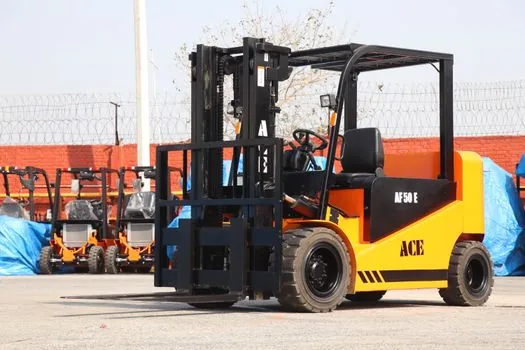
For temperature-sensitive work, specify the minimum operating temperature rather than relying on a generic “cold performance” claim. For automated or remotely managed fleets, confirm communications, charge-interlock behavior, and diagnostic outputs before approval. The blue spot light addresses pedestrian visibility rather than battery charging, so it should be handled as a separate safety decision.
Procurement Method and Break-Even Test

Calculate the decision from net present cost over the truck’s planned service life, not from battery price alone. For each option, subtract battery and charger cost, freight, installation, charger conversion, disposal, planned replacements, electricity, watering labor, maintenance labor, and downtime [S5].
The practical break-even test is straightforward. Lithium costs $6,000–$14,000+ more at installation in the cited price bands, then earns that premium through shorter charging time, no watering, lower energy use, fewer replacements, and less downtime [S5]. If the truck runs one shift per day and has dedicated charging space, the premium may not be recovered; if it runs two or more shifts, any one avoided charge delay or replacement event can materially change the result.
Request three comparable quotations: new lead-acid with like-for-like charger service, reconditioned lead-acid where capacity testing is accepted, and lithium-ion with charger, installation, warranty, and disposal priced. Record expected cycles, daily runtime, electricity rate, labor rate, and charger availability in the comparison, then review actual operating data after 90 days.