
A two-stage duplex mast typically covers 2.5–3.5 m lift heights, while a three-stage triplex mast commonly reaches 3.5–5.0 m with a similarly compact lowered envelope.
The decision depends on rack elevation, doorway and container clearance, free lift, residual load capacity, visibility, and the mechanical complexity acceptable for the pallet stacker.
Duplex and triplex definitions and selection criteria
A duplex mast has 2 lifting stages, while a triplex mast has 3. The additional stage compresses the vertical reach requirement into a lower collapsed mast, making triplex practical where high storage and restricted entry clearance occur together [S1][S3].
For one electric stacker example, a 1,500 kg load capacity and 500 mm load center are paired with a duplex mast, a 2,500–3,500 mm lift-height range, an overall height of approximately 2,250 mm, and 1,070 mm fork length [S3]. These are model examples, not universal ratings.
Specify four dimensions together: maximum fork height, overall lowered height, free fork height, and overall raised height. Maximum fork height alone can conceal an unusable doorway clearance or an overhead obstruction [S4].
Explicit comparison for procurement decisions
For lift capacity and route fit, a duplex mast has two stages, a simpler structure, slightly better visibility, and often lower cost, whereas a triplex mast has three stages, greater lift reach, a more compact collapsed height, greater complexity, and usually higher cost [S5].
Visibility and maintenance burden also favor duplex because fewer moving sections reduce structural complexity and can preserve a more open forward view. Triplex trades that simplicity for reach and route flexibility, with more cylinders, chains, rails, and interlocks to inspect and maintain [S1][S5].
Use this rule: specify duplex when the required lift is at or below the lower rack elevation and route clearance is comfortable. Specify triplex when upper rack levels exceed the duplex range, or when low entry points must coexist with lift heights approaching 5,000 mm [S3][S6].
Where each mast fits the operating task

A duplex mast fits standard warehouse racks, cross-docking, double stacking, and moderate-height truck or yard work. A triplex mast fits high-bay racking, multi-level storage, container handling, and sites combining 4,000–5,000 mm placement heights with doors, trailers, or containers that restrict total vehicle height [S1][S2].
For a rack with 1.0 m, 2.5 m, and 3.0 m loading positions, a 3,000 mm duplex stacker may be sufficient.
Do not assume every duplex or triplex design offers identical free lift. Free lift is the distance the forks can rise before the mast sections increase overall truck height, making it decisive inside trailers, shipping containers, and low-roof spaces [S4][S7].
Clearance measurements and failure modes
Measure the actual entry envelope before ordering, including the lowest obstruction at doors, canopies, trailers, containers, and transfer points. Include sprinkler pipes, lighting, door tracks, heaters, rack beams, and pallet projection rather than relying on nominal building or container dimensions [S2][S4].
Check overall raised height as well as fork height. The extended mast or load backrest can exceed the fork-supporting surface and conflict with beams, sprinklers, roof structures, or ceiling clearance [S4]. A high nominal lift height therefore does not prove route compatibility.
Verify permitted residual capacity at the actual lift height with the selected forks, load backrest, and attachments. A triplex mast may satisfy the reach requirement yet remain unsuitable if residual capacity, forward visibility, or fully raised height fails the task [S4].
Applicability by equipment and duty cycle
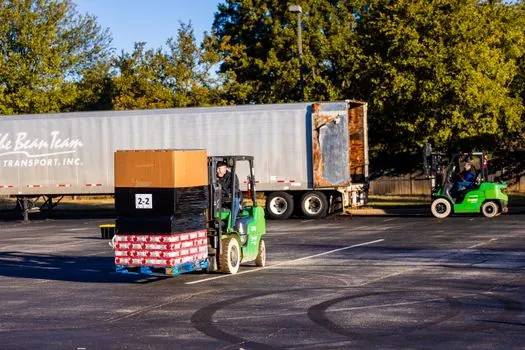
Duplex masts suit operations with moderate rack heights, frequent low-level transfers, and little need for full free lift. Triplex masts suit tall racks combined with constrained overhead access or frequent container-facing work, where the extra stage prevents the mast from becoming the limiting factor [S2][S5][S8].
Triplex is not the automatic choice for every high-lift duty. If the truck works in open yards, ceiling height is unrestricted, and maximum lift remains within duplex capability, the additional stage adds cost and complexity without a corresponding operating benefit [S5].
The structure also affects integration with surrounding equipment. Route planning should include the manual pallet jack or powered handling method used at the rack face, because mast height, fork dimensions, and residual capacity determine whether the truck can place and retrieve the load cleanly.
Supplier data and acceptance checklist
Require a dimensioned drawing and technical data table for the exact truck model, mast option, forks, load backrest, and attachments. Confirm stage count, maximum fork height, overall lowered height, free lift, overall raised height, rated capacity at the required height, and residual capacity [S4].
Manufacturer terminology is not uniform: “duplex” may appear as two-stage, while triplex may appear as three-stage or full-free-lift three-stage. The commercial mast name must therefore lead to a model-specific data table rather than replace one [S4].
Accept the configuration only after a physical route check confirms entry and raised-height clearance, a load trial confirms handling at the target rack level, and the operator confirms acceptable forward visibility. Record the measured clearances against the approved drawing so later truck, rack, or attachment changes can be checked against the same operating envelope [S2][S4].
Before releasing the purchase order, compare three trackable results: fork height at the highest required rack position, residual capacity at that height, and minimum route clearance with the mast fully collapsed. If any one of the three fails, revise the mast or route rather than accepting the stage label as sufficient evidence [S4].