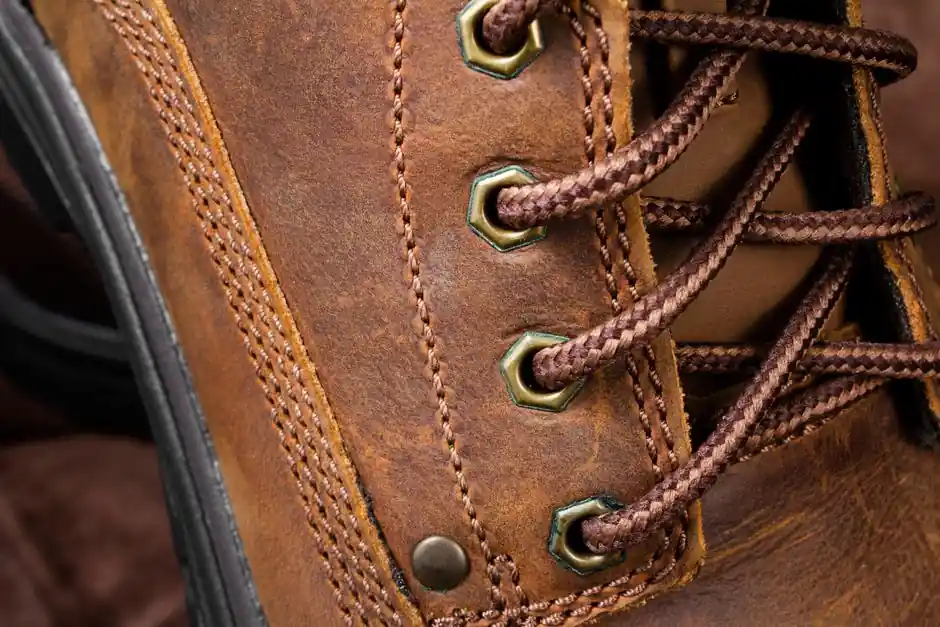
EN ISO 20345:2022 adds two new Class I protection levels, S6 and S7, both requiring whole-shoe water resistance (WR) on top of their S2 or S3 base requirements [S1][S4]. The defining technical change is the move from the older WRU "water-resistant upper material" test to a full-footwear WPA (water penetration and absorption) and WR (water resistance) assessment, meaning the seam and construction are tested, not just the leather [S3][S8].
The 2022 revision expanded the 2011 standard's six classes (SB, S1, S2, S3, S4, S5) to eight main protection levels plus several sub-variants, with S6 and S7 reserved for leather or other-material (Class I) shoes; their rubber-boot equivalents remain in Class II as S4 and S5 [S9]. Since 11 November 2024, new models placed on the EU market are certified to EN ISO 20345:2022, with residual 2011-certified stock permitted to remain in distribution until 2029 [S5].
How S6 and S7 are defined against the older S2 and S3 baselines
S6 is specified as S2 plus whole-footwear water resistance, typically delivered by a waterproof membrane such as GORE-TEX, while S7 is S3 plus the same whole-footwear water-resistance treatment, with S7L and S7S sub-classes for leather and synthetic constructions respectively [S3][S4]. The base S2 and S3 levels still carry WPA performance for the upper, but only the WR-marked S6 and S7 require the seam-and-construction test that proves no water penetrates the finished shoe [S3].
Every S6 and S7 boot inherits the standard SB baseline: a 200 J impact-resistant toe cap, 15 kN compression resistance, closed heel, oil/hydrocarbon-resistant outsole, and heel energy absorption (E) [S5]. S7 additionally requires penetration-resistant midsole protection, split into S7 (general non-metallic or metallic insert), S7L (textile insert, lighter, more flexible, type PL performance) and S7S (metal insert) [S1][S4].
Selection criteria: when to step up from S2/S3 to S6/S7
For indoor, occasionally damp work (warehousing, light logistics, indoor construction) S2 or S3 with WRU-marked uppers remains sufficient and noticeably cheaper, because WRU only proves the leather itself resists water absorption rather than proving the seam keeps water out [S3][S8]. Choose S6 or S7 when the worker stands in surface water, walks through wet concrete pours, works in outdoor utilities, food processing wash-down zones, or any environment where water can pool above the sole line for sustained periods [S5][S6].
Practical selection rule: specify the optional AN (ankle protection) marking for uneven terrain and the HRO (heat-resistant outsole, 300 °C/1 min contact) marking for hot surfaces, both compatible with S6 and S7 base models [S1]. In the 2022 standard, the old SRA/SRB/SRC slip-resistance labels are replaced by a mandatory baseline slip test on ceramic tile with detergent, with SR (glycerin on ceramic) as the optional higher-tier mark [S3].
Comparison matrix: S5 vs S6 vs S7 for wet-environment work
For procurement teams comparing models on paper, the key decision criteria are: construction material class (leather vs full-rubber), required midsole penetration protection, water-resistance scope (upper only vs whole shoe), and target environment [S4][S6]. A side-by-side of the three most common wet-environment choices under EN ISO 20345:2022:
1. Material class: S5 is full-rubber/polymer (Class II), S6 and S7 are leather or other materials (Class I). Rubber boots dominate chemical splash and wastewater work, leather dominates construction and utilities where breathability matters [S3][S4].<br>2. Penetration midsole: S5, S7, S7L and S7S all require it; S6 does not, which makes S6 lighter and more flexible but unsuitable for nail/screw puncture risk [S1][S4].<br>3. Water resistance scope: S5 is implicitly waterproof by virtue of its rubber construction; S6 and S7 must pass the WR whole-shoe test, which S2/S3 do not [S3][S6].<br>4. Cost/lead-time: S6 typically sits between S3 and S7 in price; S7 with metal midsole is often the priciest because of the WR membrane plus metallic insert combination [S1].
This matrix, drawn directly from the 2022 marking logic in [S1][S3][S4], gives a procurement engineer a one-page decision rule instead of reading the full standard text. For related PPE reference, see the [S6] footwear update guide and the lighting equipment and electric lamps entry for site illumination standards in wet outdoor work.
Real use cases where S6 or S7 is the right call, and where it is overkill
Outdoors construction in autumn/winter, road maintenance, rail trackside work, agricultural and fish-processing wash-down lines, utility trenching, and emergency-response flood operations are the canonical use cases the S6/S7 classes were written for [S1][S5]. For these tasks, the WR requirement is not a marketing claim but a defined whole-shoe test, and a single membrane failure on a seam invalidates the certificate [S3].
S6/S7 is overkill for indoor dry warehouses, cleanroom manufacturing, light assembly, retail back-of-house, or any role where the worker only encounters occasional drips. In those environments an S1, S1P, S2 or S3 shoe delivers the same toe-cap and antistatic protection at lower unit cost, lower weight, and with better breathability for an 8-hour shift [S3][S9]. The S7L variant in particular is worth specifying for workers who kneel frequently, because the textile insert tolerates flex better than a steel midsole.
Limitations, failure modes, and what WR does NOT guarantee
WR is a whole-shoe water-resistance test on a new sample; it does not certify the membrane for the full service life of the boot, and abrasion, chemical exposure, or repeated flex at the metatarsal strap can degrade membrane integrity long before the outsole wears out [S3][S8]. S6 and S7 boots should still be retired on a defined inspection cycle, not on outsole wear alone, because a compromised membrane turns a "waterproof" boot into a water-trapping wet liner that increases blister and trench-foot risk.
WR also does not cover chemical permeation: oils, fuels, solvents and some cleaning agents attack both membranes and seam sealants, and the standard does not substitute for chemical-resistant Class II rubber boots (S4/S5) where hydrocarbon splash is the dominant hazard [S4][S5]. The 2022 revision also does not change the antistatic or electrical-resistance requirements, so for electrostatic-discharge-sensitive (ESD) lines, check the separate S1S/ESD marking rather than assuming S6/S7 covers it.
Markings to verify on the label, and traceability signals to track
Every EN ISO 20345:2022-certified shoe must carry the four-digit year (2022) plus the class code and any additional symbol letters: S6, S7, S7L, S7S, WR, WPA, HRO, AN, SR, E, FO (fuel/oil resistant outsole) [S1][S4]. The EU type-examination certificate number, the notified-body four-digit code, and the manufacturer's batch trace are also mandatory; missing any of these is grounds for rejection at goods-in, because the transition period that allowed 2011-labelled stock ended on 11 November 2024 [S5].
Trackable signals for the next 12 months: first, how quickly EU member-state market-surveillance authorities begin publicly citing 2022-only labels as a non-conformity finding; second, whether the S7L textile-midsole variant proliferates beyond premium brands into mid-tier catalogues, which would indicate price compression on WR membranes; third, any official revision or amendment to EN ISO 20345:2022 (an amendment, not a full revision, is the more likely near-term output) and its handling of the WRU-to-WPA transition for legacy S2/S3 stock still on shelves until 2029. For context on how other 2022-vintage PPE standards are rolling out, see the EN 54-5 A1 vs A2 vs B heat detector classes reference.
The underlying component specifications are covered under ballast water treatment, and online water analyzer.