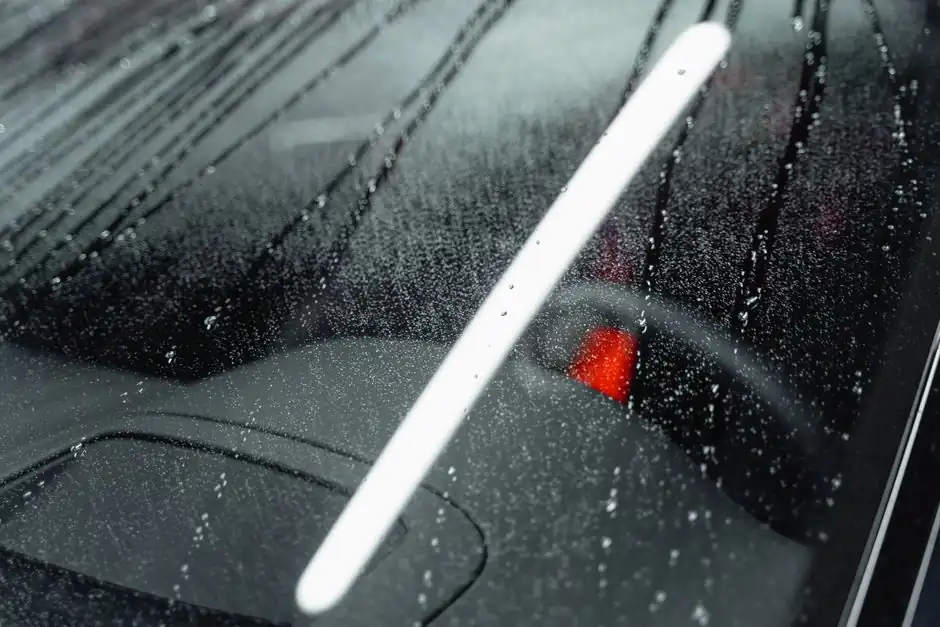
EPDM automotive glass run channels can be electrostatically flocked to meet sealing and quieting needs.
The sealing system guides moving glass inside the door frame, limits water and dust entry, supports climate control, and reduces sound transmission [S1][S2].
EPDM Properties That Control Glass Contact Wear
EPDM is used for automotive glass run channels because it combines weather, UV, and ozone resistance with strong high- and low-temperature performance [S4]. These properties matter because a channel repeatedly contacts the glass edge while the window is raised, lowered, and held at operating positions.
The polymer must retain sealing efficiency and material integrity after aging, while the profile must maintain low friction during glass movement [S1][S2]. Within the wider EPDM rubber family, the useful distinction is not simply weather resistance, but the combined behavior of the compound, contact geometry, and surface treatment.
EPDM is also suitable for extrusion and molding, allowing U-shape, single-flange, or hidden-frame concepts, with inserts, foams, trim, and an optional carrier [S2]. Electrostatic flocking customization is provided to meet the sealing and quieting needs of glass run channels.
Flocked EPDM Versus Coated Rubber Channels
Electrostatic flocking is available as a customization service for glass run channels.
The comparison matters because flocking and continuous coating solve different functional problems. Flocking creates a discontinuous fiber interface and acoustic cushioning, while coating creates a controlled continuous surface for friction, appearance, and aging behavior. Neither treatment replaces correct lip geometry, closing pressure, or drainage [S1].
Why Wear Is a System Failure, Not a Polymer Failure
Glass run channel wear develops through repeated sliding contact, abrasive particles, temperature cycling, and high local friction.
That lower abrasivity does not mean an EPDM channel is wear-proof. Geometry controls normal load, lip contact width, and whether glass edge defects become stress concentrators. Flock or coating selection then changes the friction interface, while drainage and contamination control reduce the severity of the operating environment [S1][S3].
For a robust automotive rubber seal, engineers should evaluate the complete stack: EPDM base, reinforcement or carrier where required, bonding layer, flock or coating, glass contact angle, and the operating temperature and debris conditions. Treating compound hardness or surface treatment as the sole wear criterion misses the dominant mechanical variables.
Thermal, Aging, and Environmental Exposure
Automotive EPDM channels are exposed to sunlight, ozone, temperature changes, water, and repeated glass movement. EPDM sealing profiles are specifically described as retaining sealing efficiency and material integrity over time [S2], while EPDM and TPE channels are offered with anti-aging and extreme-temperature-change resistance [S1].
Available glass run channels include flocked and coated designs, and UV resistance can be customized. These supplier statements define the intended functions, but an OEM validation must reproduce the vehicle-specific load, heat, UV, and water exposure.
Glass run channels also serve as weather seals for trucks, buses, and other automotive applications, so temperature range and exposure duration cannot be copied from a passenger-car component without evidence [S2]. A procurement specification should identify the actual material grade, compound or patent designation, test method, exposure duration, and pass criterion for each climate zone.
Geometry, Drainage, and Manufacturing Control

Glass run channel production supports customization of cross-sectional shape, hardness, color, and surface treatment. Glass run channels support customization of cross-sectional shape, hardness, color, and surface treatment.
The extrusion line controls the geometry, but the compound controls the mechanical response and the surface layer controls the interface. A production release therefore needs more than an accurate profile drawing. It should link the drawing to material hardness, cross-section tolerances, lip contact, carrier requirements, coating or flock specification, and the applicable assembly method.
For engineering-plastic comparison parts or hybrid seals, the TPE or TPV carrier must be evaluated as part of the system rather than as an interchangeable bulk material. Hutchinson lists EPDM with a TPV carrier and optional inserts, foams, trim, and assembly rope, which demonstrates that a production run channel can be a multi-material assembly [S2].
Procurement Tests for Wear and Service Life
An automotive wear case requires more than a hardness value. The evaluation should combine glass travel, contact-pressure control, temperature exposure, UV and ozone resistance, water and detergent exposure, particulate contamination, and inspection of flock loss, coating wear, glazing, compression set, and sealing force. [S1]
OEM suppliers listed in the research operate quality systems relevant to production validation. Shida identifies IATF 16949:2016 certification and more than 30 years of experience, while its portfolio includes un-beaded rubber channels, EPDM door glass runs, flocked profiles, and coextruded seals [S5]. These credentials indicate automotive supply capability, but they do not replace vehicle-specific durability evidence.
For replacement-market programs, dimensional compatibility and seal geometry must be checked before material claims are compared. A universal EPDM seal can restore a classic vehicle’s glass guide and weather seal function, but its fit, glass clearance, and operating temperature still determine service performance [S7]. Used parts also require inspection of the glass edge, channel lip, drainage openings, and contamination before installation.
Track wear through a defined sequence: baseline glass clearance, measured breakaway and operating friction, visual inspection at the coating or flock interface, and a defined number of glass cycles. The next engineering decision is to select a documented 0.5–0.8 mm flock system for acoustic and low-abrasion contact, or a qualified coating for continuous-surface appearance and wear control, then validate it against the vehicle’s actual glass edge and climate exposure [S1][S4].