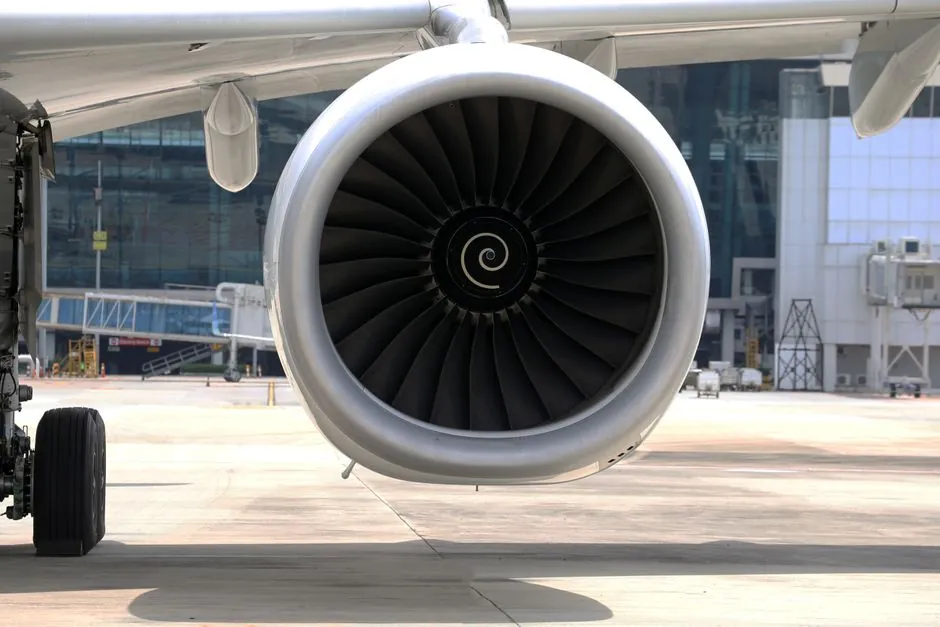
EPDM (Ethylene Propylene Diene Monomer) holds a defined slot in aerospace sealing: it is the go-to elastomer where the working environment is air, water, steam, ozone, and UV, and it is the wrong material where the working environment is jet fuel, hydraulic fluid, or mineral oil. The saturated backbone of the polymer, produced by the ethylene-propylene chemistry, is the structural reason it survives atmospheric exposure that cracks other common rubbers [S1][S2].
Aerospace-qualified EPDM is typically formulated to a 30-90 Shore A hardness window, with 500-2,500 PSI tensile strength and 100-700% elongation, per the standard compound tables in [S4]. Within that envelope, the material covers cabin door seals, window gaskets, environmental control system ducting, and weather-exposed exterior trim.
Temperature Band and What Each End Means for Flight
Aerospace EPDM is rated for continuous service from -60°F to +300°F (-51°C to +149°C), with intermittent peaks at 350°F (177°C) noted in the aerospace-focused literature [S2]. The general industrial spec map places the continuous band a touch lower, -40°C to +120°C, with steam-rated grades extending to 200°C [S1]. The aerospace window is wider because exterior airframes see ground cold in the -40s and ramp temperatures well above 100°C on a sun-soaked tarmac.
Peroxide-cured EPDM compounds extend the upper ceiling to 300°F without the sulfur-cure residue that limits high-temperature aging [S3]. For cabin pressure-cabin seals the relevant parameter is compression set rather than peak temperature, and EPDM's low compression set is one of the reasons it is repeatedly specified for door and window gaskets on pressurized airframes [S2].
Chemical Resistance: The Hard Boundary
EPDM is excellent against dilute and concentrated acids, alkalies, alcohols, ketones, hot water, steam, phosphate-ester hydraulic fluids, and silicone oil, and it is poor against hydrocarbon fuels (aliphatic, aromatic, and extended), diester oils, halogenated solvents, and petroleum-based hydraulic fluids [S4]. ASTM D-2000 classification AA, BA, CA, DA covers the standard EPDM grade families and is the shorthand procurement codes use to anchor chemical compatibility [S4].
Phosphate-ester hydraulic fluids (the Skydrol and Hyjet families used in commercial aircraft) sit on the EPDM compatibility list, which is one reason EPDM shows up in hydraulic system sealing where non-mineral fluids are specified [S2][S4]. For mineral-oil or petroleum-fuel service, the same EPDM part swells and fails; specifying FKM (Viton) or nitrile rubber (NBR) instead is the standard correction, and a useful baseline for nitrile rubber compatibility in fuel-side seals is covered separately.
Comparison of EPDM Against Other Aerospace Rubbers
Selection in aerospace is rarely a single-material problem, and EPDM competes with silicone rubber, nitrile, neoprene, and FKM on the same airframe. On four decision criteria common to aerospace sealing, the picture is [S1][S2][S5][S6]:
Temperature ceiling: EPDM reaches +300°F continuous, peroxide-cured; silicone holds higher peaks; FKM holds the highest; nitrile drops off above 250°F; neoprene is the lowest of the four at typical cabin-service ratings [S1][S2][S3].
Petroleum/fuel resistance: EPDM is rated Poor; nitrile is Good on aliphatic hydrocarbon fuels; FKM is Excellent across aliphatic, aromatic, and extended classes; silicone and neoprene are intermediate [S4].
UV / ozone / weathering: EPDM is Excellent, the best of the common elastomers because of its saturated backbone; nitrile and neoprene are Fair; silicone is Good to Excellent with specific formulations; FKM is Good but expensive [S1][S4].
Steam and hot water: EPDM is Excellent, the standard reference material for steam service; silicone is Good; nitrile is Poor; FKM is Poor to Fair at saturated steam conditions [S1][S4].
The decision rule that drops out of this comparison: pick EPDM when the failure mode is weather, steam, or hot water; pick FKM or NBR when the failure mode is fuel or mineral oil. The default EPDM substitution into a fuel-side application is the most common mis-spec, and it produces rapid seal extrusion and pressure decay.
Mechanical Properties and Manufacturing Routes
Standard EPDM compounds run 30-90 Shore A hardness, 500-2,500 PSI tensile, 100-700% elongation, with abrasion resistance rated Good and tear resistance Fair to Good [S4]. Adhesion to metal and rigid substrates is Good to Excellent, which is what allows EPDM to be co-molded or bonded to aluminum door-frame inserts on aircraft door seals [S2][S4].
Manufacturing routes for aerospace EPDM parts include compression molding, transfer molding, injection molding, extrusion, die cutting, waterjet cutting, lathe cutting, slitting, vulcanized splicing, molded corner splicing, and pressure-sensitive adhesive application [S2][S3]. The broad process envelope is the practical reason EPDM shows up in everything from a continuous extruded window seal to a custom grommet for an avionics bay. For background on the broader elastomer family, see industrial rubber.
Flame, Radiation, and Electrical Behaviour

EPDM flame resistance is Poor, which is one of the reasons EPDM is not used for firewall seals or engine-bay-adjacent gaskets; silicone or specialty FKM compounds dominate those locations [S4]. Radiation resistance is Good to Excellent, which makes EPDM a useful candidate for high-altitude and certain space-adjacent components where UV and ionizing radiation both act on the polymer [S4].
Electrical insulation is a long-standing strong point: EPDM holds good dielectric properties after hot-air aging and shows superior resistance to high-voltage corona discharge, which is why EPDM insulation on aerospace high-voltage cable harnesses is a recurring specification [S2]. For broader polymer comparisons in electrical and sealing roles, silicone rubber is a useful counterpoint with higher temperature ceiling but lower tear strength.
Where EPDM Is and Is Not Used in Aerospace
Typical aerospace EPDM applications listed by compounders include window seals, fabricated gaskets, EPDM tubing, and custom hose; the same family of parts appears on defense platforms (gaskets, seals, tubes) and in HVAC grommets [S3]. A consistent pattern in the sources: EPDM is the cabin-side and exterior-weathering material, never the fuel-side or hydraulic-mineral-oil material [S1][S2][S3][S8].
For procurement teams, the working rule is short: if the qualified fluid is phosphate-ester hydraulic fluid, Skydrol, hot water, steam, de-icing fluid, or simply atmospheric exposure, EPDM is in scope. If the qualified fluid is Jet A, JP-8, mineral hydraulic fluid, or any hydrocarbon solvent, EPDM is out of scope and FKM or NBR should be evaluated. A defensive-spec note: avoid blending EPDM with NBR or FKM in the same gland or groove, because the dissimilar cure systems and compression-set behaviours will shorten service life of both.
Procurement and Specification Checkpoints

The minimum specification data to lock in for an EPDM part: Shore A hardness (30–90), tensile strength (500–2,500 PSI), elongation (100%–700%), compression set (rated Poor to Excellent), and the ASTM D-2000 classification (AA, BA, CA, or DA). Curing system matters: specify peroxide cure for any aerospace service above 250°F continuous, because sulfur-cured EPDM ages out faster at high temperature [S3].
Post-cure (typically 24 hr at 200°C) is a standard requirement for aerospace-grade EPDM to drive off peroxide residues and stabilize compression set, and it is worth flagging in the print because the same compound without post-cure will not hit the same compression-set number. The general rubber-to-elastomer selection logic for industrial buyers is reviewed in plastic and rubber, which covers the broader polymer-decision framework.
Trackable signals to watch over the next quarter: any new aerospace-qualified EPDM compound with extended low-temperature flexibility (below -60°F static) for high-altitude unpressurized bays; any update to ASTM D-2000 EPDM grade tables covering peroxide-cured aerospace lines; and any OEM service bulletin that re-routes a phosphate-ester hydraulic seal from NBR back to EPDM. None of these is signalled in the available sources today, but each is the kind of change that would shift EPDM share on a given airframe.
This topic is covered further in NBR selection for energy equipment: ACN, hardness and service band.