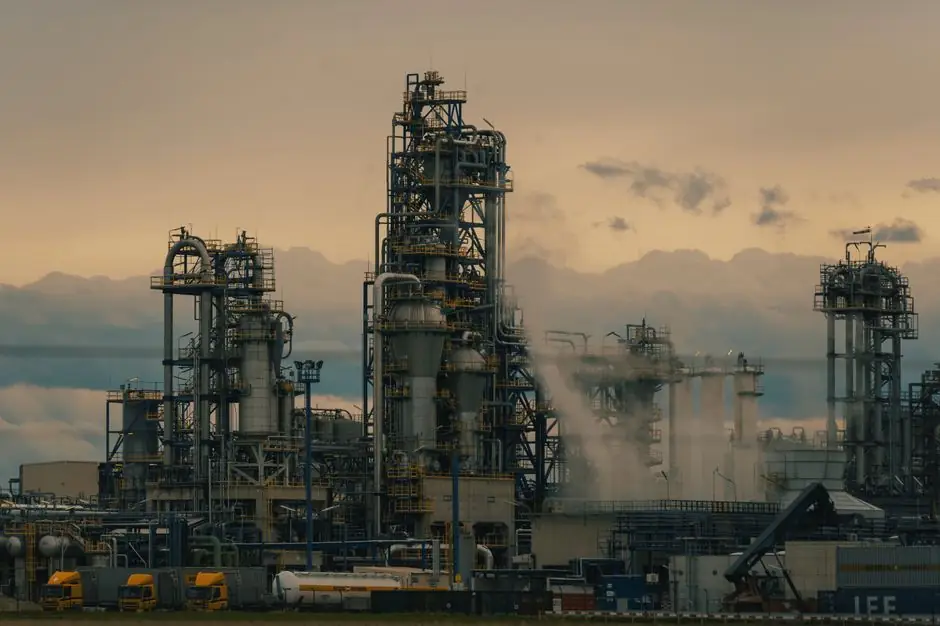
A 200 kW excavator estimated at a 0.65 load factor, 210 g/kWh BSFC, and 835 g/L fuel density burns about 32.69 L/h before site-specific corrections [S1].
Engine power provides a defensible starting point only when paired with load, fuel consumption, and density data; tank-to-tank measurement over several dozen operating hours establishes the machine’s actual burn rate [S1][S4].
Engine power to litres per hour
The calculation is <strong>Fuel burn (L/h) = engine power (kW) × load factor × BSFC (g/kWh) ÷ fuel density (g/L)</strong> [S1]. The calculation produces grams of fuel per hour before the density division converts the mass rate to a volumetric rate.
For a 200 kW excavator, multiplying 200 kW by 0.65 and 210 g/kWh gives 27,300 g/h. Dividing by 835 g/L gives 32.69 L/h [S1]. BSFC is a mass-based measure and must not be treated as the machine’s litres-per-hour rate [S1].
For example, a 200 kW excavator at a 0.65 load factor and 210 g/kWh BSFC is estimated to consume 32.69 liters of fuel per hour. These are estimation inputs, not universal operating specifications, so model-specific data or measured fuel records take precedence [S1].
Selecting the load factor
Load factor is the fraction of rated engine output represented by the work, and it must describe the actual duty cycle rather than continuous full power [S1][S2].
This shortcut is less specific than the BSFC method and should be used only when rated consumption and measured BSFC are unavailable [S1][S2].
Load categories differ when a rated volumetric rate is used instead of engine power. A calculator based on rated fuel rate uses 60–70% for light work and frequent idling, 75–85% for medium earthwork, and 90% or more for hard digging or continuous rock excavation [S3]. The percentage must be matched to the basis of the input rather than copied blindly from another method.
Comparison of estimation methods
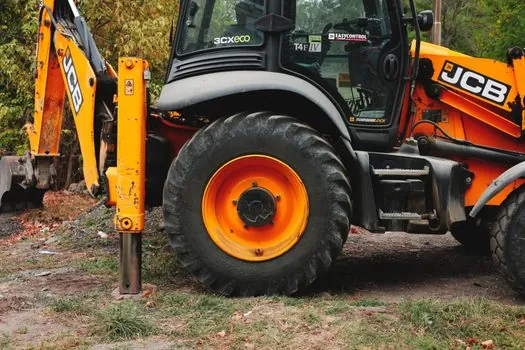
The engine-based BSFC method is suitable for early budgeting when rated engine power and credible BSFC are available, while its sensitivity to load factor makes it weak for comparing machines under different work [S1]. The rated-rate method is faster to apply and supports daily fuel and cost planning, but its result inherits the quality of the rated L/h figure [S3].
A 20 L/h rated excavator rate at a 0.75 load factor gives 15 L/h, or 120 L over an 8-hour shift. Over 30 working days, the calculated requirement is 3,600 L [S3]. This arithmetic is valid for budgeting, but the rated rate and load factor still require comparison with operating evidence [S3][S4].
Validating the estimate by tank measurement
Tank-to-tank measurement divides litres consumed by operating hours, and the same method can compare a machine’s burn across defined tasks [S4][S5]. Fill the tank, record the hour meter, operate normally for several dozen hours, refill at the same place on level ground, and divide the litres added by the elapsed hours [S4].
If 100 L is added over 10 operating hours, measured consumption is 10 L/h [S5]. A single shift can be distorted by tank expansion, spillage, topping up, or inaccurate hour-meter entries, so a longer measurement period reduces the relative effect of filling error [S4].
Telematics can shorten diagnosis rather than replace the basic calculation. A displayed tank level is not a per-hour consumption figure unless refills or another fuel-flow measurement are paired with it [S4].
Where the estimate fails
The largest errors come from treating rated power as constant real work, selecting a generic load factor, or excluding idle time [S1]. The same machine can consume different quantities while loading loose gravel, digging hard material, operating a breaker, or trimming a slope [S4].
Heavy-duty idling is estimated at 1.5–3.5 L/h [S1], while excavator and dozer idle can consume 1.0–1.5 gal/h [S2]. A calculation based only on productive digging will therefore overstate the effective burn rate for a full shift if it ignores standby periods [S1][S2].
Attachments, terrain, material hardness, operating mode, maintenance condition, fuel type, tire condition, and operator technique also change consumption [S1][S2]. These effects explain why an engine-power estimate needs a site-specific calibration period.
Choosing the right denominator
Litres per hour measures the rate of fuel use, but it does not establish whether the machine produced useful work [S5]. Excavators can be assessed in L/h or L/m³ excavated, loaders in L/h or L/tonne handled, dumpers in L/km, L/trip, or L/tonne-km, cranes in L/h or L/lift, and generators in L/h or L/kWh [S5].
For example, 100 L consumed while excavating 720 m³ equals 0.139 L/m³ [S5]. This output-based metric can reveal that a machine using more litres per operating hour is still more efficient if it completes more productive work under the same conditions [S5].
The estimate is suitable for fleet budgeting, rental comparisons, and early project pricing when its inputs are explicit and sensitivity-tested [S1][S3]. It is not suitable as a guaranteed operational rate or a production guarantee, because the BSFC formula and load-factor shortcut do not replace direct measurement [S1][S4].
For a durable baseline, calculate the BSFC estimate, record it beside the machine hour meter, and reconcile it against tank-to-tank consumption for a defined task. Repeat the comparison after changes to attachment, power mode, terrain, or maintenance condition, then track fuel per unit of productive output rather than litres per hour alone [S1][S4][S5].