
An expansion joint in cast-in-place concrete is usually detailed with two distinct sealing elements: a waterstop embedded across the joint and an elastomeric sealant applied to the surface, because each component blocks a different failure mechanism [S1][S4].
The waterstop is a profile or strip cast into the concrete to obstruct water passage through the joint body, while the surface sealant is a gun-grade elastomer bonded to the joint face that stretches with thermal and structural movement; omitting either layer leaves a defined leak path [S1][S3][S4].
What Each Component Actually Does
A waterstop is a material embedded in the concrete across the joint to obstruct the passage of water through the joint, and is not an elastomeric sealant or coating adhered to the concrete surface at a joint [S1][S4]. Standard PVC thermoplastic waterstops are sold in 50 ft rolls at 4 in to 12 in widths and 3/16 in to 1/2 in thicknesses, with flat-web profiles for low-movement joints and center-bulb profiles for joints that must absorb shear and transverse movement [S1][S4].
Surface sealants are field-applied elastomers that bond to the two concrete faces of the joint and stretch as the gap opens and closes. The TOWER AU-1 sealant, for example, is certified to ASTM C-920 as a Type S, Grade NS, Class 35 sealant, applied between 40 °F and 140 °F on substrates that are not frozen, and tooled within 15 minutes of placement to form the standard hourglass profile [S3]. The design rules from the same guide limit joint width to 2 in, require a width-to-depth ratio of 2:1, and call for a backer rod whenever sealant depth exceeds 1/2 in [S3].
Movement Capability and Joint-Width Limits
Selected waterstops must accommodate the expected lateral, transverse, and shear joint movements as well as the expected hydrostatic pressure, which is why ribbed profiles with a center bulb and a tear-web are specified where large movement is expected: the tear-web side ruptures on expansion and the bulb opens to reduce stress on the embedded ribs [S1][S4]. Tear-web waterstops are installed with the tear-web side facing the direction of positive water pressure so the rupture opens toward, not away from, the water head [S4].
Surface sealants carry their own movement budget. Pecora's published guidance for sealants in expansion joints over 1 in wide identifies sealant slump or sagging as the primary failure mode, since wider joints demand deeper sealant beads that gravity pulls out of the hourglass shape before cure [S5]. The same article recommends a bond-breaker tape or backer rod at the joint base, and an A-to-B width-to-depth ratio close to 2:1 to keep the sealant in its designed strain range [S3][S5]. For most commercial applications, elastomeric construction sealants are limited to roughly 2 in of joint width before a preformed compression seal or cover plate becomes the practical choice [S3].
Where a Waterstop Is Not Enough
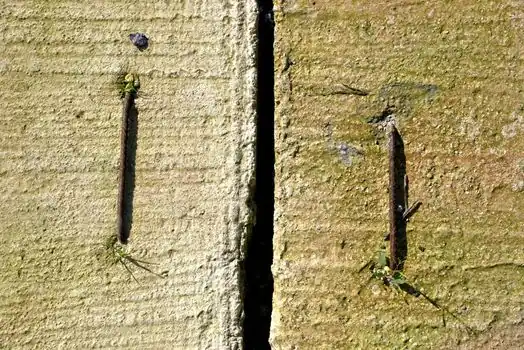
Waterstops are unable to prevent water ingress through cracks that develop in the concrete due to building settlement, load deflection, or concrete shrinkage, and the same limitation applies to settlement-induced cracking that runs through the joint body outside the waterstop's plane [S1][S4]. For those crack patterns the specifier needs a waterproofing membrane system on the substrate, not a wider waterstop.
For joint movement and surface sealing the waterstop on its own also fails, because PVC, hydrophilic rubber, and bentonite profiles are not designed to track the cyclical opening and closing of an expansion joint face the way a Class 35 urethane-acrylic or a polyurethane sealant does. The standard belt-and-suspenders pairing in waterproofing design is therefore a waterstop plus a membrane on the substrate, with a surface sealant on top of the joint to absorb movement and shed water at the face [S1][S4].
Joint Filler Material Comparison
The compressible filler behind the sealant is a separate decision and is chosen for recovery, not for sealing. W. R. Meadows publishes a comparison of common fillers: asphalt-fibre fillers recover to a minimum of 70% of original thickness after 50% compression, sponge rubber recovers to 95% or more at a density of at least 30 lb/ft³ (480.56 kg/m³), cork recovers to 95% after 50% compression, self-expanding cork expands up to 140% of original thickness to compensate for concrete shrinkage, CERAMAR flexible foam recovers over 99% from a closed-cell isomeric polymer structure, and the newer X-FOAM polypropylene closed-cell filler is supplied in 1/2 in, 3/4 in, and 1 in thicknesses [S2].
For waterproofing of below-grade structural expansion joints, self-adhered versus hot-applied sheet membrane selection on the outer concrete face interacts with the waterstop choice, since the two layers must overlap by enough material to survive differential settlement at the joint. None of these fillers are themselves a waterstop or a sealant, and the recovery number alone does not predict waterproofing performance; it predicts whether the filler stays in compression as the joint opens and closes [S2].
Selection Criteria and Field Constraints
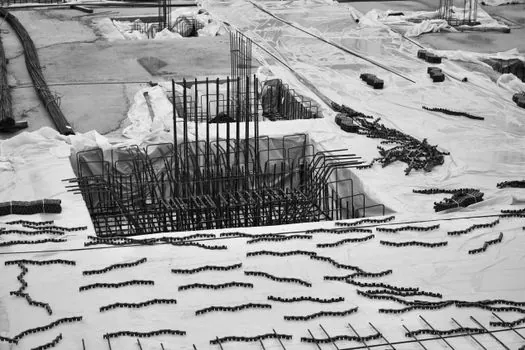
Specifying a waterstop for an expansion joint is governed by three numbers: expected hydrostatic head, expected joint movement range, and joint type (construction, contraction, or expansion). PVC dumbbell and ribbed waterstops cover the majority of expansion-joint duty when paired with a tear-web center bulb, while hydrophilic bentonite and rubber strips are typically reserved for construction joints with limited movement and where the concrete mix is known to be compatible with the swelling polymer [S1][S4].
For the surface sealant, four constraints dominate: substrate moisture condition, joint width, expected movement (often expressed as a Class 12.5, 25, 35, or 50 per ASTM C-920), and chemical exposure. Field installation requires the joint to be filled in a single pass with no air pockets, full contact with both substrates, and tooling within the working time, which for AU-1 is 15 minutes at 75 °F and 50% relative humidity, with tack-free at 30 minutes, paint-ready at 6 to 8 hours, and full cure at 21 days [S3]. Below-grade use of a non-swellable surface sealant is generally excluded, and high foot-traffic joints need a traffic-grade sealant or a cover plate to prevent mechanical damage to the cured elastomer [S3].
When One Layer Can Substitute for the Other
A waterstop alone is acceptable on construction and contraction joints where little or no movement is expected, because flat-web PVC profiles in those locations only have to resist hydrostatic pressure, not cyclic strain [S1][S4]. A surface sealant alone is acceptable on above-grade expansion joints with low hydrostatic head, such as a building facade or an interior slab, where the driving force for water ingress is wind-driven rain rather than a pressure gradient and the specifier can route drainage away from the joint face [S3].
For any below-grade expansion joint, any tank or pool wall, any joint wider than 1 in, or any joint carrying more than a few feet of hydrostatic head, the practical answer is both layers: a waterstop across the joint body and an ASTM C-920 elastomeric sealant on the joint face, sized to the expected movement class and tooled to the standard hourglass profile [S1][S3][S4][S5]. The two components are not redundant; the waterstop catches water that gets past the surface sealant, and the surface sealant catches water and debris that the waterstop cannot reach. Trackable signals for the next revision of this guidance are the publication of an updated ACI 504R chapter on joint sealing and any movement of ASTM C-920 Class limits beyond the current 12.5/25/35/50 tiers, both of which would shift the cut-off width at which a single sealant layer can replace the combined system [S3][S5].
For the relevant spec sheets and selection criteria, see surface roughness tester.