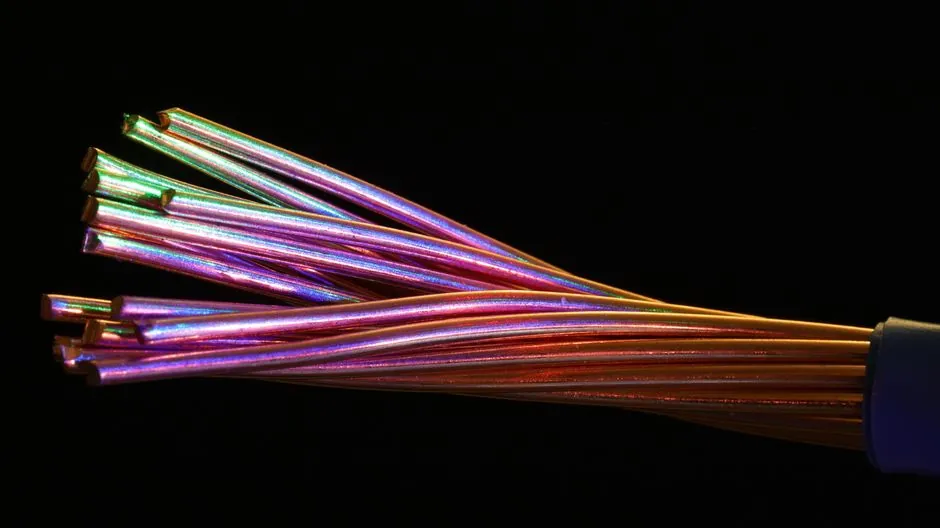
ASTM A416 seven-wire uncoated strand is offered in Grade 250 and Grade 270, with the relaxation class declared by the manufacturer rather than read from the diameter [S1]. The two classes are not just a test result: they are produced by different thermal histories, with Class 2 requiring a stabilising stress-relief at around 350–400°C after stranding to lock in lower long-term loss.
The distinction matters because relaxation is the second-largest prestress loss after elastic shortening in pretensioned members, and the design effective prestress fse in ACI 318-14 / AASHTO LRFD is calculated using the strand tensile strength fpu and the assumed jacking level [S2]. Picking the wrong class changes long-term camber, deflection, and crack control in service, which is why prestressing strand datasheets always print the class alongside diameter and grade.
How ASTM A416 Defines the Two Classes
ASTM A416 measures relaxation as the load drop from initial stress, expressed as a percentage of the initial load, on a strand sample held at constant length for 1000 hours at 20°C ± 2°C. For low-relaxation (Class 2) seven-wire strand, ASTM A416 sets a maximum relaxation of 2.5% at 70% of the specified ultimate tensile strength (GUTS) and 3.5% at 80% GUTS, per the Sumiden technical data covering diameters 3/8" through 0.6" (9.5–15.2 mm) [S1]. Class 1 (normal-relaxation, sometimes called "stress-relieved" in older literature) is not separately tabulated in modern A416 datasheets because the standard was rewritten to focus on low-relaxation as the default product.
EN 10138 and ISO 6934 use a parallel but more granular scheme. EN 10138-3 defines two classes: Class 1 with max 2.5% loss at 60% of the actual breaking load, and Class 2 with max 2.5% loss at 70% of the actual breaking load over 1000 hours at 20°C [S9]. The Chinese GB/T 5224 standard, widely used for export, mirrors this 60%/70% split, with normal-relaxation labelled as Class I and low-relaxation as Class II. So the "class 1 vs class 2" question is really a 60% GUTS vs 70% GUTS test condition, not a different steel chemistry.
Numerical Comparison: Loss at Equal Initial Load
If both classes are loaded to 60% GUTS (a common jacking level for pretensioned beams), Class 1 strand loses up to 2.5% over 1000 hours, while Class 2 strand loses roughly 1.0% under the same loading, based on the 60% vs 70% GUTS test points and the typical log-linear behaviour of stress-relieved wire [S5][S9]. That 1.5-percentage-point gap is the entire economic reason low-relaxation strand exists.
The relaxation gap is widest in the first 24 hours and then decays. ASTM A416 reports the 1000-hour value because roughly 80% of the total 50-year loss occurs in the first 200 hours after anchoring [S1]. Designers typically add a relaxation loss term ΔfR of 35–55 MPa for Class 2 strand in pretensioned members, versus 80–120 MPa for Class 1, depending on initial stress level. The PCI Journal study on Grade 300 (2070 MPa) strand notes that the same ACI/AASHTO empirical formulas used for Grade 270 (1860 MPa) carry forward, so picking the right class is mostly about accurate loss estimation rather than different member geometry [S2].
Selection Criteria: When Each Class Fits
Class 2 is the right default for any pretensioned bridge girder, hollow plank, or double-tee in North America, because AASHTO LRFD and ACI 318-14 design equations were calibrated against low-relaxation strand [S2]. It is also the correct pick for post-tensioned slabs and beams where long-term camber and tendon elongation must be tightly controlled, and for cable-stay and ground-anchor systems where fatigue performance at higher sustained stress ranges matters [S4].
Class 1 is not obsolete: it is still common in cost-driven pretensioned products (piles, railway sleepers, certain agricultural panels) where the lower unit price offsets the higher loss, and the member is over-prestressed slightly to compensate. It is also widely specified in markets where GB/T 5224, KS, or JIS standards are the reference, and where the local code was originally written around normal-relaxation values. Engineers retrofitting older structures designed under ACI 318-63 or AASHTO Standard Specifications (pre-2007 interims) should also keep Class 1 assumptions, because changing the relaxation class mid-life alters predicted losses and camber growth.
Standards, Sourcing, and What a Mill Cert Must Show
A valid mill test certificate for either class must include the diameter, grade, relaxation class, actual 1000-hour relaxation value, area, weight, and minimum breaking strength. For a 1/2" (12.7 mm) Grade 270 strand, that means 41,300 lbf (183.7 kN) minimum breaking strength and 37,170 lbf (165.3 kN) minimum yield at 1% extension under ASTM A416 [S1]. The same product under EN 10138-3 is identified by construction (e.g., Y1860S7 for 1860 MPa, 7-wire) and relaxation class suffix, and the central wire (king wire) diameter is required to be about 3–5% larger than the outer wires for proper torque balance [S9].
For project buyers comparing offers, the steel strand grade, the relaxation class, and the actual test relaxation value (not just "meets standard") should be lined up across mills. A 0.5–1.0% relaxation difference between two Class 2 heats can change long-term tendon loss by 15–20 MPa, so asking for the actual 1000-hour value is a normal pre-purchase step, not over-specification. Buyers should also confirm that the wire rod feedstock is clean high-carbon steel with controlled inclusions, because inclusions drive both fatigue life and relaxation scatter at high sustained stress [S4].
Limits, Failure Modes, and Common Misreads
Class 2 strand does not eliminate relaxation; it reduces it. At 80% GUTS the ASTM A416 ceiling is still 3.5% for low-relaxation strand, so jacking above 75% GUTS erases much of the practical advantage of Class 2 over Class 1 [S1]. Real installations also see additional losses from concrete creep, steel relaxation under variable temperature, and cyclic loading; the Paulson fatigue study found that the allowable stress range for uncracked prestressed members lies between AASHTO Category A and Category B curves, and that relaxation properties do not significantly change the fatigue boundary at ordinary bridge stress ranges [S4].
The most common engineering mistake is reading "low relaxation" on a datasheet and assuming a single number (e.g., "1% loss") applies at any jacking level. The relaxation curve is log-linear with initial stress, so a Class 2 strand at 80% GUTS can lose more than a Class 1 strand at 50% GUTS. Another misread is treating relaxation class and stress-relieved vs as-drawn as the same thing: all modern Class 2 strand is stress-relieved, but the term "stress-relieved" alone on a legacy cert usually means Class 1, not Class 2. For seismic applications, Seismic Grade E Rebar 1.25 TS/YS Ratio on the mild reinforcement side is the parallel concern for ductility, while relaxation class governs the prestress side.
Class 1 versus Class 2 is a single material option on the same product line, so the procurement question is whether the project specification or the governing code calls out low-relaxation by name, and whether the mill cert states the class, the actual 1000-hour test value, and the test temperature. Anything less is incomplete data for a long-span pretensioned design. Watch for project specs that list ASTM A416 without naming a class, since most Grade 270 strand on the global market is now Class 2 by default, but old Class 1 stock still exists in some regional warehouses.