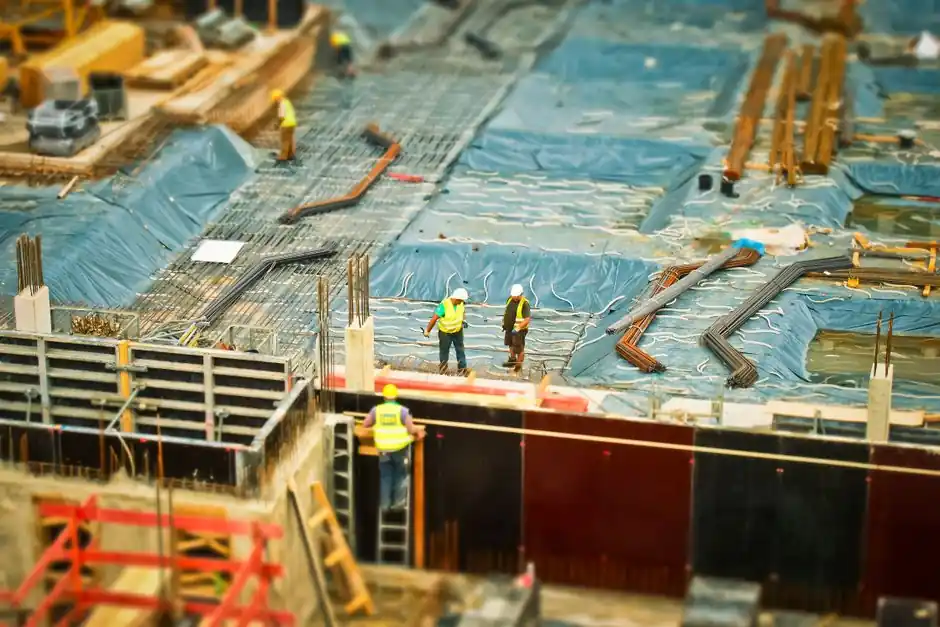
The seismic Grade E rebar specification requires a minimum tensile-to-yield strength ratio (fu/fy or TS/YS) of 1.25, codified in ASTM A706 and adopted by ACI 318 for reinforcement resisting earthquake-induced forces in frame members and wall boundary elements [S1][S2].
The 1.25 floor exists because Grade E rebar is expected to yield before it fractures: a bar with fu/fy close to 1.0 ruptures with almost no plastic strain, eliminating the ductile hinge that absorbs seismic energy. Coupled with the elongation requirement (≥10% in an 8 in. gauge for Grade 60), the ratio sets a minimum reserve of post-yield deformation capacity [S2][S4].
Where the 1.25 Rule Originates and How It Is Written
The 1.25 figure first entered U.S. seismic practice through ASTM A706, low-alloy deformed bars intended for special moment frames and shear walls, and is mirrored in ACI 318 Subsection 5.21.2.5.1-equivalent text: the actual ultimate tensile stress divided by the actual yield stress shall not be less than 1.25 [S1][S4][S7]. The Philippine NSC 5.21.2.5.1 reproduces the same rule for Grades 275 and 415 rebar accepted under ASTM A706/PNS 49 [S4]. ACI 318-14 Tables 20.2.2.4a and 20.2.2.4b list the current restrictions for non-prestressed deformed reinforcement, including the 1.25 limit on fu/fy [S2]. Engineers should note that the rule is applied to actual (mill-test) values, not nominal grade values, so a bar showing 70 ksi actual yield must still deliver at least 87.5 ksi actual tensile strength to comply.
Comparison: ASTM A615 vs ASTM A706 vs A1035 (Grade 100/120)
ASTM A615 is the commodity billet rebar specified for non-seismic concrete; its Grade 60 and Grade 80 chemistries can ship with fu/fy as low as 1.10-1.18, which is why A615 is excluded from special seismic systems unless the engineer proves compliance with the fu/fy ≥ 1.25 and elongation clauses [S2][S7]. ASTM A706, by contrast, is the seismic grade: chemistry is restricted (carbon ≤ 0.30%, CE typically ≤ 0.55%), and the 1.25 ratio plus 10% elongation in 8 in. is mandatory at Grade 60 [S2][S4]. ASTM A1035 covers chrome-bearing Grade 100 and Grade 120 bars; the ACI 318-14 cap on nominal yield for non-confinement reinforcement sits at 80 ksi (550 MPa), so A1035 Grade 100 is currently accepted mainly as confinement steel and is under ongoing research to extend it to flexural members [S2][S3]. For a project that needs ductility and weldability, A706 is the default; for high-rise confinement columns where cutting congestion matters, A1035 Grade 100 is increasingly common once the engineer accepts the rounded-house stress-strain curve (no yield plateau) and verifies fu/fy and elongation on the mill cert.
Why 1.25 Specifically: Hinge Mechanics and Wall Test Data
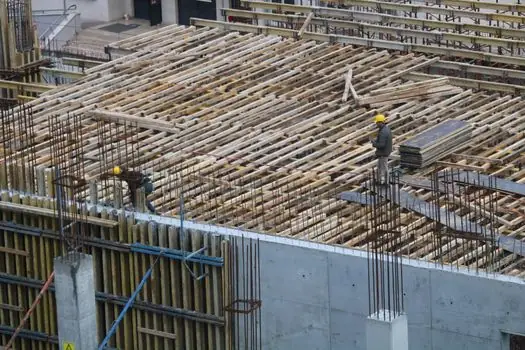
The 1.25 threshold is calibrated so the bar can stretch at least 25% beyond yield before tensile failure, which translates into a rotation capacity of roughly 0.04 rad in well-detailed beams before strength loss sets in. Huq et al. (2021) tested six large-scale T-shaped slender walls under reversed cyclic loading, varying only the Grade 100 fu/fy at 1.15, 1.25, and 1.35; walls with fu/fy between 1.18 and 1.39, uniform elongation ≥ 6%, and fracture elongation ≥ 10% achieved similar drift ratio capacities to the Grade 60 control wall, while specimens below 1.18 degraded prematurely [S3]. The ACI ITG-6 and NEHRP GCR 14-917-30 documents report the same conclusion: when fu/fy drops below 1.20, fracture-dominated failure replaces ductile bar buckling and energy dissipation falls sharply [S1]. The practical field check is therefore: ask for the mill-certified fu and fy, compute the ratio, and reject heats where actual fy exceeds specified fy by more than 18 ksi (120 MPa) or where fu/fy falls under 1.25 [S4][S7].
Test Procedure, Gauge Length, and Acceptance Checks
Elongation is read on an 8 in. (200 mm) gauge, and Grade 60 A706 must reach ≥ 10%; Grade 80 A706 requires ≥ 10% as well, while higher grades have not yet been adopted for flexural seismic use under ACI 318-14 [S2]. The mill cert should report: bar size, heat number, grade, actual yield (ksi or MPa), actual tensile (ksi or MPa), elongation %, and a chemistry column (C, Mn, S, P, CE). Project-side QA labs re-test at a frequency dictated by the project specification, often one sample per 10-20 tonnes, and the rejection rule is the same as ACI's: any heat whose actual fu/fy falls under 1.25, or whose actual fy overshoots the specified fy by more than 18 ksi, is rejected for seismic locations [S4][S7]. Bar identification, bend tests, and rebar testing with calibrated extensometers are the only ways to catch substitution of A615 heats into A706 lots, a common fraud in tight supply markets.
Limits: Why High-Strength Bars Can Fail the 1.25 Test
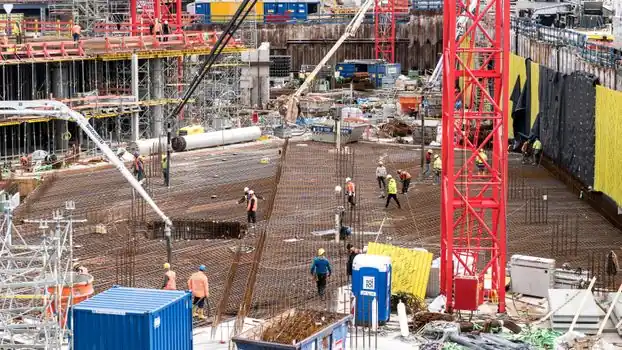
As yield strength climbs from 60 to 100 to 120 ksi, the tensile-to-yield ratio, elongation at peak stress, and yield plateau length all shrink unless the steel mill deliberately increases alloy content and adjusts the thermo-mechanical controlled processing (TMCP) schedule [S2]. A conventional Grade 100 A615-type heat may ship with fu/fy around 1.10-1.15 and uniform elongation of 4-5%, which clears the strength number but fails the ductility clause, and ACI 318-14 caps such bars at confinement use only [S2][S3]. Heat straightening, field reheating, or re-bending cold-worked bars further reduces fu/fy and is a documented cause of brittle fracture near welded splices [S1]. The 1.25 rule is therefore not a paper formality: it is the contract between the metallurgist and the structural engineer, and every deviation must be tracked on the mill cert, not glossed over in the spec book.
Sourcing, Standards, and Field Verification
Three documents govern a seismic Grade E rebar call-out on a U.S. project: ASTM A706 for the bar itself, ACI 318-14 (or the local code edition) for the 1.25 fu/fy and elongation restrictions on reinforcement resisting earthquake-induced forces, and the project-specific structural drawing notes that pin which table (20.2.2.4a or 20.2.2.4b) applies [S2][S7]. NEHRP GCR 14-917-30 and the ACI ITG-6 reports give the technical justification and the wall/beam test data behind the 1.25 figure [S1][S3]. For procurement, require mill certs reporting both actual and specified values, verify the heat chemistry, and pair the rebar with rebar couplers and rebar benders rated for the same grade to avoid work-hardening the bar below the 1.25 threshold at splice locations. Watch for two trackable signals over the next revision cycle: whether ACI 318-25 lifts the 80 ksi cap on flexural Grade 100 with a 1.25 fu/fy and ≥ 6% uniform elongation floor, and whether ASTM A706 expands to cover Grade 80 and Grade 100 chemistry on the same low-alloy platform [S2][S3].
Track these two signals: (1) ACI 318-25 ballot language on Grade 100 flexural rebar in SDC D/E/F, and (2) mill-cert audit findings on fu/fy drift in A706 heats delivered between 2026-Q1 and 2026-Q3.
See also our earlier report, Low-Level vs Mid-Level Order Picker: Lines Per Hour Compared.