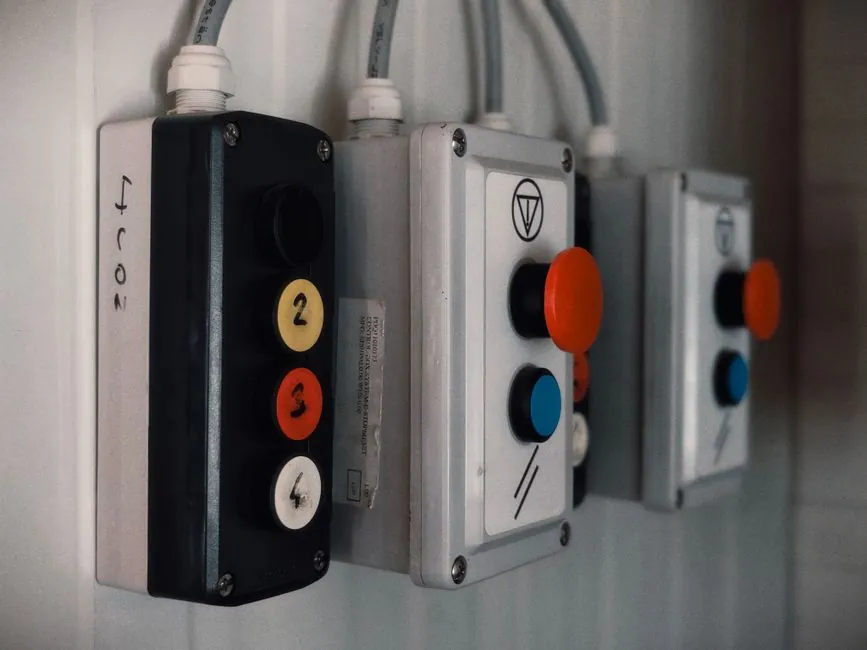
Interlocked explosion-proof plug and socket assemblies can prevent plug removal while energized, with product families covering 16 A to 125 A and one 200 A circuit-breaker receptacle rated for 600 V AC [S2][S3][S5].
The assembly combines a plug, socket, switching mechanism, and mechanical interlock for portable motor-generator sets, compressors, lighting, three-phase equipment, and other loads in hazardous industrial areas [S1][S4].
How the switch interlock controls disconnection
The required operating sequence is insert the plug, lock it in position, switch ON, operate the equipment, switch OFF, release the plug, and remove it [S2]. This is a mechanical control of connection and disconnection, not a substitute for overload or short-circuit protection [S2].
While the socket switch is ON, the interlock prevents withdrawal of the plug. Before removal, the operator must return the switch to OFF, reducing the risk of uncontrolled contact separation and arcing [S2][S7]. The AME Series follows the same principle: the plug can be pulled out only after the socket switch is off, and the switch can be turned on only after the plug is correctly engaged [S7].
That distinction matters because separating contacts while current continues to flow can create an arc whose severity and duration depend on current, voltage, AC or DC supply, load type, power factor, switching mechanism, and contact separation speed [S2]. Repeated arcing can damage contact surfaces, increase contact resistance, and create local heating [S2].
Voltage, current, and protection comparison
Standard switch-socket families cover 16 A, 32 A, 63 A, and 125 A, while a separate 200 A interlocked receptacle demonstrates that the product class extends well beyond small portable tools [S4][S5]. Available configurations include 2P, 2P+PE, 1P+N+PE, 3P+PE, and 3P+N+PE, providing a practical framework for comparing single-phase and three-phase loads [S4].
SUREALL specifies voltage inputs up to 690 V AC, IP66 ingress protection, and NEMA 4X for its listed receptacle family [S4]. The Larson EPO-200A-3W4P-CB is rated at 200 A, 600 V AC, and 250 V DC, with a 3-wire, 4-pole configuration and circuit breakers available from 125 A to 225 A [S3].
A switch interlock and a circuit breaker are different layers of protection. The interlock enforces the operating sequence, while the breaker responds to overload or short-circuit conditions; a high-current assembly may include both functions [S2][S3].
Hazardous-area approvals and enclosure construction
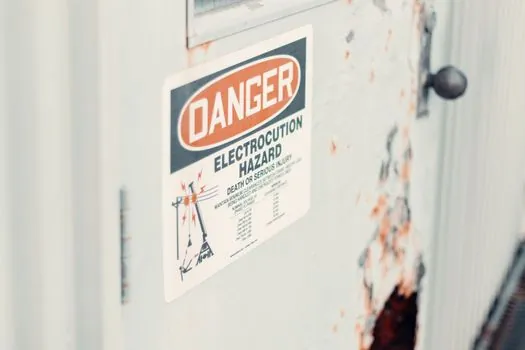
Listed SUREALL configurations address Class I Division 1 and Division 2, Class II Division 1 and Division 2, and Zone 1, Zone 2, Zone 21, and Zone 22 locations, with gas groups including IIB and IIC [S4]. The Larson unit is specified for Class I Divisions 1 and 2, Groups C and D, Class II Divisions 1 and 2, Groups F and G, and Class III hazardous areas [S3].
The same product family uses a die-cast aluminum alloy flameproof Ex d housing or a glass-reinforced plastic increased-safety housing, with recessed contacts intended to limit arcing and spark exposure [S4]. The Larson receptacle uses copper-free aluminum, fiberglass-reinforced polyester insulation, and a spring-loaded door that is mechanically interlocked with its circuit breakers [S3].
Environmental ratings differ by configuration. The SUREALL range lists IP66 and NEMA 4X with an ambient range of -40 °C to +55 °C [S4]. The Larson model lists NEMA 3, 7CD, 9FG, and 12 ratings for indoor and outdoor use in damp, wet, and corrosive locations, with a 1.875 in minimum and 2.50 in maximum cable outer diameter [S3].
These ratings are not interchangeable. The approval document and marked group, division or zone, voltage, current, ingress rating, and enclosure type must all match the installation. For broader enclosure selection, compare Ex d versus Ex e housings before treating the receptacle housing as part of the wider area classification.
Electrical and mechanical selection criteria
Begin with the connected load, not the enclosure catalog. Confirm rated voltage, current, pole arrangement, grounding arrangement, and whether the load is single-phase or three-phase. The listed options cover currents from 16 A to 125 A, 690 V AC maximum for one family, and pole arrangements including 3P+PE and 3P+N+PE [S4][S5].
Next verify the physical interface. A receptacle and plug are a mating system, so contact configuration, conductor size, cable entry, and mounting arrangement must agree. The Larson 200 A receptacle accepts cable with an outer diameter from 1.875 in to 2.50 in and mates with the specified EPP-200A-3W4P-DW plug [S3].
The switching method also determines operating controls. R. STAHL switch sockets are available from 16 A through 125 A and use a padlockable switching handle [S5]. The Larson receptacle instead uses mechanically interlocked circuit breakers with an operating handle that can be padlocked in the OFF or ON position; the breakers remain trip-free of the handle if an overload or short circuit occurs [S3].
For machinery access points, a separate safety interlock switch may be needed to guard a hazardous-area door or prevent access during operation. A plug-and-socket interlock protects the power-disconnection sequence, but it does not automatically provide a machine-guard safety function [S2][S9].
Applications where the interlock adds value
Portable motor-generator sets and compressors are explicit applications for Eaton BHR and SRD explosionproof interlocked receptacles [S1]. The 600 V AC, 250 V DC, 200 A Larson configuration is aimed at high-current mobile or industrial connections and includes short-circuit and thermal overload protection [S3].
Other listed loads include explosion-proof lighting, motors, air conditioners, single-phase equipment, and three-phase devices used in hazardous or corrosive areas [S4]. The practical benefit is operational control: the operator cannot pull the energized plug free, while the circuit breaker remains responsible for fault protection [S2][S3].
The assembly is not a universal substitute for fixed explosion-proof electrical equipment. It is most useful where portable or temporary equipment must be connected and disconnected in a classified area, and where the manufacturer has supplied a documented switching and mechanical-interlock sequence [S1][S2][S4].
Failure modes and procurement checks
Interlock failure modes include an incompletely inserted plug, a worn or damaged locking mechanism, a switch that fails to reach OFF, and deliberate bypassing or unauthorized alteration. The sequence must be verified during commissioning by confirming that the switch cannot be energized with the plug removed and that the plug cannot be withdrawn while the switch is ON [S2][S7].
Check the circuit breaker or fuse arrangement independently. A mechanical interlock does not protect conductors from overload or short circuit, so upstream and local protection must be coordinated with the receptacle rating [S2][S3]. Do not infer protection from a padlocked ON handle because the listed 200 A unit's breakers remain trip-free of the handle [S3].
For procurement, request the exact model, drawing, marked ratings, certificate or approval documentation, pole configuration, material, cable range, mounting method, and replacement-plug designation. The catalog examples demonstrate why model-level verification matters: one device combines 200 A, 600 V AC, 250 V DC, 3-wire/4-pole construction, copper-free aluminum, and fiberglass-reinforced polyester [S3].
The next engineering checkpoint is a mechanical operating test against the manufacturer sequence, followed by verification that the marked hazardous-area approval, electrical ratings, ingress rating, and fault protection match the installed load [S2][S3][S4].