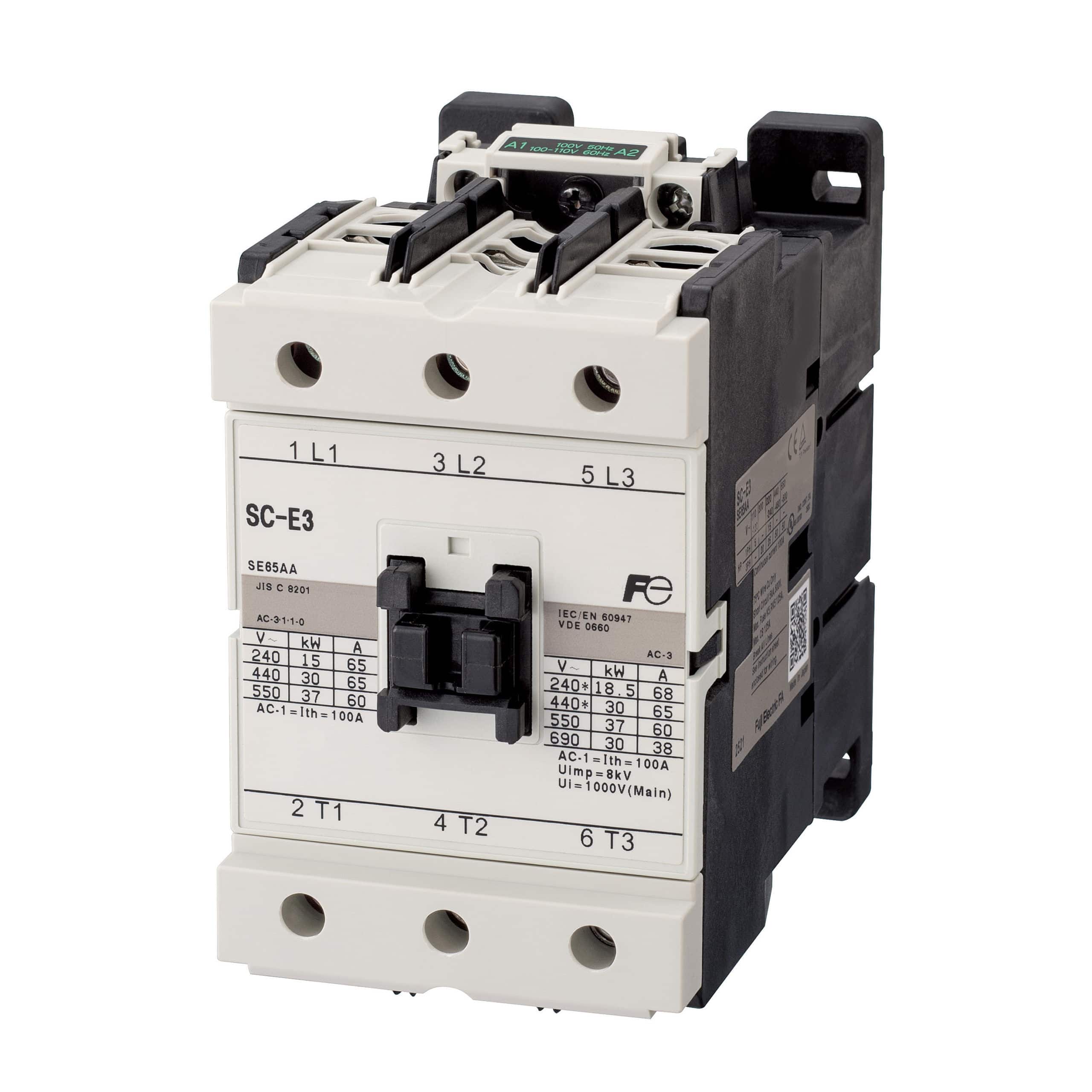
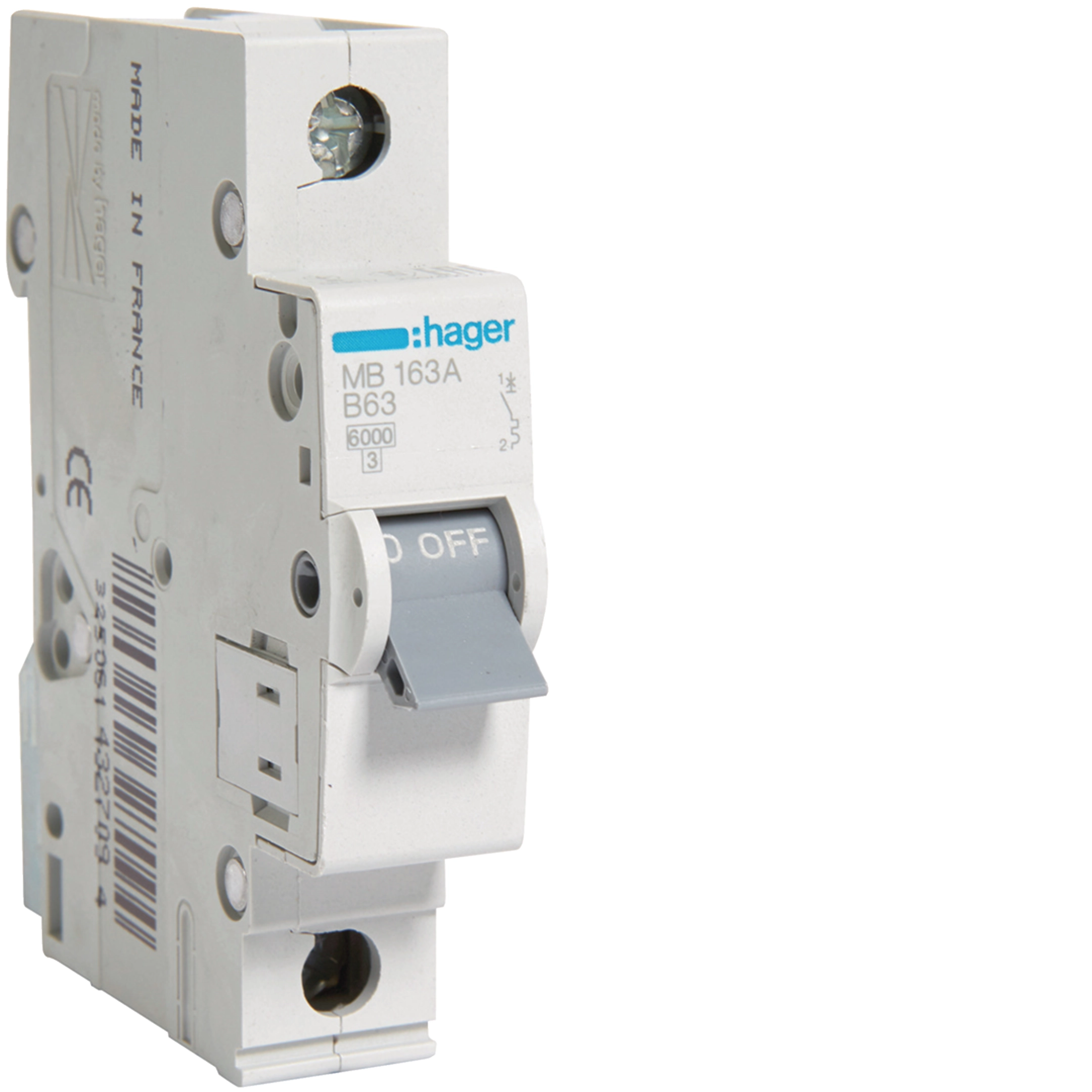
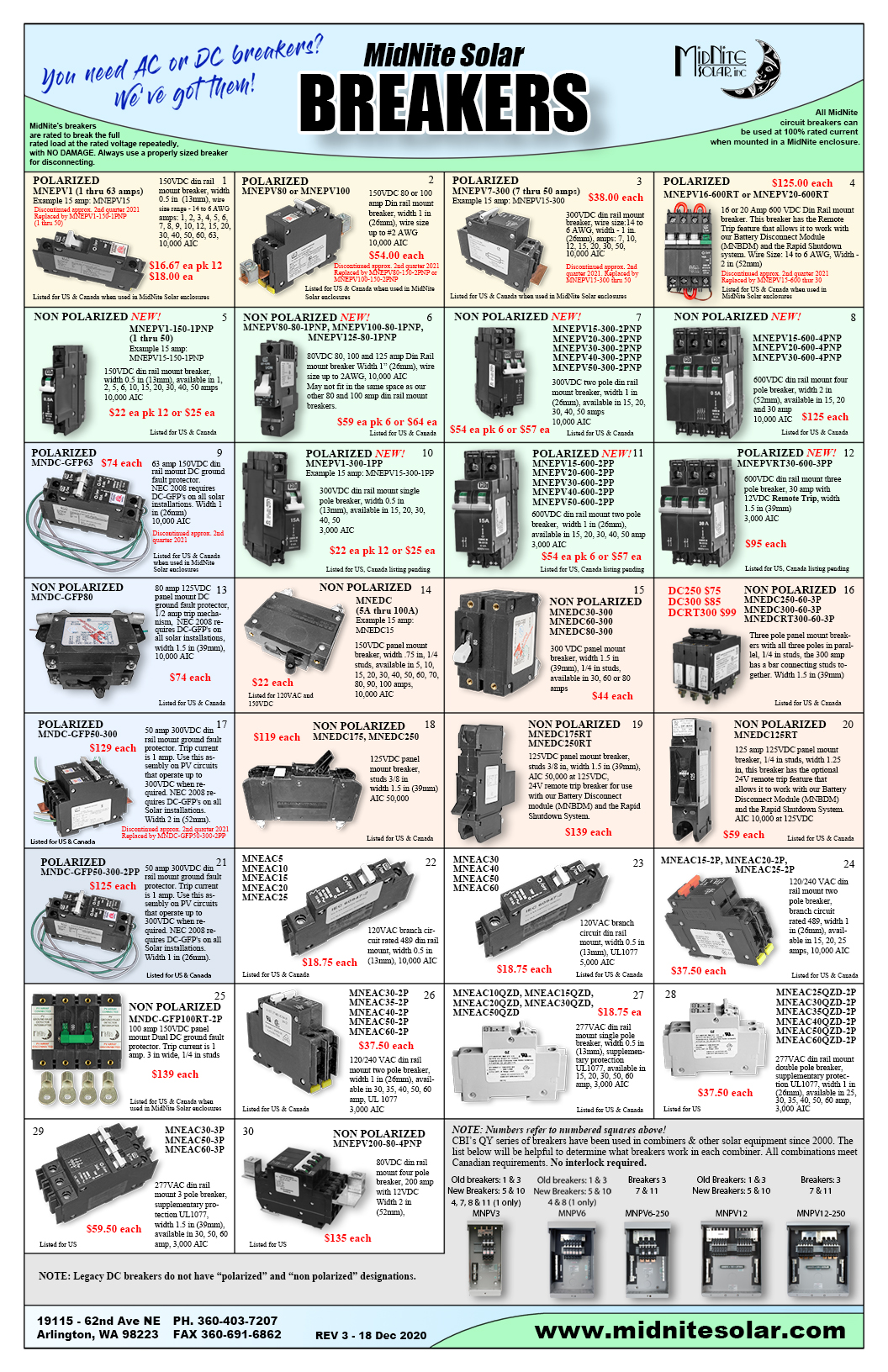
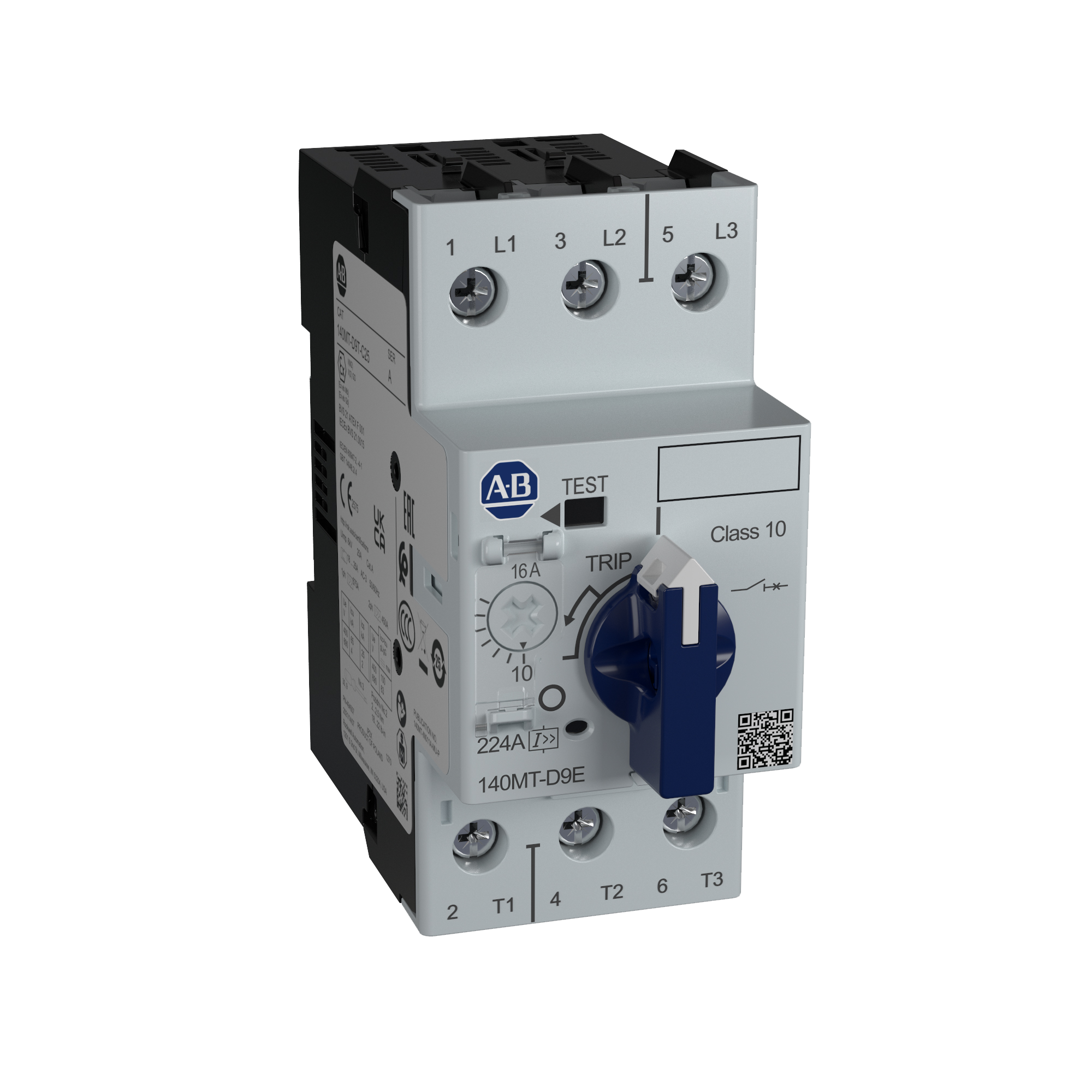
A circuit breaker is an automatically operated electrical switch that protects a circuit from damage caused by overcurrent, short circuit, or earth fault. Unlike a fuse, which must be replaced after it operates, a breaker detects the fault, opens its contacts to interrupt the current, and can be reset and reclosed. It is the backbone of every low-voltage distribution board and medium-voltage switchgear lineup in industry, working alongside the surge protective device that handles transient overvoltage.
The category spans a vast range of physical sizes and ratings: from a 6 A miniature circuit breaker (MCB) on a DIN rail in a lighting panel, to a molded-case circuit breaker (MCCB) feeding a motor control center, to a 6,300 A air circuit breaker (ACB) at the main incomer of a substation, up to medium-voltage vacuum breakers switching 12 kV and 40.5 kV networks. Selection is governed primarily by IEC 60947-2, IEC 60898-1, IEC 60947-3 (the standard that also covers the upstream switch-disconnector used for isolation) and, in North America, UL 489 and ANSI/IEEE.
Photo: Kae, CC BY-SA 3.0, via Wikimedia Commons
This guide is aimed at industrial purchasing engineers and design engineers. It covers 6 chapters from what a breaker is, through MCB / MCCB / ACB classification, trip technologies, arc interruption media and standards, spec-sheet decoding, to selection decisions, with 7 selection FAQs and manufacturer comparisons. All parameters reference IEC 60947-2, IEC 60898-1, IEC 60947-3, IEC 62271-100, and UL 489 public standards.
Chapter 1 / 06
What is a Circuit Breaker
A circuit breaker is a mechanical switching device capable of making, carrying, and breaking currents under normal circuit conditions, and also making, carrying for a specified time, and breaking currents under abnormal conditions such as those of a short circuit. That definition, paraphrased from IEC 60947-2, captures the dual nature of the device: in everyday service it behaves like a manually operated switch, but the moment current exceeds a programmed threshold it acts as a protective device, opening its contacts in milliseconds to clear the fault before the conductor insulation, busbar, or downstream equipment is destroyed.
The contrast with a fuse is fundamental. A fuse is a one-time sacrificial element: a calibrated metal link melts and must be replaced after every operation. A circuit breaker isolates the fault, survives the interruption (within its rated breaking capacity), and is reset by an operator or, in transmission applications, by an automatic reclosing scheme. This resettability, combined with adjustable protection settings and the ability to be remotely operated, is why breakers dominate modern distribution while fuses persist mainly in semiconductor protection and some service-entrance roles.
Every breaker, regardless of size, is built from four functional blocks. First, a contact system, with fixed and moving main contacts (and frequently separate arcing contacts that take the wear). Second, an operating mechanism, a spring-charged toggle or motor-charged stored-energy mechanism that drives the contacts open fast enough to limit let-through energy. Third, a trip unit, the sensing and release element that detects overload, short circuit, or earth fault and releases the mechanism. Fourth, an arc-extinguishing system, the arc chute, vacuum bottle, or gas chamber that quenches the inevitable electric arc drawn as the contacts part under load.
The history of the device runs in parallel with electrification. Thomas Edison described a circuit breaker concept in an 1879 patent, but the early protective element of choice was the fuse. The modern low-voltage breaker took shape in the first half of the twentieth century, and Royal W. Sorensen at the California Institute of Technology pioneered the vacuum interrupter principle in the 1920s, a concept that became commercially practical around 1960 and would later transform medium-voltage switching. By the late twentieth century three trends reshaped the field: molded-case construction made compact industrial breakers affordable, microprocessor trip units replaced bimetal and coil with adjustable electronic protection, and vacuum interruption displaced oil and air-blast designs in medium-voltage switchgear.
In terms of scale, the circuit breaker spans roughly four orders of magnitude in current and three in voltage. A control-panel MCB may carry 0.5 A; a generator or main-incomer ACB carries 6,300 A; medium-voltage vacuum breakers carry up to 4,000 A while interrupting fault levels of 40 kA to 63 kA at 12 kV. No single technology serves this whole range, which is exactly why the category subdivides into distinct construction classes, each tied to its governing standard and its physical principle of arc extinction.
Chapter 2 / 06
Breaker Types and Classification
Low-voltage breakers (up to 1,000 V AC / 1,500 V DC) divide into three construction classes by physical size and governing standard: the miniature circuit breaker (MCB), the molded-case circuit breaker (MCCB), and the air circuit breaker (ACB). Above 1,000 V the device becomes a medium-voltage breaker, predominantly vacuum or SF6 type, built to IEC 62271-100. The single most common selection error is mixing standards or under-rating breaking capacity, so the first decision is always which class and which standard apply. The table below contrasts the four mainstream classes.
Class
Governing Standard
Rated Current
Breaking Capacity
Typical Application
MCB (miniature)
IEC 60898-1
0.5 to 125 A
Icn 6 to 10 kA
Final circuits, lighting, sockets
MCCB (molded case)
IEC 60947-2
16 to 1,600 A
Icu 25 to 150 kA
Sub-distribution, MCC, feeders
ACB (air)
IEC 60947-2
630 to 6,300 A
Icu 42 to 150 kA
Main incomer, bus-tie, generator
MV vacuum / SF6
IEC 62271-100
630 to 4,000 A
20 to 63 kA at 12 kV
MV switchgear, transformer, motor
Miniature circuit breaker (MCB) is built and tested to IEC 60898-1, the standard for breakers operated by ordinary persons in household and similar installations. Ratings reach 125 A with a rated short-circuit capacity (called Icn under this standard, not Icu) of 6 kA or 10 kA. Trip curves are fixed B, C, or D with no field adjustment, and the magnetic instantaneous band is sealed by the manufacturer. The MCB clips to a 35 mm DIN rail and is the workhorse of final-circuit protection. Where an MCB is supplied to industrial requirements it may instead be tested to IEC 60947-2, which changes the declared ratings and intended user.
Molded-case circuit breaker (MCCB) is built to IEC 60947-2 and rated for skilled-personnel industrial use. Frame sizes span roughly 16 A to 1,600 A, with some frames extending to 2,500 A or 3,200 A, and Icu values commonly from 25 kA up to 150 kA at the operating voltage. The current-carrying parts, contacts, and arc chute are enclosed in a molded insulating case. MCCBs offer adjustable thermal-magnetic or electronic trip units and carry both Icu and Ics ratings. Representative ranges include ABB SACE Tmax XT, Siemens SENTRON 3VA, Schneider Electric ComPact NSX, and Eaton, many of which are dual-listed to IEC 60947-2 and UL 489.
Air circuit breaker (ACB) is the largest low-voltage class, rated 630 A to 6,300 A and used at main incomers, bus-ties, and generator connections where high continuous current and selective coordination matter. ACBs are open-construction, draw-out devices with a spring-charged or motor-charged mechanism and almost always an electronic trip unit providing full LSIG protection. The ABB SACE Emax 2 family (E1.2 / E2.2 / E4.2 / E6.2) reaches 6,300 A, and the Mitsubishi AE-SW and Schneider MasterPact MTZ ranges occupy the same role. Their short-time withstand current (Icw) lets them hold a fault for a defined interval to permit downstream devices to clear first.
Medium-voltage breakers step above 1,000 V into IEC 62271-100 territory, with rated voltages such as 12 kV, 24 kV, and 40.5 kV and continuous currents from 630 A to 4,000 A. Vacuum is now the dominant indoor technology: ABB VD4, Siemens 3AH and SION, and Schneider Evolis interrupt 25 kA to 63 kA in a sealed vacuum bottle that recovers its dielectric strength automatically. SF6 designs such as ABB HD4 remain installed and serviceable, but environmental policy on fluorinated gases is pushing new specifications toward vacuum and emerging clean-air alternatives.
Chapter 3 / 06
Trip Units and Trip Curves
The trip unit is the brain of the breaker: it senses current, decides whether a condition is a tolerable overload or a destructive fault, and releases the mechanism at the right instant. Two technologies dominate low-voltage breakers, thermal-magnetic and electronic, and the protection behavior they produce is described by a trip curve, a log-log plot of trip time against current as a multiple of rated current In. Understanding the curve is the difference between nuisance tripping and a coordinated, reliable installation. The table below compares the two trip-unit technologies.
Trip Unit
Sensing Element
Trip Accuracy
Adjustability
Best For
Thermal-magnetic
Bimetal + magnetic coil
about +/- 20%
Fixed or limited
Fixed downstream loads, cost-sensitive
Electronic (microprocessor)
Current transformers + CPU
about +/- 5%
Wide LSIG ranges
Coordination, metering, ground fault
Thermal-magnetic trip units combine two independent physical effects. The thermal element is a bimetallic strip carrying load current: under sustained overload it heats, bends, and releases the latch, with an inverse time characteristic (the larger the overload, the faster the trip). The magnetic element is an electromagnetic coil that, under a high short-circuit current, generates enough force to trip the mechanism almost instantly. The design is rugged, inexpensive, and self-powered, but its trip tolerance is around plus or minus 20 percent and the bimetal responds to ambient temperature, so the same breaker trips sooner in a hot panel than a cold one.
Electronic trip units replace the bimetal and coil with internal current transformers feeding a microprocessor that measures true RMS current and runs protection algorithms in firmware. Accuracy improves to about plus or minus 5 percent and is immune to ambient temperature. More importantly, the protection settings become independently adjustable as LSIG functions: L (Long-time delay, overload pickup Ir, typically 0.4 to 1.0 times In), S (Short-time delay, pickup Isd often 0.6 to 10 times In with a definite or I-squared-t delay), I (Instantaneous, pickup Ii often 1.5 to 15 times In with no intentional delay), and G (Ground fault, residual current pickup often 0.1 to 1.0 times In). Electronic units also report current, voltage, energy, and fault history to a building or power management system.
For MCBs, the IEC 60898-1 standard fixes the magnetic instantaneous band into named curves, which removes any adjustment but guarantees a known response. The thermal section is common to all curves: the breaker must not trip below 1.13 times In and must trip above 1.45 times In within the conventional time. The differences live entirely in the magnetic band, summarized below.
Trip Curve
Magnetic Trip Band
Typical Load
Type B
3 to 5 x In
Long cable runs, resistive and lighting loads
Type C
5 to 10 x In
Mixed lighting and small motor loads (general default)
Type D
10 to 20 x In
High-inrush loads: transformers, large motors
Type K
8 to 12 x In
Motor and transformer circuits
Type Z
2 to 3 x In
Sensitive semiconductor and control circuits
The practical rule is to match the curve to the load inrush, not the cable. A Type B breaker on an AC motor circuit nuisance-trips on starting inrush, which is one reason large motors are often started through a soft starter or drive that limits inrush; a Type D breaker on a lighting circuit may fail to clear a low-level fault at the far end of a long cable because the fault current never reaches 10 times In. Type C is the safe general-purpose default; Type D and K are reserved for inductive inrush; Type Z protects electronics. On MCCBs and ACBs the equivalent flexibility comes from adjusting the LSIG pickups directly rather than choosing a fixed letter.
Chapter 4 / 06
Arc Interruption Media and Standards
When a breaker opens under load, the current does not stop the instant the contacts part. An electric arc, a column of ionized conducting plasma, bridges the contact gap and must be actively extinguished. How the breaker quenches that arc is its defining engineering challenge, and it determines which physical medium the device uses: air, vacuum, or gas. Each medium maps to a voltage and current envelope, and each is qualified against a specific standard.
Air interruption (arc chute) is the principle behind every MCB, MCCB, and ACB. As the contacts separate, an arc is drawn and magnetically driven upward into an arc chute, a stack of mutually insulated steel splitter plates. The plates divide the single arc into many short series arcs and cool it, sharply raising arc resistance and arc voltage until the voltage required to sustain the arc exceeds the supply voltage. At the next natural current zero the arc cannot reignite and is extinguished. This high-resistance method is simple and maintenance-light, which is why air dominates low voltage, but the arc energy and required chute volume grow with voltage, making pure air interruption impractical much above 1,000 V.
Vacuum interruption is the dominant medium-voltage technology. The contacts sit inside a sealed ceramic vacuum bottle (the vacuum interrupter). Because there is almost no gas to ionize, the arc is confined to a metal vapor that condenses on the contacts within microseconds of the current zero, and the gap recovers its dielectric strength almost instantly. Vacuum breakers need no gas refill, have a long mechanical and electrical endurance, and self-recover their insulation, which is why ABB VD4, Siemens 3AH and SION, and Schneider Evolis are specified for 12 kV to 40.5 kV switchgear interrupting up to 63 kA.
SF6 gas interruption uses sulfur hexafluoride, an electronegative gas with excellent dielectric and arc-quenching properties, blown across the arc to cool and de-ionize it. SF6 breakers such as ABB HD4 were long standard at medium and high voltage. However SF6 is a potent greenhouse gas, and tightening regulation on fluorinated gases is steering new medium-voltage projects toward vacuum and clean-air or low-GWP gas mixtures. Existing SF6 fleets remain serviceable but are increasingly treated as a managed, declining technology.
The standards landscape divides along regional lines, and the difference is not cosmetic: the same breaker carries different kA numbers under each. The table below summarizes the principal standards a buyer encounters.
Standard
Scope
Capacity Term
Region
IEC 60898-1
MCB, ordinary-person use
Icn
International (IEC)
IEC 60947-2
MCCB / ACB, skilled use
Icu, Ics, Icw
International (IEC)
UL 489
Molded-case breakers
AIC
USA / Canada (ANSI)
IEC 62271-100
MV AC circuit breakers
Rated short-circuit breaking current
International (IEC)
The deepest practical trap is comparing IEC and UL kA ratings directly. IEC 60947-2 quotes symmetrical RMS breaking capacity and tests at a power factor of 0.25 above 25 kA with an O-t-CO-t-CO operating sequence, while UL 489 quotes a single asymmetrical AIC value and tests at a higher 0.45 to 0.50 power factor, which produces a less severe peak. A breaker labeled 65 kA under UL is not equivalent to 65 kA under IEC. For projects bridging both regimes, choose dual-listed ranges (ABB Tmax XT, Siemens 3VA, Schneider PowerPact) and read the rating in the column matching the project standard and operating voltage.
Chapter 5 / 06
Key Specification Parameters
A breaker datasheet can list dozens of parameters, but a handful drive every selection decision. Reading them precisely, and never confusing rated current with breaking capacity or Icu with Ics, is the core competence of a distribution engineer. The parameters below are the ones that must be checked against the installation before any model number is fixed.
Rated current (In) is the continuous current the breaker carries indefinitely at a reference ambient temperature, usually 40 degrees C (104 degrees F) for industrial breakers. Standard frame and trip ratings follow a preferred series: 16, 25, 32, 40, 50, 63, 80, 100, 125, 160, 250, 400, 630, 800, 1,250, 1,600 A and upward. Note that In is temperature-dependent: a breaker in a hot enclosure must be de-rated, and thermal-magnetic trip units shift with ambient temperature while electronic units do not.
Rated voltage (Ue) is the operating voltage class, for example 400 V, 415 V, 690 V, or 1,000 V AC for low voltage, and 12 kV, 24 kV, 40.5 kV for medium voltage. Breaking capacity is always quoted at a specific voltage and falls as voltage rises, so the kA figure is meaningless without its voltage. Direct-current ratings are separate and lower, because DC has no natural current zero to assist arc extinction.
Breaking capacity (Icu and Ics) is the single most important fault parameter. Icu, the rated ultimate short-circuit breaking capacity, is the maximum prospective fault current the breaker can interrupt once. Ics, the rated service short-circuit breaking capacity, is the level it can interrupt and still remain in service, declared as a percentage of Icu (preferred values 25, 50, 75, 100 percent). For critical feeders specify Ics equal to 100 percent of Icu. Icw, the rated short-time withstand current, applies mainly to ACBs and Category B MCCBs: it is the current the breaker can carry without tripping for a defined time (typically 0.5 s, 1 s, or 3 s), the physical basis of time-graded selectivity.
Utilization category (A or B) per IEC 60947-2 declares whether the breaker is designed for selectivity. Category A breakers have no intentional short-time delay and trip instantaneously on a downstream fault, suiting final and radial circuits. Category B breakers have a rated Icw and can withstand a fault for a defined interval, deliberately delaying their trip so a downstream device clears first, which is the mechanism behind selective coordination in main and sub-main breakers.
Number of poles and breaking pattern ranges from 1P for single-phase final circuits, through 2P and 3P, to 4P for three-phase plus neutral. On 4P breakers the neutral pole may be unprotected, fully protected, or switched, which matters for TN-S, TT, and IT earthing systems. The remaining parameters complete the picture:
Rated insulation voltage (Ui) and impulse withstand (Uimp): the dielectric design limits, for example Ui 800 V and Uimp 8 kV, which govern clearances and creepage.
Mechanical and electrical endurance: the number of no-load and on-load operating cycles, important for frequently switched duties such as motor and capacitor circuits, where routine switching is usually delegated to a contactor while the breaker handles only protection.
Trip unit type and protection functions: thermal-magnetic versus electronic, and which of L, S, I, G are present and adjustable.
Ingress protection and mounting: open chassis, plug-in, or draw-out; enclosure rating IP from IP20 inside a board to higher classes for standalone enclosures.
Communication: Modbus, PROFIBUS, PROFINET, EtherNet/IP, or IEC 61850 on electronic-trip breakers for integration into a power management system.
Chapter 6 / 06
Selection Decision Factors
To turn the knowledge of the preceding five chapters into a specific model, follow the decision sequence below. Most selection failures come not from a single wrong number but from deciding in the wrong order, for example fixing a frame size before the prospective fault level is known. These eight steps can serve as a fixed RFQ template.
System voltage and earthing: establish nominal voltage (for example 400 V or 690 V LV, or 12 kV MV) and the earthing arrangement (TN-S, TT, IT), which sets the rated voltage and the pole configuration including how the neutral is treated.
Rated current (In) and load type: size In to the continuous load with headroom, de-rate for enclosure ambient temperature above 40 degrees C, and identify inrush behavior so the trip curve or LSIG settings match the load rather than the cable.
Prospective short-circuit current (Ik): calculate the fault level at the point of installation from a network study driven by the supply power transformer rating and impedance, then require breaking capacity at least equal to Ik. Under IEC use Icu at the operating voltage with Ics equal to 100 percent of Icu for critical feeders; under UL use the AIC rating.
Breaker class and standard: choose MCB (IEC 60898-1), MCCB or ACB (IEC 60947-2), or MV vacuum / SF6 (IEC 62271-100) by current rating and duty, and confirm the standard matches the project regime, never mixing IEC and UL kA figures.
Protection and coordination: decide thermal-magnetic versus electronic trip, select LSIG functions and ground-fault protection, and verify selectivity (current, time, or zone-selective interlocking) or back-up cascading against the manufacturer tables.
Construction and mounting: DIN-rail, fixed, plug-in, or draw-out; number of poles; and enclosure ingress protection for the installation environment, with draw-out preferred where uptime during maintenance is critical.
Certifications and compliance: the governing breaker standard plus any sector requirements such as marine, rail, hazardous-area, or functional-safety ratings, and regional marks (CE, UKCA, UL listing, CCC).
Total cost of ownership (TCO): purchase price plus installation, spare-parts strategy, maintenance interval, and downtime cost. A draw-out ACB with an electronic trip costs more upfront but lowers maintenance downtime and enables metering that pays back over a 20-year switchboard life.
One last commonly overlooked dimension is serviceability and lifecycle support: availability of trip-unit firmware updates, local spare-part inventory, field calibration and testing service, and the maker's commitment to keep a range in production. A switchboard typically outlives several generations of breaker electronics, so a discontinued range can strand an installation. ABB, Siemens, Schneider Electric, Eaton, and Mitsubishi Electric maintain long-term spare-part and service networks across major industrial regions, which makes them defensible choices for projects where the breaker must be supportable a decade or more after commissioning.
Both come from IEC 60947-2. Icu is the rated ultimate short-circuit breaking capacity: the maximum prospective fault current the breaker can interrupt once, after which it may be damaged and unfit for further service. Ics is the rated service short-circuit breaking capacity: the fault current the breaker can clear and still continue in normal service. Ics is declared as a percentage of Icu, with the standard preferred values 25, 50, 75, and 100 percent. A breaker rated Icu 50 kA with Ics 100 percent can break 50 kA and keep operating; one with Ics 50 percent is only guaranteed reusable up to 25 kA. For critical feeders specify Ics equal to 100 percent of Icu.
What is the difference between an MCB and an MCCB?
An MCB (miniature circuit breaker) is built and tested to IEC 60898-1 for household and similar use, rated up to 125 A with a rated short-circuit capacity Icn of 6 to 10 kA, fixed B, C, or D trip curves, and no field adjustment. It is designed to be operated by ordinary persons. An MCCB (molded-case circuit breaker) is built to IEC 60947-2 for industrial use, rated roughly 16 A to 1,600 A (frames up to 2,500 A or 3,200 A), with Icu commonly 25 to 150 kA, adjustable thermal-magnetic or electronic trip units, and is intended for skilled personnel. The standard, not just the size, defines the category: IEC 60898-1 calls the rating Icn, IEC 60947-2 calls it Icu and Ics.
How do I read MCB trip curves B, C, D, K, and Z?
Trip curves describe the magnetic (instantaneous) pickup band as a multiple of rated current In, per IEC 60898-1 and IEC 60947-2. Type B trips instantaneously at 3 to 5 times In, suited to long cable runs and resistive loads. Type C trips at 5 to 10 times In, the general-purpose default for mixed lighting and small motor loads. Type D trips at 10 to 20 times In, for high inrush loads such as transformers and motors. Type K trips at 8 to 12 times In for motor and transformer circuits. Type Z trips at 2 to 3 times In to protect sensitive semiconductor and control circuits. The thermal section is common to all curves: no trip below 1.13 times In and a guaranteed trip above 1.45 times In within the conventional time.
When should I choose an electronic trip unit over a thermal-magnetic one?
Thermal-magnetic trip units use a bimetal strip for overload and a magnetic coil for short circuit. They are robust, low cost, and adequate for fixed downstream loads, but trip tolerance is around plus or minus 20 percent and the bimetal drifts with ambient temperature. Electronic (microprocessor) trip units measure current through internal current transformers and achieve roughly plus or minus 5 percent accuracy, with independently adjustable LSIG settings (Long-time, Short-time, Instantaneous, Ground fault), true RMS sensing, and immunity to ambient temperature. Choose electronic trip units where you need selective coordination, ground-fault protection, energy and power metering, or wide adjustable ranges, which is typical for main incomers, large MCCBs, and all air circuit breakers.
What does LSIG protection mean on an air circuit breaker?
LSIG is the set of four protection functions in an electronic trip unit. L (Long-time delay) sets the continuous overload pickup Ir, typically adjustable 0.4 to 1.0 times the sensor rating In, protecting cables from gradual thermal damage. S (Short-time delay) sets a pickup Isd, often 0.6 to 10 times In, with a definite or I-squared-t time delay so the breaker rides through transient inrush and lets a downstream device clear first, the core of selective coordination. I (Instantaneous) sets a pickup Ii, often 1.5 to 15 times In, that trips with no intentional delay for severe faults. G (Ground fault) detects residual earth-fault current, commonly adjustable 0.1 to 1.0 times In with its own time delay. Tuning these four lets one breaker both protect its cable and coordinate selectively with breakers above and below it.
How do I size breaking capacity against the prospective short-circuit current?
First establish the prospective short-circuit current (Ik) at the point of installation from the transformer rating, impedance, and cable lengths, normally from a network study. The breaker rated breaking capacity must be greater than or equal to Ik at the rated voltage: under IEC 60947-2 use Icu at the operating voltage, and for service-critical feeders require Ics equal to 100 percent of Icu. Under UL 489 the single AIC (ampere interrupting capacity) value must exceed the available fault current. Do not mix standards: IEC quotes symmetrical RMS values with a 0.25 power factor above 25 kA, while UL tests at a higher 0.45 to 0.50 power factor, so the kA numbers are not directly interchangeable. Cascading (back-up protection) lets an upstream breaker boost a downstream one, but only for tested combinations published by the manufacturer.
What is the difference between selectivity and back-up protection (cascading)?
Selectivity (discrimination) means that for a fault anywhere downstream, only the nearest upstream breaker trips while all breakers above it stay closed, so the fault is isolated with minimum loss of supply. It is achieved by current grading, time grading using the short-time delay S, or energy/zone-selective interlocking on electronic trip units, and is verified against manufacturer selectivity tables. Back-up protection, or cascading, is the opposite trade-off: a downstream breaker with a breaking capacity lower than the prospective fault current is permitted because an upstream breaker assists in clearing the fault, reducing let-through energy. Cascading saves cost on downstream devices but sacrifices selectivity at high fault levels, and is only valid for breaker pairs the manufacturer has tested and tabulated.
Circuit Breaker Manufacturers
Source-backed product routes. Open a company dossier for procurement scope and cited evidence.