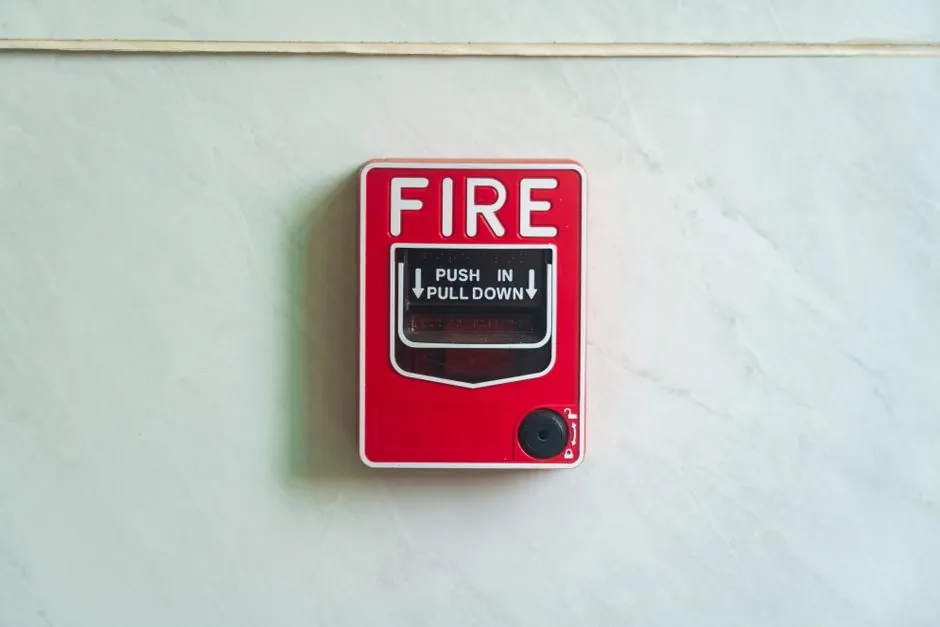
Addressable FACPs at work-at-height sites need loop capacities of 200–250 devices, surface-mountable enclosures between 315 mm and 543 mm tall, and operating-temperature windows that cover at least -10°C to +50°C to survive scaffold and tower environments [S1][S2][S5].
Conventional panels remain an option for single-zone scaffolds: the Fire-Lite MS-5012 delivers 5 initiating zones and 12 notification circuits from 120 VAC with 24 VDC standby, sized 26" H × 16" W × 5" D and 22 lb (10 kg) [S3]. Selection between addressable and conventional types hinges on cable run length, device count, and whether a remote fire alarm control panel is needed at ground level.
Loop capacity and device count: the 200 vs 250-device split
The AFP901 series addressable panel drives up to 250 addressable devices per loop, with a 50 Ohm maximum loop resistance, 300 pF maximum loop capacitance, and 10–18 AWG twisted-pair cabling (2.5 mm² to 1.0 mm²) [S1]. The Honeywell Gent Vigilon VIG1-24/VIG1-72 caps each loop at 200 addressable devices, supports up to 4 or 6 loop cards per panel, and limits RS232 bridging to 15 m cable length [S2]. For a scaffold over 30 m tall, that 200/250-device split is the first gate: a 250-device loop saves a repeater cabinet mid-rise, but a 200-device panel lets you network via fibre optics up to 2 km or RS485 copper up to 1.2 km, which is the relevant metric when the control panel component must be reached from ground [S2].
The Chinese XHA CA200 (referenced in the candidate FACP spec gate) targets 1–6 loops with 254 points per loop and a hard ceiling of 1,524 detectors per panel, drawing 90–270 VAC and running from -10°C to +50°C at ≤95% RH [S5]. The 254-per-loop figure tracks the AFP901's 250, both implying that each device sits on a single addressable node rather than a shared zone.
Enclosure dimensions, weight, and mounting height on the mast
The AFP901 enclosure is 315 mm (L) × 400 mm (H) × 92 mm (W) at 5 kg without batteries, with rear or top cable entries to keep glanded entries away from the lift-off door [S1]. The Vigilon panel measures 543 mm H × 406 mm W × 172 mm D including the outer door, weighing about 10.2 kg plus two 12 V 21 Ah batteries (6 kg each), and is rated IP30 [S2]. The MS-5012 is the largest at roughly 26" H × 16" W × 5" D (about 660 × 406 × 127 mm) and 22 lb (10 kg), built into a red steel cabinet [S3].
Autronica's AutroSafe BS-420/BS-430 system is qualified to EN 54-2 §12.1.6 and EN 60721-3-3:1995 class 3k5, runs from -15°C to +70°C ambient, and is rated IEC-529 IP32, with explicit "Mounting Height / Space Requirements" called out in the installation handbook [S4]. The 92 mm depth on AFP901 versus 172 mm on Vigilon matters when the panel is bolted to a scaffold ledger: the slimmer box fits inside a standard 100 mm kicker rail, the deeper one needs a custom bracket. Cabling entry is the other constraint: a perimeter alarm interface or auxiliary input typically lands at the bottom, so rear entry keeps condensation off the glands.
Power, batteries, and standby sizing for unattended lifts
AFP901 takes 90 to 270 VAC at 50/60 Hz, draws 50 mA standby (no load) and 60 mA standby (full load) at 220 VAC, with an 80 mA alarm current; backup is 2 × 12 V / 4.5 Ah sealed lead-acid batteries with a 0.9 A / 27 VDC charger and a 3 A / 24 VDC PSU rating [S1]. The MS-5012 runs on 120 VAC at 50/60 Hz with a supervised 24 VDC battery standby, drawing 1.5 mA alarm current per the standard Fire-Lite design pattern [S3]. The Vigilon panel uses up to 8 × 12 V 21 Ah batteries in the dedicated battery box, bringing the total panel-plus-battery weight to 55.2 kg [S2].
For work-at-height installs where mains is intermittent, a 24-hour standby target at the 60–80 mA FACP load needs roughly 1.5–2 Ah per day, so the AFP901's 4.5 Ah pack gives 48–60 h of quiescent operation without an alarm event. The MS-5012's larger enclosure typically pairs with 7 Ah or 17 Ah batteries, giving a 24 h + 5 min alarm margin on conventional sounder current budgets.
Operating-temperature window and IP rating: cold-morning vs monsoon tests
AFP901 is rated to the conventional 0°C–49°C office range typical of indoor panels, with no published IP rating beyond the metal back box itself [S1]. The Vigilon operating range is -5°C to +40°C, storage -10°C to +55°C, with up to 90% non-condensing RH between +5°C and +40°C and an IP30 enclosure, all to BS EN 6100-6-3:2001 emission and BS EN 50130-4:1996 immunity [S2]. The XHA CA200 stretches the working range to -10°C to +50°C at ≤95% RH, without condensation control [S5]. The AutroSafe BS-420/BS-430 is the widest at -15°C to +70°C ambient with IEC-529 IP32, per EN 54-2 chapter 12.1.6 [S4].
For a scaffold mast in northern Europe or a tower crane in a tropical port, the Vigilon's IP30 and +40°C ceiling will fail above the 8th floor in summer sun; the AutroSafe's IP32 and +70°C rating covers it. The MS-5012's 0°C–49°C and NFPA 72 indoor UL 864 listing makes it the wrong choice unless the FACP lives inside an insulated cabin [S3]. Where a height gauge is part of the same instrument cluster, mounting the FACP adjacent to it on a vibration-isolated plate keeps the IP rating valid.
Compliance standards: EN 54-2, UL 864, and DIN 14661

The Vigilon is "Designed to EN54-2:1997 + A1:2006" including optional clauses 7.8, 7.9, 7.9.1, 7.10, 7.10.1, 7.11, 7.12.3, 8.3, 9.5 and 10, with LPCB third-party approval [S2]. The AutroSafe BS-420 references EN 54-2 chapter 12.1.6 for environmental qualification under EN 60721-3-3:1995 class 3k5 [S4]. The MS-5012 is UL 864 Listed and NFPA 72 compliant for the US market [S3]. DIN 14661:2016 (with its 2011 predecessor cited in DIN 14661:2011-02) governs the German fire-brigade control panel interface for fire detection and alarm systems, under ICS 13.220.20 [S6].
For EU tower-crane and offshore-platform sites, EN 54-2 plus the relevant local brigade interface (DIN 14661 in Germany) is the binding pair. For North-American high-rise work, UL 864 + NFPA 72 is the equivalent. Specifying a panel only to CE without EN 54-2 is the most common rejection reason at the fire alarm control panel tender stage; pairing a third-party approval (LPCB, VdS, or UL) with the standard is what passes.
Housing material and flame rating for outdoor enclosures
Where the FACP is mounted in a plastic IP65 box on a scaffold, the enclosure material is itself a fire-safety spec. ABS or polycarbonate housings certified to UL94 V-0 self-extinguish within 10 seconds of flame removal and prevent the cabinet from contributing to external fire propagation [S7]. The MS-5012's red steel cabinet is non-combustible by default, but at 22 lb (10 kg) it is the heaviest option in the comparison set [S3]. The AFP901's metal back box delivers the same non-combustible benefit at 5 kg without batteries [S1].
UL94 V-0 is the right material gate for any plastic auxiliary cabinet housing sounder beacons, isolators, or the aerial work platform operator's repeater panel. A V-2 rated housing is a common cost-cut that fails muster on sites with hot-work permits.
Selection matrix: addressable vs conventional for scaffolds, towers, and cabins
Three decision criteria separate the candidate FACPs for work-at-height use: loop count and device density, environmental window, and compliance jurisdiction. On density, the AFP901's 250-device loop and the XHA CA200's 254-point loop and 1,524-point system ceiling both beat the Vigilon's 200-device loop [S1][S2][S5]. On the environment, the AutroSafe's -15°C to +70°C at IP32 covers cold-morning tower-crane sites; the Vigilon's -5°C to +40°C at IP30 suits temperate indoor-plant rooms; the MS-5012's 0°C to 49°C at NFPA 72 covers US indoor-only installs [S2][S3][S4]. On compliance, EN 54-2 with LPCB or VdS third-party approval is the EU gate, UL 864 + NFPA 72 is the US gate, and DIN 14661:2016 is the German fire-brigade interface [S2][S3][S6].
For a single scaffold under 20 m with fewer than 100 detectors, the MS-5012 conventional panel is the cheapest route; for a 30+ storey high-rise with thousands of points, the AFP901 or XHA CA200 with a fibre network and an aerial work truck for panel access is the realistic answer. The Vigilon is the middle ground: it networks up to 2 km on fibre and runs EN 54-2 with LPCB, but its IP30 and +40°C ceiling cap it at indoor-shaded or temperate-climate installs.
Also re-check the XHA CA200 datasheet when the 1,524-point ceiling is published with an updated EN 54-4 PSU compliance line, as that will determine whether the panel is acceptable for European high-rise work alongside the FACP selection for electrical work gate and the broader fire alarm control panel spec gate.