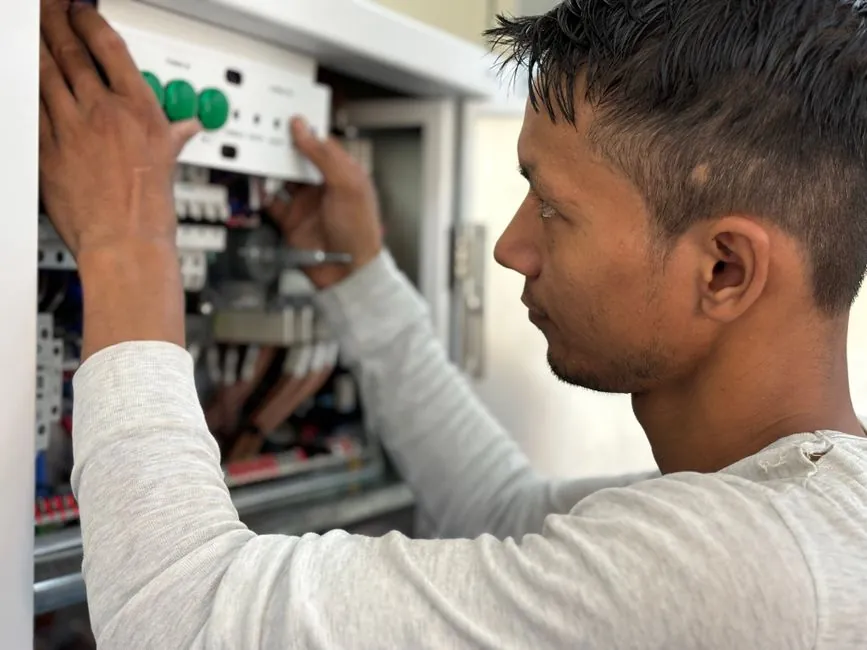
Food processing lines combine grease-laden cooking, dust-heavy grain handling, washdown cleaning and refrigerant-cooled cold rooms, so the fire alarm control panel sits at the centre of four very different hazard zones in the same building.
For greenfield plant builds in 2026, the panel choice normally comes down to 2-zone conventional hardware (CP1002-class units, 2.2 kg cabinet, AC 90-270 V input, up to 25 detectors per zone, 30-detector maximum per panel, 90 dB sounder at 1 m, master-slave ring for up to 31 slaves) versus addressable loops of the GST200N type, with the deciding line drawn at total point count, washdown exposure and required integration with Ansul or Amerex suppression panels [S2][S3][S5].
Hazard zoning inside a typical food plant
Process engineers usually partition a food factory into four fire zones: the hot kitchen or fryer line (grease Class K, surface temperatures above 200 °C), the dry goods / flour / sugar area (combustible dust, ignition-sensitive), the cold store and chiller plant (refrigerant leak risk, temperatures down to -25 °C), and the packaging and palletising hall (high-rack storage with 8-12 m ceilings) [S4].
Each zone pulls the panel spec in a different direction: fryer lines need heat detectors with high IP ratings and a control panel component that can interlock to a kitchen hood suppression circuit, dry-goods areas want aspirating smoke detection wired back to addressable loops, and cold stores demand detectors certified below 0 °C and a panel relay rated to drive refrigerant plant shutdowns [S4][S5].
Conventional vs addressable: the decision gate
Conventional 2-zone panels like the CP1002 list at roughly USD 63-85 per box in 1-9 box quantities, carry CE marking, and run a four-wire sub-loop (Class B IDC) with two 4AH backup batteries in the same enclosure [S2][S3].
Addressable panels such as the GST200N are EN 54 compliant, assign a unique ID to every detector, support hundreds to thousands of points on a single loop, and expose programmable logic for exhaust fans, fire suppression release and emergency lighting, at higher unit cost but with lower per-point commissioning labour [S5]. For a small bakery with fewer than 60 field devices, the conventional topology is the cheaper total installed cost; for a 5 000 m² dairy or ready-meal plant, addressable wins on fault localisation and suppression interlock logic [S4][S5].
Detector pairing and loop loading rules

Heat detectors in a fryer zone should be fixed-temperature around 90-100 °C with a rate-of-rise element, and the panel must accept the detector's EOL resistor so a severed cable triggers a fault rather than a false alarm [S2].
On the dry-goods side, aspirating smoke detection or flame detectors feed the same addressable loop and the panel's cause-and-effect matrix isolates the affected conveyor or silo, instead of tripping a plant-wide evacuation that loses product unnecessarily [S4][S5]. One practical rule: keep detector loading below 80% of the loop current limit so a single short does not brown out neighbouring devices.
Suppression panel interlock
Ansul and Amerex suppression systems use their own dedicated gas alarm controller-style control panels for kitchen hoods and paint or solvent booths, and these must interlock to the building's main fire alarm panel through dedicated Fire 1 and Fire 2 relays rated 2.0 A at 30 VDC [S2][S6][S8].
Bypassing or manually forcing a release on a suppression panel is unsafe; only certified Ansul or Amerex technicians should fault-find suppression electronics, and the main panel is configured to send a holding signal to the suppression panel so discharge only happens after the cause-and-effect condition is satisfied (for example, two cross-zoned detectors in alarm plus a manual pull activation) [S6][S8].
Washdown, IP rating and cabling

Food plants hose down production floors daily, so detector bases and remote indicator bezels need at least IP65, and any control cable run through washdown zones should be PVC-jacketed and routed in stainless conduit to keep cleaning chemicals off the conductors [S4].
Loop integrity matters more than brand here: a single open circuit on a Class B conventional loop will drop the affected zone, while a Class A loop returns through a second path, so addressable loops are normally wired as a ring with isolator bases every 20-30 devices to contain a short [S5]. Cold-store cabling also wants low-temperature PVC or XLPE jackets rated to -30 °C, otherwise the insulation cracks during defrost cycles and produces intermittent faults that look like detector failures.
Compliance, testing and documentation
CE-marked conventional panels and EN 54 compliant addressable panels both meet the baseline for European food plants, but the authority having jurisdiction (fire brigade, insurer, local building control) will require a cause-and-effect matrix, loop loading calculation, and a recorded commissioning certificate before sign-off [S2][S3][S5].
For facility electrical teams working through the EN 54 loop and zoning logic, this FACP selection for electrical work: zones, loops, EN 54 companion guide covers the cable-sizing and loop-loading calculations that pair naturally with the panel choice above. Heat detector placement in cold stores and fryer lines is covered in heat detector selection for firefighting: 2026 hazard map and decision gate, which is a useful cross-check when finalising the detector-to-zone mapping [S5].
Trackable signals for the next planning cycle

Two verifiable signals to watch into Q4 2026: UL 864 listing status updates for the EN 54 addressable panels being bid into US dairy and beverage plants, and any new EN 54-13 compatibility guidance for the suppression-panel interlock relay logic (since this is where most commissioning failures occur in mixed food-and-chemical builds) [S5][S6][S8].
Engineering teams can track both via their panel OEM's quarterly technical bulletin and the EN 54 maintenance logs already kept in the plant's fire system binder.