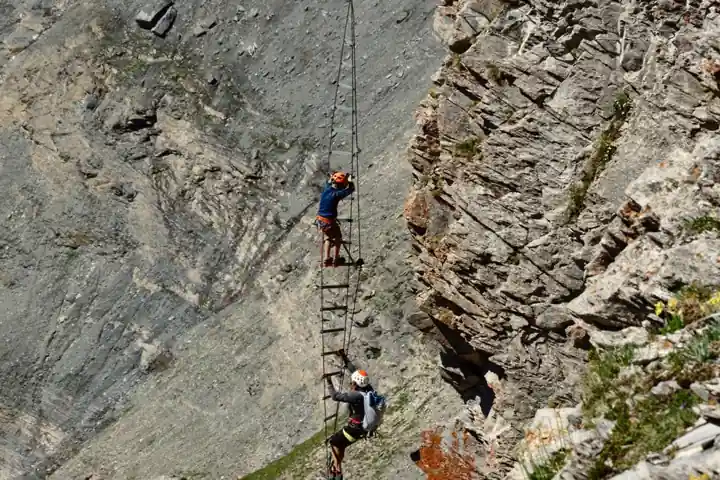
A front sternal D-ring connects a full-body harness to a ladder climbing system, while the dorsal D-ring remains the primary fall-arrest attachment point.
Correct selection depends on attachment function, harness fit, system compatibility, fall clearance, and the intended climbing task.
Front D-Ring Role in Fixed-Ladder Protection
A climbing harness commonly includes a front or sternal D-ring for connection to a ladder climbing system.
The sternal D-ring is specifically associated with fixed-ladder fall protection, while the dorsal D-ring is the primary connection for conventional fall arrest [S5][S10]. A ladder system may therefore use the front ring during climbing without replacing the rear ring used for fall arrest from elevated work areas.
The Werner LITEFIT climbing harness includes a chest D-ring for climbing applications.
Compare D-Ring Functions Before Purchase
D-ring configuration should be matched to the intended function: dorsal for fall arrest, waist or front for ladder climbing, side or hip for positioning, and shoulder for confined-space retrieval [S5].
Side and hip D-rings must not be treated as interchangeable with dorsal or sternal fall-arrest points [S5]. A harness with a sternal D-ring also requires a chest connection appropriate to the complete system, rather than a carabiner selected only by shape.
The comparison is straightforward: a front sternal ring solves the ladder-climbing interface, a dorsal ring addresses conventional fall arrest, a side ring supports positioning, and a shoulder ring supports retrieval. Treating all four as general-purpose tie-off points creates a system-level failure risk.
Who Needs a Sternal D-Ring

Utility technicians, tower workers, and personnel using vertical or fixed-ladder climbing systems need a front attachment when the system design requires a sternal connection [S4][S10]. Front D-rings also support restraint applications where system design restricts free-fall distance [S8].
This harness is not the correct answer for every elevated task. A worker who needs conventional fall arrest from a roof, platform, or leading edge requires a dorsal attachment, not a side ring and not a sternal ring selected merely because it is accessible [S5].
A climbing harness is also not a complete ladder safety system. It must operate with compatible connectors, an anchorage or rail arrangement, and the applicable connector or lifeline. Colorado Safety Supply separates its catalog into harnesses and ladder equipment, including climbing rails, ladders, and ladder anchors, which reflects that system-level boundary [S2].
Engineers evaluating a fall-arrest harness should confirm the intended attachment position before comparing price or padding. A harness carrying more rings is not automatically better if one ring is unused.
Compatibility, Fall Clearance, and System Design
Ladder safety systems constrain free-fall distance, and the front sternal D-ring is used where that constraint is part of the system design [S8]. Connector selection must match the rail or rope interface and the permitted attachment method rather than relying on visual fit.
Three checks should precede installation. First, identify whether the climbing device requires a front, sternal, or waist connection [S1][S3][S5]. Second, confirm that the connector, system, and harness are approved as a compatible combination by the applicable manufacturer or system documentation.
Third, evaluate the complete installation for clearance, anchorage, and approach geometry. OSHA 1926.502(d)(17) fixes the fall-arrest attachment at the dorsal D-ring. That requirement reinforces why a front climbing ring cannot be substituted for a dorsal fall-arrest connection.
For applications where component choice depends on total fall-clearance calculations, the comparison between a self-retracting lifeline and shock-absorbing lanyard is directly relevant to system selection.
Fit, Hardware, and Work Environment

A usable climbing harness must fit the wearer while preserving access to the front D-ring and preventing the connector from interfering with the chest hardware. Harness selection guidance treats fit and adjustment range as primary requirements rather than comfort features [S5].
Material and hardware selection must match the environment. Heat-resistant or Kevlar webbing can be appropriate for hot work, while corrosion-resistant hardware finishes require evaluation in corrosive sites [S5]. These choices affect the harness but do not alter the functional separation between dorsal, sternal, waist, side, and shoulder attachment points.
Hardware options are visible in the market: a six-D-ring category includes a Platinum Tower harness with aluminum D-rings listed at $708.99 [S6]. Aluminum versus steel should not be selected from appearance alone; the specification must account for the working environment, connector compatibility, exposure, and manufacturer instructions.
For crews working around flame, arc flash, sparks, or heat, specialized construction of the protective clothing may also be required. That clothing decision is separate from confirming whether the harness attachment point serves climbing, positioning, retrieval, or fall arrest.
Inspection and Common Selection Errors
D-ring function is only one inspection point. The complete harness, connectors, climbing device, and anchorage must each be inspected under the manufacturer’s procedure, and inspection remains separate from the initial purchasing decision [S5].
A common error is treating a front D-ring as a dorsal fall-arrest point. Another is using side or hip rings for fall arrest even though those points are intended for positioning [S5]. The third is selecting a connector that appears compatible but has not been matched to the ladder system’s permitted interface.
Fit errors add an independent failure path. Loose leg straps, an incorrectly adjusted chest section, or an improperly positioned sternal D-ring can interfere with connector engagement or movement. Operators should verify adjustment range for the actual crew before deployment.
Training must cover the complete sequence: connect before climbing, maintain the prescribed connection to the system, and follow the device instructions during ascent, descent, and work stops. Colorado Safety Supply lists ladder anchors, climbing rails, and training as separate operational elements, reinforcing that the harness is one component of the safety system [S2].
Specification Checklist for Buyers

A compliant ladder-climbing harness specification should identify the front sternal D-ring, full-body construction, intended attachment function, permitted connector interface, size range, webbing material, hardware material, and manufacturer documentation [S1][S8][S9].
The purchase record should also identify whether the harness will perform fall arrest, restraint, positioning, or a combination. Front and sternal D-rings support specific ladder protection tasks, but they do not make a harness universally suitable [S9]. The dorsal D-ring remains necessary where conventional fall arrest is required [S5][S10].
For verification, document 4 points: the D-ring function, the ladder system connection, the connector model, and the inspection requirement. A sixth-D-ring catalog count may help identify product families, but it is not a technical basis for selection; the listed Platinum Tower harness with aluminum D-rings at $708.99 demonstrates that configurations and prices vary [S6].
The next engineering checkpoint is the installed-system review, including the manufacturer instructions for the harness and ladder device, connector compatibility, fall clearance, anchorage condition, and wearer fit. Those verified records provide a more defensible basis than selecting a harness by ring count or brand alone.