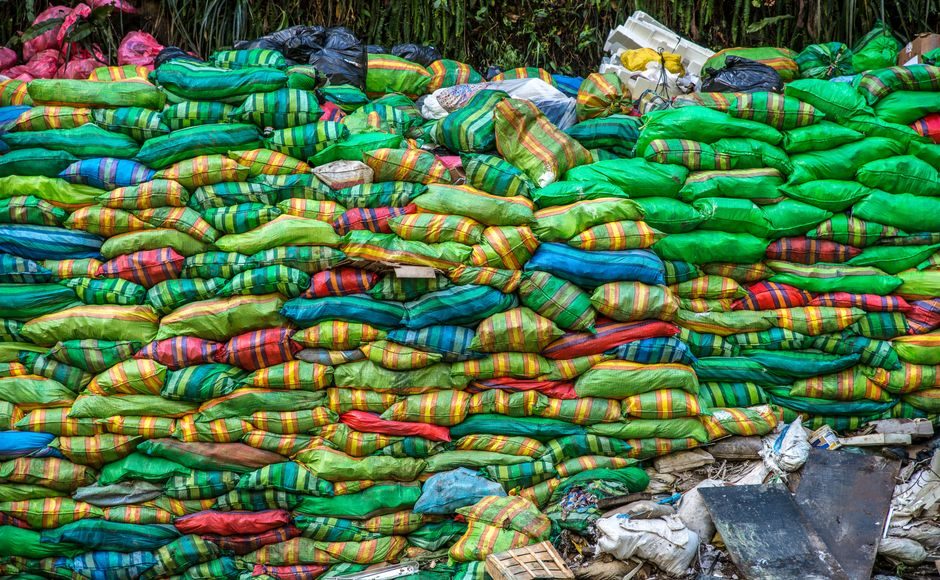
Flexible Intermediate Bulk Containers (FIBCs) and PET strapping band are not substitutes — the first is a primary transport container rated 500–2000 kg per unit, the second is the unit-load closure that secures palletised sacks or coils at break strengths typically 2000–4500 daN.
Specifying the wrong family is the single most common reason FIBC shipments fail at 5:1 SF drop tests: bag body is selected on price, not on electrostatic or food-contact grade [S1][S2].
Material-Grade Map for Woven-PP FIBC Bodies
Jiangsu/Shandong manufacturers supply FIBC bodies exclusively from woven polypropylene (PP) tape fabric, with the four electrostatic variants — TYPE A, TYPE B, TYPE C and TYPE D — defined by IEC 61340-4-4 behaviour and used to match combustible-dust or solvent-vapour hazards [S2][S5]. TYPE A offers no electrostatic protection; TYPE B limits breakdown voltage to ≤6 kV; TYPE C uses conductive yarn interwoven at ≤10⁷ Ω surface resistivity requiring grounding; TYPE D dissipates charge without grounding via quasi-conductive threads [S5].
UV-stabilised 5:1 and 6:1 safety-factor constructions are the standard offer, with 5:1 for single-trip and 6:1 specified when bags are rated for multi-trip warehouse cycles [S1]. Anti-static liner thicknesses between 1.0 and 8.0 mil are stocked as a separate SKU for chemical-product users who need a moisture-vapour barrier plus static dissipation [S1].
PET Strapping Band — Where It Fits in the Same Material Flow
PET strapping band is extruded from polyester (PET) — not PP — and is specified for unitising finished bagged product, not for containing bulk powder. PET replaces steel strapping in the 12–19 mm width range with break strengths of 2200–4500 daN, elongation at break of 10–14 %, and no rust-bleed risk on bagged goods [S8].
For a 1000 kg bulk bag palletised for export, two cross-strapped 16 mm × 0.9 mm PET bands plus edge protectors are the default close — no steel band, no corner-cut hazard, and the PET band survives tropical humidity that would corrode cold-rolled steel [S8].
Decision Matrix: FIBC Variant vs PET Strap for One Tonne of Dry Goods
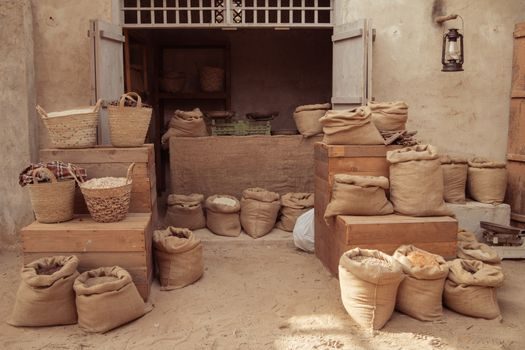
Specifying one tonne of a free-flowing powder, granules or aggregate to a single-use 5:1 SF design at 1000 kg SWL, the comparison reads as follows. [S1]
On payload rating, FIBC 4-panel/U-panel designs support 500–1500 kg rated, with 1500–2000 kg available on reinforced cross-corner and tubular constructions [S1][S5]; PET strap does not carry payload — it only secures already-bagged product. On static safety, TYPE A is acceptable only for non-flammable powders; TYPE C and D are mandatory for MIE below 30 mJ powders or solvent vapours [S5]. On food contact, food-grade FIBC requires a dedicated production line and BRC/ISO 22000 documentation, separate from standard industrial FIBC [S3].
On cost-per-tonne-handled, 1000 kg FIBCs in 1-piece MOQ 1000 lots from Chinese manufacturers cleared FOB at US $6–8/piece in 2026-08 listings, with TYPE D conductive baffled variants at US $6–10/piece [S9].
Which Material-Grade Fits Which Use Case
For a 1–1.5 tonne single-trip shipment of dry sand, cement or fertiliser in non-flammable ambient, TYPE A UV-treated 5:1 SF 4-panel bag with spout top and spout bottom is the baseline — no ground wire, no dissipative thread, lowest unit cost [S1][S5].
For 1 tonne of flour, sugar or starch — combustible dust with MIE around 10–30 mJ — TYPE D dissipative bag is the correct pick, because it eliminates the grounding-fault failure mode that a TYPE C bag would introduce on a worn loom [S3][S5]. For 1 tonne of metal powder or carbon black, TYPE C with verified ground loops and ≤10⁷ Ω surface resistivity is the only defensible option for ATEX zone areas [S5].
For food-grade powders requiring migration testing under EU 10/2011 or FDA 21 CFR 177.1520, only manufacturers running segregated food lines — e.g. JMJ/Codefine's dedicated India food-grade production — should be sourced, and the audit trail (food-grade inner liner, no recycled PP, no ink migration) must travel with the lot [S3].
Failure Modes When Material-Grade Mismatch Occurs
Cross-spec'ing a TYPE A bag for solvent vapour is the documented path to dust-cloud ignition: TYPE A allows brush-discharge up to several kV, enough to ignite MIE ≤30 mJ powders. Selecting TYPE B where TYPE C/D was required removes the MIE guard but still leaves no static bleed path [S5].
Choosing a 5:1 single-trip bag for a multi-trip cycle (e.g. intermediate-bulk returnable loop) is the second most common fail: a 1500 kg bag dropped once at 5:1 SF survives; on the third cycle the webbing shows UV-crazing and loop-stitch creep, with a 6:1 multi-trip bag the only spec that survives a 6-month internal fleet rotation [S1][S5]. Specifying PET strap on a coil-load >1500 kg without edge protectors cuts the band on the first crane-handle cycle, which is why a strapping machine with tension-controlled 60–80 % yield pre-set is paired with 0.9 mm PET, not 0.6 mm [S8].
Sourcing Signals and Standards Discipline
The active 2026-08 sourcing map has 1500 kg class 4-panel and cross-corner FIBCs clearing FOB China at US $6–10/piece with 4-week peak-season lead time and 2-week off-season — a stable range over the past 18 months, with food-grade lines carrying a 2–3 week premium [S9].
Trackable signals to watch: (1) whether the supplier's electrostatic FIBC certificate is tied to TYPE C or TYPE D, with TYPE D supply tightening through 2026 as dissipative-thread weaving capacity remains constrained; (2) whether the strapping line ships with 0.7–0.9 mm PET for carton-unit and 1.0–1.27 mm PET for pallet-strut, with hand-grade embossed bands reserved for sub-300 kg pack [S8][S9]. Specifying the bag body from the bulk bag and the closure strap from the strapping band family as two independent POs is the only structure that lets a buyer audit each line against the correct standard.
Background reading: Color Mark Sensor vs Magnetic Sensor: Safety Integrity Comparison and Selection Map.