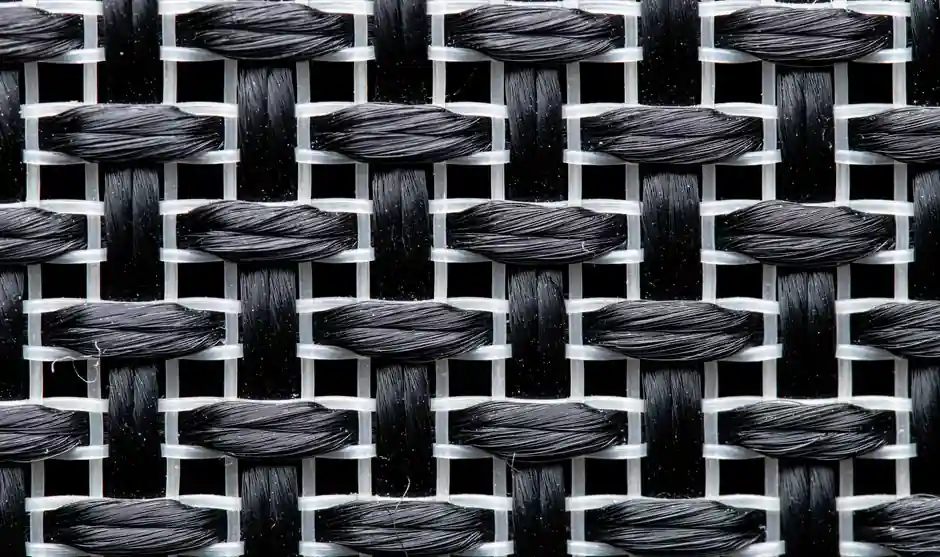
Standard-modulus carbon fiber has an elastic modulus of about 230–240 GPa versus 70–75 GPa for E-glass fiber, making CFRP the stiffness option where deflection controls the design [S1].
GFRP normally costs less per kilogram, while CFRP can cost many times more and generally requires more demanding fabrication, so the economical choice depends on section geometry, load case and production volume [S1][S2][S6].
Stiffness and weight comparison
Bare standard-modulus carbon fiber has a tensile modulus of approximately 230–240 GPa, compared with 70–75 GPa for E-glass, while fiber density is about 1.75–1.9 g/cm³ versus 2.5–2.6 g/cm³ [S1]. The modulus advantage is the decisive engineering benefit because the same geometry deflects less under bending [S1][S3].
Carbon fiber can deliver roughly three times the stiffness of E-glass at standard grades, with some comparative descriptions placing the overall range at three to eight times depending on the carbon grade selected [S1][S3]. That difference allows a thinner or lighter CFRP member in stiffness-controlled applications, but it does not automatically reduce installed cost because material price and fabrication requirements rise sharply [S1][S2].
Carbon fiber is roughly three times stiffer than E-glass fiber, while fiberglass costs much less per kilogram and dominates rebar and other large-volume construction products [S1]. These finished-product figures illustrate why bare-fiber data must not be substituted directly for laminate design values [S1].
Cost structure and comparison
Carbon fiber is materially more expensive than fiberglass because carbon production requires precursor processing, carbonisation and surface treatment, while glass fiber is produced by melting silica-based glass and drawing it into filaments [S1][S2]. Relative material cost is listed as low for E-glass and high, often many times glass, for carbon fiber [S1].
A BoatDesign.net discussion questioned whether building a boat in carbon would cost three times as much as using glass, but the respondents said that no reliable rule of thumb was known [S5]. This is not a universal cost multiplier. Hull construction, a thin mast, a reinforcement strip and a large pultruded channel have different material-to-labor ratios, so total cost requires a component-level estimate [S5].
For a same-geometry stiffness decision, CFRP wins on weight and deflection control, GFRP wins on acquisition cost, and either material may win on installed cost when a deeper GFRP section avoids a thin, labour-intensive CFRP laminate [S1][S5]. The material choice should therefore be priced by function rather than by kilogram alone [S1].
Strength, failure behavior and durability

E-glass fiber has a reported tensile-strength range of 2,000–3,500 MPa, compared with 3,500–5,000 MPa or more for standard-modulus carbon fiber, but failure strain differs: approximately 2.5–4.5% for glass versus 1.5–2% for carbon [S1]. Carbon composites are therefore stiffer and can be stronger without proportionally higher failure strain, while GFRP tolerates more deformation before fiber failure [S1][S4].
CFRP can be more brittle under sudden impact, whereas fiberglass is more flexible and generally better at absorbing impact without cracking [S2][S4]. For impact-sensitive parts, handrails, covers and protective enclosures, GFRP is usually the more forgiving engineering choice [S2][S4].
Chemical and temperature resistance are controlled primarily by the resin rather than by the fiber, and both GFRP and CFRP avoid rusting because they contain no steel reinforcement [S1]. Electrical behavior differs materially: glass fiber is an insulator, while carbon fiber conducts electricity [S1].
Electrical and galvanic corrosion constraints
Glass fiber is electrically non-conductive, whereas carbon fiber is conductive, making this a material-selection criterion for electrical insulation, antenna components and composite-to-metal interfaces [S1]. The conductivity difference is not a defect; it determines whether the composite can perform an electrical function or must be isolated [S1].
Wet contact between CFRP and steel or aluminum can promote galvanic corrosion of the metal, while glass fiber does not create the same issue [S1]. An insulating isolation layer, compatible coating and a project-specific corrosion review may therefore be necessary where CFRP contacts dissimilar metals in wet service [S1].
CFRP is suitable for conductive, lightweight or high-stiffness structures and for uses where its electrical behavior is intentional. GFRP is better for electrical insulators, large wet industrial structures and applications where contact with steel or aluminum makes galvanic isolation a priority [S1][S4].
Use-case selection
Choose GFRP for grating, ladders, poles, tanks, pipes, rebar, boat hulls, construction panels and general industrial products where corrosion resistance, impact tolerance, simple fabrication and material cost dominate [S1][S2][S4]. The same GFRP structural family can be deepened to control deflection, often at lower total cost than switching a long member to carbon [S1].
Choose CFRP for aircraft structures, racing components, high-end sports equipment and strengthening strips where high stiffness-to-weight performance has direct operational value [S1][S2][S4]. Carbon fiber is also appropriate when minimum mass justifies higher material and fabrication cost, including thin-wall designs that use the modulus advantage to reduce section thickness [S1][S5].
Do not choose CFRP merely to obtain greater tensile strength when the service limit is deflection, impact damage, galvanic isolation or acquisition cost. Conversely, do not accept GFRP merely because it is cheaper if dimensional stability, weight or fatigue performance is the controlling requirement [S1][S4].
Fabrication and specification discipline
GFRP commonly uses polyester, vinyl ester or epoxy resin and can be manufactured through practical processes such as pultrusion, open-moulding or closed-moulding, while CFRP fabrication is more demanding and generally costs more for the same component [S2][S6]. A component-level comparison must include fibre, resin, labour, tooling, finishing, inspection and scrap rather than raw reinforcement cost alone [S5][S6].
For a like-for-like comparison, specify the same resin family, fibre architecture, finished geometry and test basis. E-glass woven cloth, chopped-strand mat, unidirectional carbon and pultruded carbon do not form a valid one-variable material comparison [S1][S2]. Verify the tested datasheet for the actual product, since listed fiber properties are indicative rather than laminate properties [S1].
The deeper stiffness-to-weight selection guide covers the structural comparison, while the material families described in FRP composite and carbon fiber provide the relevant constituent definitions. For related ceramic alternatives, use alumina ceramic only when wear, hardness and temperature requirements displace polymer composites.
The next trackable procurement step is a component-by-component estimate using fiber grade, reinforcement form, resin, section geometry, allowable deflection, environmental exposure and installed assembly cost, followed by verification of the finished laminate or profile datasheet.