Mineral wool batt insulation provides 22–37% more R-value per inch than fiberglass insulation, making it the stronger choice when wall thickness is constrained [S2][S3].
Both materials can meet labeled thermal requirements, but mineral wool costs more, performs better under moisture and fire exposure, and is better suited to premium walls and acoustic applications [S4][S5].
Thermal Performance by Thickness
Mineral wool has the higher thermal resistance per unit thickness, with an R-value advantage of 22–37% over fiberglass in buyer and contractor comparisons [S2][S3]. This advantage matters in a 2 x 6 wall: the Insulation Institute cost model lists R-21 fiberglass and R-23 mineral wool, so mineral wool adds 2 R-values in the same 6-inch stud depth [S5].
The documented comparison in the Insulation Institute material includes R-21 fiberglass and R-23 mineral wool in a 2 x 6 assembly [S5]. In the cited Nebraska project, mineral wool increased the nominal value from R-21 to R-23 while costing $988 more for 1,128 square feet of wall cavity area, excluding stated membrane and installation costs [S4].
Decision Matrix: R-Value, Cost, Moisture and Fire
For thermal performance, mineral wool wins: buyer guidance gives it 22–37% higher R-value per inch [S2][S3]. The Insulation Institute model gives consumer costs of $1.19 per square foot for R-15 kraft-faced fiberglass, $1.51 for R-15 mineral wool, $1.72 for R-21 kraft-faced fiberglass, and $2.16 for R-23 mineral wool [S5].
For moisture and fire exposure, mineral wool has the stronger specification profile because it is hydrophobic, mold resistant, and fireproof, while fiberglass generally costs almost half as much [S4]. Neither material should be treated as immune to installation defects: compression, gaps, improper fitting around framing, and damaged facing can reduce labeled thermal performance.
Cost and Installation Tradeoffs
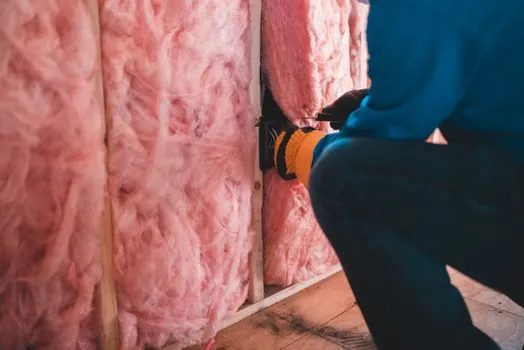
Fiberglass is the practical choice for builders with a fixed budget, conventional 2 x 4 framing, and a schedule that rewards readily available batts. In the Insulation Institute comparison, fiberglass and mineral wool were both described as cost-effective routes to desired labeled thermal performance, and the two materials together represented 72% of insulation material in new homes [S5].
Mineral wool provides a 22–37% higher R-value per inch than fiberglass and helps control sound, while moisture and fire resistance may also be valued on projects where those properties are specified [S2][S5]. The Nebraska case shows the procurement problem clearly: 54 bundles of R-23 mineral wool required 3.2 pallets, so the estimator rounded to 3 pallets while acknowledging that stud area could materially change the final quantity [S4]. The quantity of mineral wool batts required and the associated pallet considerations can affect procurement planning [S4].
Installability also affects the delivered result. Paper-faced fiberglass provides a visible vapor-retarder layer that can be stapled flat to framing and overlapped between batt sections [S4].
Use Cases and Material Selection
Choose fiberglass batts for conventional wood-frame walls, large volume residential work, and projects where labeled R-value is the primary acceptance criterion and material cost is tightly controlled. The modeled 2 x 6 option was R-21 kraft-faced fiberglass at $1.72 per square foot to the consumer, compared with $2.16 for R-23 mineral wool [S5].
It is also the stronger choice for reducing cavity thickness while retaining thermal resistance [S1][S2][S4].
Mineral wool is not the automatic answer for every thermal application. Both fiberglass and mineral wool are made from naturally non-combustible fibers, and both are presented as effective for thermal performance and sound control [S5]. If the project has a controlled budget, standard wall depth, and no explicit requirement for hydrophobic or enhanced fire behavior, fiberglass normally delivers the lower total installed cost.
Performance Limits and Quality Control
Thermal labels describe the insulation under defined test conditions, not the complete wall assembly. A nominal R-21 fiberglass batt does not guarantee R-21 performance after compression, installation gaps, air leakage, or wet material; the cited $736 R-21 fiberglass option remained materially cheaper than the $1,444 mineral-wool material estimate because of the associated membrane and product-cost differences [S4].
Mineral wool batts provide a 22–37% higher R-value per inch than fiberglass batts [S2]. Specifiers should verify the labeled R-value, cavity depth, facing type, fastener compatibility, and local code requirements for each product rather than compare product families only by generic names.
Sourcing and Applicable Standards
The Insulation Institute material includes R-15, R-21, and R-23 labels, 2 x 4 and 2 x 6 stud cavities, and material costs [S5]. The Insulation Institute model also distinguishes unfaced and kraft-faced fiberglass and uses 16-inch on-center wood-frame walls [S5].
Use the manufacturer's current product label and the project code for final acceptance. The cited comparison establishes a decision range, not a universal design value: mineral wool is 22–37% higher in R-value per inch, while modeled consumer cost ranges from $1.19 to $1.72 per square foot for the listed fiberglass options and $1.51 to $2.16 per square foot for the listed mineral wool options [S2][S5].
For the next procurement review, obtain three comparable quotes covering the same R-value, stud depth, facing, and wall area, then compare installed cost per square foot and per R-value rather than unit price alone [S5].