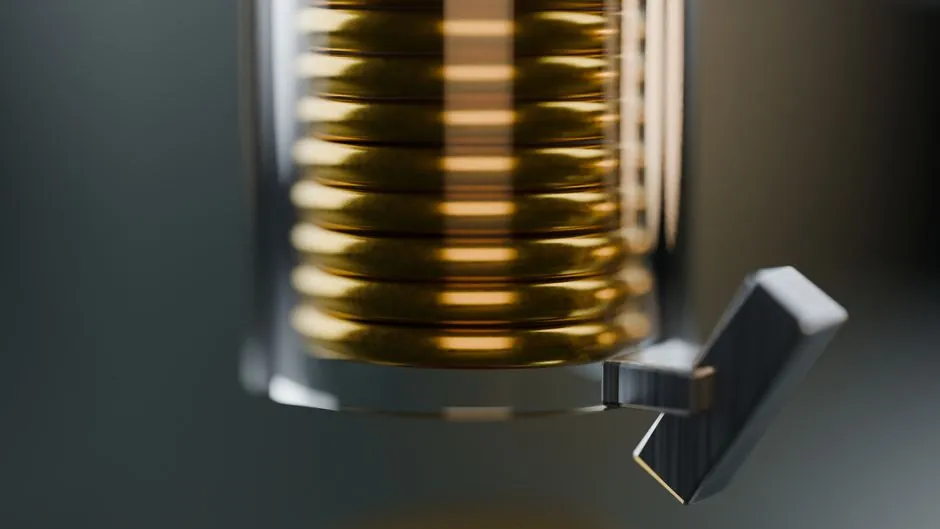
A chemical anchor filling washer can close a clearance gap with epoxy or mortar exceeding 40 MPa, allowing a multi-anchor connection to transfer shear load across the group rather than concentrating it in the row nearest the loaded edge [S1].
Ramset offers zinc-plated AGWM washers in M10, M12, M16, M20 and M24 versions, each providing 5 mm of additional fixture thickness, with internal diameters of 12, 14, 17, 21 and 25 mm and external diameters of 26, 28, 34, 41 and 48 mm, respectively [S1].
Why the Clearance Gap Changes Anchor-Group Behavior
The annular gap is the empty space between an anchor shaft and the larger clearance hole through a base plate or profile. Its presence allows the fixture to slide before load reaches the anchor group, so shear can initially be carried by only the anchors nearest the load direction [S1][S2].
AS 5216:2021 addresses this load path by considering shear applied to the front row of anchors closest to a nearby edge. Filling the gap creates a rigid connection, transfers load from the base plate, and distributes it more evenly through all rows in the connection [S1].
European concrete-anchor design under EN 1992-4 treats the connection differently depending on gap treatment: an adequately compressed fill can support group action, while an unfilled clearance requires hole-clearance provisions and reduced shear behavior [S2]. For seismic assessment, filling also removes initial slip and the impact effect associated with a fixture striking an anchor [S2].
Compare the Three Filling Arrangements
Open injection, a dedicated washer and a supplier-specific filling kit all act by placing a compressive fill between the anchor rod and the clearance-hole wall. The engineering distinction lies in installation control, geometry and whether the specified anchor system has an approved assembly [S1][S2][S5].
Open injection uses the anchoring adhesive to fill the ring around the installed rod. It exposes the filled perimeter for visual inspection and avoids a dedicated accessory, but it is not automatically acceptable for every anchor approval [S2]. A filling washer controls the fill location and can serve as the final installation step, while a supplier-specific kit adds a filling disc, spherical washer and lock nut for a defined assembly [S2][S5].
The choice should follow the anchor approval, hole geometry and design software assumptions, not accessory branding alone. A dedicated kit is justified when the specification or ETA requires that specific approved assembly; otherwise, open injection using the anchor adhesive is the baseline method [S2].
Match Washer Geometry to the Anchor and Hole

Ramset AGWM washers cover M10 through M24 anchor configurations with internal diameters of 12, 14, 17, 21 and 25 mm. Their external diameters are 26, 28, 34, 41 and 48 mm respectively, and each washer has a 5 mm or 6 mm thickness [S1].
These washers are not interchangeable solely because their nominal anchor sizes match. The internal diameter must suit the anchor rod, the external diameter must suit the fixture hole, and the washer must be compatible with the selected adhesive and anchor system. MKT states that its washer can accompany BZ plus wedge anchors and BSZ concrete screws or replace the washer on VMZ, VMH, VMU plus and VME injection systems [S5].
Check Material Strength and Installation Limits
Ramset requires the annular gap to be filled with high-strength epoxy or mortar having compressive strength greater than 40 MPa [S1].
MKT specifies the same installation sequence: apply installation torque first, then inject adhesive through the mixer reducer tip until adhesive seeps out [S5]. The MKT Filling Washer VS permits larger holes in the attached item and can increase allowable shear loads under seismic loading, but when choosing an anchor, the thickness fastened must be reduced by up to 6 mm [S5].
These dimensional reductions can affect bracket geometry, projection, washers, nuts and the grout or bearing surface. They must be included in the fixture design rather than treated as an installation detail. Chemical-anchor selection also requires confirmation of the approved resin, embedment, installation parameters and substrate conditions, as described in the chemical anchor reference.
Use It for Grouped Shear and Seismic Connections
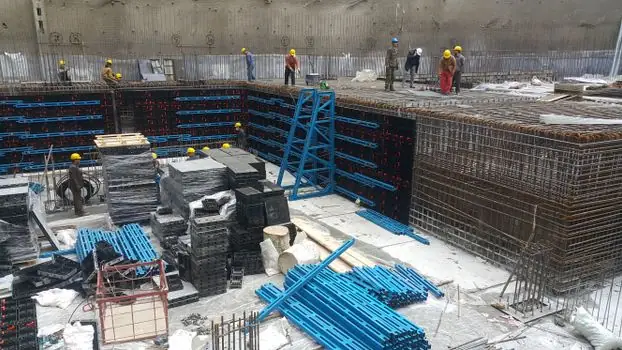
A filling washer is appropriate when a through-profile chemical anchor must act as part of a rigid group under shear, especially with multiple rows or several anchors sharing a base plate. ICCONS identifies annular-gap filling with high-strength epoxy anchors as a method for ensuring even load distribution in seismic design under AS 5216:2021 [S4].
It is less relevant to a single isolated anchor whose governing action is tension, provided the connection has no stated requirement to eliminate fixture clearance. It is also unsuitable as an unverified substitute for a compliant anchor system. An Hilti engineering enquiry records that its filling washers were available only up to M24 when a project required filled holes for a three-bolt arrangement [S3].
For a four-fastener group subject to shear perpendicular to a nearby edge, AS 5216:2021 is the relevant Australian design method cited in the Ramset system data. That document addresses the four-fastener condition, while the independently tested filling system is associated with EAD 330232-01-0601 for mechanical fasteners used in concrete [S1].
Quality-Control the Filled Connection
A complete fill should be verified before the fixture is loaded. Ramset washers include an inspection port and a filling port, allowing installation personnel to confirm the annular space has been filled without dismantling the base plate [S1]. MKT uses the same functional approach, instructing the installer to inject until adhesive seeps out [S5].
Open injection offers a visible adhesive ring for quality control, whereas an enclosed dedicated kit makes inspection more difficult [S2]. That distinction matters on multi-anchor installations, where voids in one washer can leave that anchor outside the intended load-sharing group even if the remaining anchors are correctly installed.
For through-installation applications, the expansion anchor and architectural hardware references help separate clearance-hole behavior from fixture geometry, washer seating and load-transfer details. The design record should identify the washer part number, internal and external diameters, fixture-thickness reduction, adhesive grade, cure regime, installation torque and the final inspection method.