Chemical anchors can retain performance in dry, wet, water-filled, and submerged holes, but each condition must be covered by the product approval before its characteristic resistance is used for design [S2][S4][S5].
The selection process covers resin chemistry, concrete cracking, embedment depth, hole condition, gel and cure time, edge distance, anchor spacing, and the required tension, shear, seismic, or combined loading [S1][S3][S4].
Wet and submerged conditions require separate qualification
Three hole states must be distinguished in an installation specification: dry, wet or flooded, and submerged. Chemical anchor systems can be formulated for these conditions, but suitability is not universal, and the manufacturer or approval document must explicitly cover the actual base-material condition [S2][S5].
Among the Hilti products listed, one injectable epoxy mortar is approved for dry, submerged, and water-filled concrete, while some hybrid mortars are approved only for dry and water-filled holes [S2]. This product-level distinction matters because the approval defines the conditions under which the published resistance values may be used, rather than merely showing that the resin can be dispensed into water.
Chemical anchors are used for applications including cracked and uncracked concrete, lightweight concrete, grout-filled CMU, and post-installed rebar connections, depending on the system [S2]. For comparison, normal-weight concrete has an approximate unit weight of 150 lb/ft³, while lightweight concrete is approximately 115 lb/ft³ [S1].
Design resistance starts with an approved bond model
Bonded-anchor resistance is calculated within a limit-state framework that separates actions from resistance and includes steel failure, concrete cone failure, splitting, combined pullout and cone failure, pry-out, and edge failure modes [S3]. The bonded-anchor design method addresses cracked and uncracked concrete, anchor groups, load direction, concrete members, and the relevant safety class [S3].
The characteristic resistance is not simply the rod tensile capacity. It must remain consistent with the approved anchor system, base material, installation parameters, concrete condition, edge geometry, and applied load. EOTA Technical Report TR 029 provides the technical framework for bonded anchors, including partial safety factors for resistance and separate serviceability checks [S3].
Installation geometry remains part of the resistance calculation. Minimum spacing and edge distances reduce available resistance because an anchor group can interact through splitting or overlapping concrete cones. The governing minimum spacing and edge distance must be taken from the product approval, and the design must satisfy the requirement that design action does not exceed design resistance [S4].
Resin performance changes with water exposure
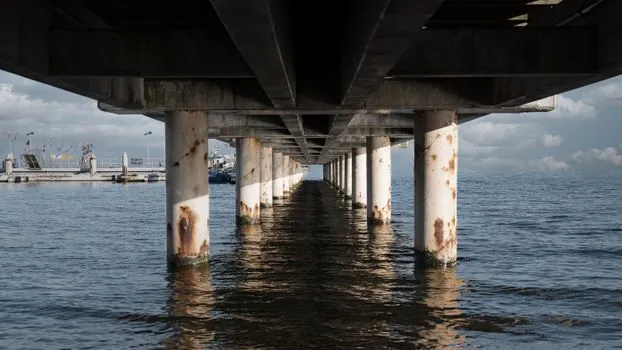
Water can affect both the installation process and the long-term bond interface, so a resin classified for a dry hole cannot be transferred to a flooded or submerged application without qualification [S1][S5]. The engineering decision is based on verified hole-condition approval, resin chemistry, curing state, and substrate condition rather than on the general observation that some chemical anchors work underwater [S2][S5].
A submerged-condition study found that the average pullout strength of polyester-resin anchors installed under water was approximately one-third lower than the comparison value [S6]. That result is specific to the tested polyester system and conditions, not a universal reduction for epoxy, hybrid, or cementitious adhesives, but it demonstrates why a generic wet-hole capacity is unsafe to use for submerged design.
Polyester, epoxy, and cementitious systems should therefore be compared separately by approved substrates and hole conditions. Epoxy mortars are offered for cracked concrete, uncracked concrete, submerged holes, and water-filled holes in at least one listed approval [S2]. The listing shows why resin family, strength class, approval, and installation environment must be evaluated as a package.
Compare anchors against four design criteria
Wet-hole suitability is a pass-or-fail approval condition, not a measure of overall capacity. A chemical anchor should be compared against mechanical anchors on approved base materials, hole condition, installation sequence, and resistance behavior.
Mechanical anchors suit many beam, column, and slab connections, while chemical anchors address applications where a mechanical expansion mechanism is unsuitable or where the product approval covers cracked concrete, rebar connections, or difficult geometry [S2][S4]. The chemical anchor category is appropriate when load, substrate condition, and environmental exposure require a bonded system rather than an expansion shell.
Installation variables can invalidate a nominal capacity
At least eight installation variables can change the achieved resistance: concrete strength, cracking state, aggregate type, hole diameter, hole condition, embedment depth, cleaning method, and cure history. Normal-weight and lightweight concrete both occur in anchor applications, and precast concrete may contain thinner sections than cast-in-place members [S1][S2].
Aggregate is not a neutral variable. The relationship between aggregate properties and adhesive-anchor performance is not fully understood, so test results from one aggregate should not be assumed to represent all concrete aggregates [S1]. Reinforced concrete also permits cracking, which matters because approval for cracked concrete imposes different design conditions from approval for uncracked concrete [S1][S2].
For dual-action capsule systems, the listed installation-temperature range is -18 to 104 °F, and diamond drilling is addressed by the cited DD 30-W SAFEset option [S2]. These figures belong to the named product configuration and should not be transferred to another resin or capsule system. Likewise, drilling with hammer, rotary, or diamond equipment and the clearance-hole diameter must match the installation instructions and approval [S4].
Verification must follow product documentation and approval
Design documentation should identify the exact resin, anchor element, concrete class, cracking state, installation depth, edge distance, spacing, load direction, and environmental condition. The expansion anchor comparison is useful when weighing installation speed against bonded-system requirements, but the governing values must come from the approved product documentation. [S4]
For a submerged connection, require written evidence that the specific mortar or capsule is approved for submerged concrete. Record whether the hole is dry, wet, water-filled, or submerged, and verify that the adhesive was placed without voids and held for the specified cure period before loading. If the approval does not cover the condition, the design should not assign a reduced capacity by assumption; it should use a qualified alternative or another approved system.
Chemical attack is a separate resistance check from water exposure. Anchor material must be resistant to substances with which it contacts, so a water-service installation in a chemical plant still requires compatibility review for the resin, metal, hole contents, and surrounding exposure [S1]. For projects with repetitive wet or submerged fixings, the concrete admixture and base-material decisions should also be coordinated with the anchor submittal rather than treated as separate package issues.
The trackable decision points are the approved hole condition, the published characteristic resistance for that condition, and the installation record showing correct embedment, cleaning, placement, gel time, and cure time. Any gap in those three records means the design resistance is unverified, regardless of the resin's general reputation for underwater use.