
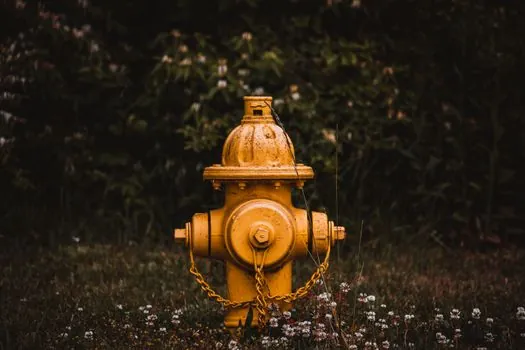
Fire hydrant nozzle height above finished grade is set by local jurisdictions, not by a single national rule, and the four most-cited U.S. codes prescribe an envelope from 16 in to 30 in measured to the bottom of the lowest outlet, with 18 in the most common minimum [S1][S2][S7].
U.S. municipal standards diverge enough that a hydrant set to NFPA 291 flow requirements can still fail inspection on grade, because the vertical dimension is governed by city or water utility spec, not by the AWWA C502 hydrant itself. Engineers and contractors pouring hydrant bases in 2026 should treat nozzle-to-grade as a permit-driven number, not a manufacturer default.
Lowest-outlet rule: the 16-30 in envelope and where it applies
Painesville, Ohio Code 939.01(b) sets the widest published band, requiring the bottom of the lowest nozzle to sit no less than 16 in and no more than 30 in above surrounding finished grade, with the measurement taken at the lowest nozzle on the hydrant barrel [S1]. That same ordinance ties the hydrant body to AWWA Standards and mandates a 6 in barrel, a steamer connection, and two 2.5 in hose connections with national standard thread [S1].
Clarkston, Washington (Chapter 9.20) and LaVerkin, Utah (Section 8-7-5) collapse the band to a single floor, requiring the lowest outlet to be at least 18 in above finish grade, with the hydrant set plumb on a concrete foundation of at least 18 in [S2][S7]. For a typical dry-barrel fire hydrant these rules govern how tall the above-grade barrel must be ordered from the factory, and they interact with bury depth because a 5.5 ft bury hydrant installed too deep will fail the lowest-outlet minimum.
Pumper (steamer) connection: the separate 18-24 in band
Fire Hydrant Installation Criteria (up.codes viewer) specifies the steamer or pumper connection at a minimum of 18 in and a maximum of 24 in above grade, treated as a dedicated dimension independent of the 2.5 in hose nozzles [S8]. That band lines up with the 1940 AWWA standard guidance calling for at least 4 in clearance on hydrants with two 2.5 in nozzles and at least 5 in on hydrants with three 2.5 in nozzles, originally written to keep hose caps clear of snow and curb [S3].
Bullhead City, Arizona tightens the upper bound to a maximum of 4 in above sidewalk or finish grade, measured at the above-grade flange, which is a much closer-to-grade limit than the 30 in ceiling in Painesville or the 24 in steamer ceiling in the IFC-derived criteria [S4]. The spread, 4 in to 30 in, is the practical range a spec writer will see walking U.S. jurisdictions in 2026, and the right number is whichever AHJ signed the permit.
Ground-ring vs nozzle: two different reference planes
Metropolitan Utilities District of Omaha Construction Standard 3.0.1 (effective 5-10-23, latest revisions posted 12-03-2025) measures to a different reference: the hydrant ground ring, which must sit at ground level to no more than 2 in above the finished grade, with the finished grade at curb installations defined as the top of curb elevation adjacent to the hydrant [S5]. For a curb-set hydrant in MUD territory, the ground ring governs, not the lowest nozzle centerline, and the spec mandates plumb installation with level outlets.
That creates a two-plane problem: the ground ring (flange) and the lowest nozzle can each fail independently, so a hydrant can be ring-compliant at 1 in above grade and still violate a 16 in or 18 in lowest-outlet rule if the barrel is too short. Specifying a pressure transmitter for the test header downstream does not change either dimension, but engineers running flow tests per NFPA 291 still need both planes documented on the as-built.
Comparison: four jurisdictions, four different height rules
Side-by-side, the codes split on reference plane, lower bound, and upper bound: Painesville uses the bottom of the lowest nozzle with a 16-30 in band [S1]; Clarkston and LaVerkin use the lowest outlet with an 18 in minimum and no explicit maximum [S2][S7]; the IFC-derived criteria use the steamer connection with an 18-24 in band [S8]; Bullhead City uses the above-grade flange with a 4 in maximum and no explicit minimum [S4]; MUD uses the ground ring with a 0-2 in band and an 18 in lowest-outlet expectation carried over from neighboring specs [S5].
The decision criteria for an engineer or inspector boil down to three: which reference plane does the AHJ measure to (lowest nozzle, steamer, ground ring, or flange), what is the lower bound (16 in or 18 in most common), and what is the upper bound (2 in for ground ring, 4 in for flange, 24 in for steamer, 30 in for lowest nozzle). On cost there is no meaningful spread, because the same AWWA C502 hydrant with different bury lengths satisfies every band, but on lead time a 7 ft bury versus a 5.5 ft bury can add factory cycle time when the wrong spec is ordered.
Adjacent-infrastructure dimensions that interact with nozzle height
AWWA 1940 guidance adds a clearance-of-hose-caps rule: at least 4 in for two-nozzle hydrants and at least 5 in for three-nozzle hydrants, sized so the caps clear curb and snow [S3]. MUD extends the adjacent-infrastructure discipline by requiring the hydrant centerline 3 ft from the back of curb, no portion of the hydrant or nozzle cap closer than 6 in to any sidewalk, and a minimum 10 ft separation from any sewer inlet or manhole unless the engineer approves otherwise [S5].
For a hydrant set between curb and sidewalk, the nozzle-clearance dimension can dominate the height decision: a 4 in or 5 in cap clearance plus a 6 in sidewalk setback plus a 16-18 in lowest-outlet minimum stack, and the hydrant ends up taller than the textbook 18 in. Mueller's 2020 maintenance best-practices piece flags incorrect height as a vehicle-impact risk, which is the same failure mode Bullhead and MUD try to suppress with their tight upper bounds [S6][S4][S5].
Selection and verification workflow for new hydrant installations
The defensible 2026 workflow is to (1) pull the AHJ ordinance and the serving water-utility standard before ordering the hydrant, (2) identify the reference plane the AHJ measures to, (3) match bury depth to that plane plus the adjacent-infrastructure setbacks, and (4) document the as-built with both ground-ring elevation and lowest-outlet elevation on the same sheet [S1][S2][S5]. On a flow meter test header the same as-built should record the steamer-centerline height so the 18-24 in IFC check can be verified in the field.
Hydrants that have been in service since before 1990 are a separate case: Painesville Ordinance 27-90 was passed 8-20-90 [S1], and Clarkston's 1977 ordinance already required replacement non-conforming hydrants to be brought up to current standard when renewed [S2], so any inspection in 2026 of a pre-1990 hydrant should expect either a documented variance or a replacement order.
Limitations, conflicts, and what the codes do not cover
None of the cited codes address clearance to overhead power lines, signage sight-lines, or vertical clearance for tall apparatus, and the 30 in Painesville ceiling is wide enough that a hydrant set at 28 in is technically compliant but a tripping hazard for caps being removed by hand [S1]. Bullhead's 4 in flange maximum and MUD's 2 in ground-ring maximum solve the trip and vehicle-impact risk but create their own problem: in regions with deep snow, a hydrant set 2 in above grade can be buried for weeks, which is why northern jurisdictions gravitate to the 16-30 in lowest-outlet band instead [S4][S5][S1].
There is also no U.S. national mandate harmonizing these numbers, and the AWWA C502 standard covers the hydrant as a factory artifact rather than its installed elevation. The 1940 AWWA piece is the closest thing to a national reference and it stays silent on finished-grade height, focusing only on nozzle-to-nozzle clearance [S3]. For a related read on field-instrument selection that follows the same AHJ-driven pattern, see the category-4 safety-circuit piece on redundancy depth beyond simple duplication, which carries the same "verify before specifying" discipline.
Trackable signals to watch: any 2026-2027 revision to AWWA C602 (trench installation) that pulls in a finished-grade tolerance, and any ICC action on the IFC fire-hydrant criteria chapter that would shift the 18-24 in steamer band into a single statewide number.
Related analysis: Smart Camera OCR: Pixel Height Targets, FOV Math, and Sensor Sizing.