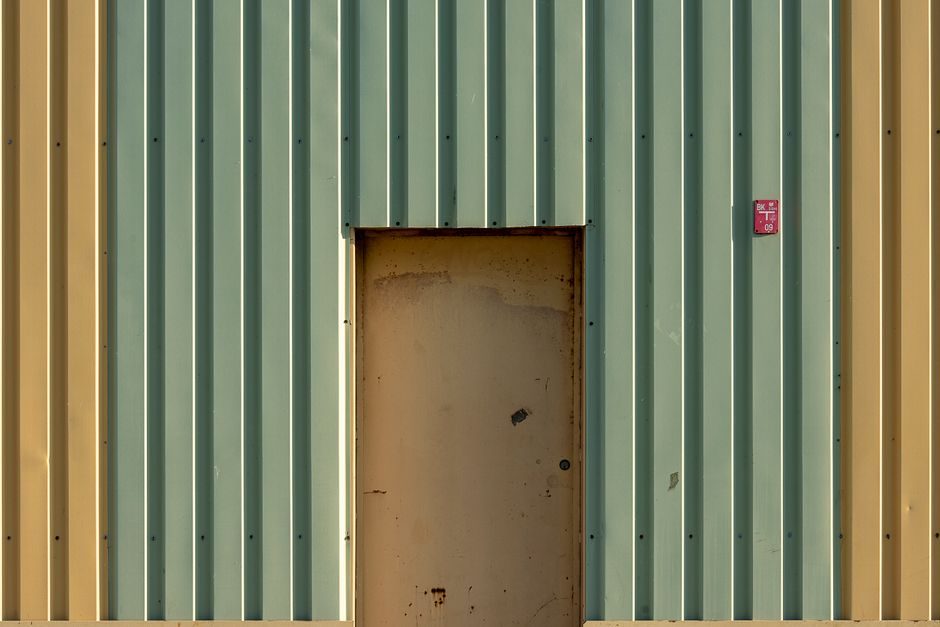
Specifying a fire-rated door for a dust-collection line is not the same as picking one for an office corridor: the door must satisfy a fire-resistance rating (typically 30, 60, or 90 minutes) AND survive a continuously negative-pressure, particulate-laden, often combustible-dust environment [S1][S5].
Trudoor lists 90-minute fire-rated commercial steel doors with frames from $350 list, sized for personnel and equipment access on industrial envelopes [S1]. Tongxiao documents 30/60/90-minute ratings on double-leaf steel doors, 40–50 mm leaf thickness, class A/B/C fire rating, for equipment-pass-through duty [S5]. Neither listing alone resolves the dust-collector case; both define the rating axis you must confirm on the data sheet.
Fire-Rating Class and Label Geometry That Actually Match the Duct
ASTM E152 / UL 10C fire ratings are tested on a specific wall orientation, leaf configuration, and maximum size, and the label on the door lists all three [S1]. Selecting a 90-minute door at the wrong size or in a non-listed frame voids the label and the AHJ will reject it [S1].
For dust collection, the dominant configurations are single-leaf personnel doors (typically 3'-0" × 7'-0" / 914 × 2134 mm) for bag-access and clean-out, and double-leaf equipment doors (6'-0" × 7'-0" and up) for filter and cyclone replacement [S5]. Confirm that the listed size envelope on the label covers the cut-out you actually have in the collector housing, not just the nominal dimension.
Dust-Tight Sealing vs Fire-Rated Gasketing — Different Problems
Fire-door listings test with intumescent and smoke gasketing around the perimeter, but they do NOT certify dust-tightness, and dust gasketing (EPDM, silicone, brush) is not fire-rated in the same test [S1][S2]. A door can carry a 90-minute label and still leak fines at the head and jamb, raising fugitive-emission and ignition-source exposure.
The engineering fix is to specify gasketing as a separate line item with both properties declared: an intumescent seal listed for the same rating, plus a compression-set-resistant dust seal on the dust-side of the leaf. Nystrom's insulated fire-rated access door (IT/IW/IP series) is one example of a steel, powder-coated access panel with latch and lock options for wall or ceiling use [S2]. The same idea scales to full-size dust-collector doors: list both seals, both test references, and install the dust seal to a removable retainer so it can be replaced without breaking the fire-rated gasket.
Pressure Regime and Door-Swing Direction
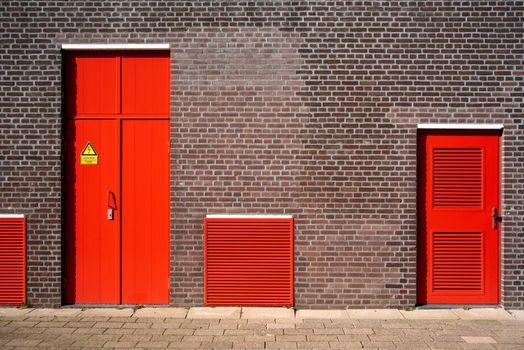
Dust collectors run at negative pressure typically -2 to -8 in. w.c. (-0.5 to -2.0 kPa) at the housing, with peaks above that during pulse-jet cleaning cycles. A standard fire door is not tested under sustained negative pressure on the cold side, and an inward-swinging door can be held partially open by the pressure differential, breaking the latching the listing depends on [S1].
Specify the swing direction relative to the higher-pressure side and confirm with the AHJ. For personnel doors on a vacuum side, outward-swinging (away from the higher pressure) is the conservative choice, and the latch must be a listed fire-door latch, not a commodity gate latch. If the door must be inward-swinging due to egress geometry, the spec should call for a listed self-latching device that positively latches against the differential, with an audible latch-throw indicator.
Construction Materials and Deflagration Context
NFPA 652 and NFPA 654 govern dust hazard analysis and deflagration protection on dust-handling equipment. The door itself is passive, but it sits in the wall of equipment that may be subject to deflagration venting; the door must not become a secondary projectile hazard or a leakage path that feeds a secondary dust cloud. Cold-rolled steel with welded seams (typical of the 40–50 mm leaves in [S5]) resists deformation better than hollow-core or honeycomb-core constructions [S5].
For lines handling metal dusts (aluminum, magnesium, titanium), specify non-ferrous or spark-resistant hardware on the dust side — hinges, latches, and view-window frames in spark-resistant materials, and confirm the door is electrically bonded to the housing. For lines handling combustible organic dusts (grain, wood flour, sugar), the dominant risks are flame extension through gaps and secondary dust cloud ignition; tighter gasketing and a higher fire rating (60–90 min) are the right tradeoff, with regular inspection cadence tied to the DHA.
Hardware, View Windows, and Inspection Access
Fire-rated view windows are listed separately and carry their own fire rating that must match or exceed the door leaf rating. If included, the cut-out reduces the listed structural rating of the leaf, so the listing's allowable cut-out geometry must be followed exactly [S1].
Self-closing devices (listed fire-door closers) are mandatory; a propped-open fire door in a dust-collector wall has been a documented cause of secondary fire spread. Listed hold-open devices tied to a releasing device (heat detector, smoke detector, or DHA-initiated signal) are permitted but must release the door on loss of power and on activation, and the test must be exercised on the maintenance schedule. For a complementary engineering view on safety-instrumented functions tied to the same DHA, see SIL rating selection for safety instrumented functions.
Certification, Marking, and Site Acceptance
Every fire-rated door ships with a permanent label from the listing agency (UL, WHI, FM). Field painting over the label, trimming beyond the listed size envelope, or field-installing hardware that is not part of the listing all void the rating and will fail inspection [S1]. The receiving inspection must check for the label and photograph it; the project QA file should retain the manufacturer cut sheet, the listing report reference, and the installation instructions on file for the life of the asset [S1].
For facilities operating globally, dual certification (UL for North America, CE / EN 1634 for Europe) is available from some manufacturers and simplifies multi-site spec; see UL Certification vs CE Marking for the practical differences in test method, marking, and AHJ acceptance. On dust-collector lines, also confirm the door's listing covers the mounting condition (wall, ceiling, or face-of-housing) — STARC's fire-rated temporary walls are an example of a listed system that does NOT automatically transfer to a permanently installed steel door on a process housing [S3].
Comparison of Door Options Against Decision Criteria
Three construction classes cover most dust-collector applications, and the right choice depends on four criteria: required fire rating, particle hazard (combustible vs non-combustible), pressure differential, and access frequency. [S1]
Single-leaf commercial hollow-metal steel doors [S1] fit 30/60/90-minute ratings at the lowest cost (entry list from $350 per [S1]), suit non-combustible dust with low access frequency, and tolerate modest negative pressure when the swing is correct. Double-leaf steel doors [S5] provide 30/60/90-minute ratings in 40–50 mm leaf thicknesses, suit equipment access on cyclones and filter housings, and handle higher pressure differentials through heavier construction and listed multi-point latching. Insulated fire-rated access panels [S2] fit 30–90-minute ratings at small sizes (typically up to 24" × 36" / 610 × 914 mm), suit wall or ceiling inspection points, and are appropriate only when the access is for instruments and sight glasses, not for personnel or filter change-out.
The decision rule is straightforward: specify by rating label first, by seal stack second (intumescent + dust seal, both documented), by hardware listing third (latch, closer, view window each carrying matched fire rating), and by pressure-regime suitability last. Reverse the order and you will buy a door that passes a furnace test but leaks fines, holds dust, or swings open on a pulse-clean cycle.
Trackable next signal: confirm the manufacturer's listed size envelope and pressure-side swing with the AHJ before fabrication release, and lock the dust-seal part number in the CMMS so a replacement is sourced against the same drawing reference. For adjacent specs on the same skid, conductivity meter selection for chemical dosing skid design and earthing for outdoor corrosion sites cover complementary instrument-side criteria that typically ship in the same package as dust-collector enclosures.
Related: fire rated door, fire door, dust detector.