
Fixed gas detectors are specified to monitor a single point continuously, with sensors normally placed within 5 m (about 16.5 ft) of a credible leak source per current HVAC-R installation guidance [S4]. The selection is driven by four independent variables: target gas identity, measurement range, sensor principle, and the hazardous-area classification of the mounting location [S1][S2].
Specifiers treat fixed and portable detectors as complementary, not interchangeable: fixed units are permanently installed with battery backup and continuous 4-20 mA or digital outputs to a controller, while portables are battery-powered, worn, and used for personnel protection in tasks the fixed network cannot cover [S3]. Reading those roles correctly is what stops the wrong category of device from being bought on a PO [S5].
Sensor technologies and the gases they actually fit
Electrochemical cells are the workhorse for toxic gases such as H2S, CO, NO2 and Cl2, with typical measurement ranges of 0-50 ppm for H2S and 0-500 ppm for CO, and a service life of 2-3 years in clean service [S2][S6]. Catalytic bead (pellistor) sensors detect flammable gases by oxidising the gas on a heated element, commonly scaled 0-100% LEL, but they are poisoned by silicones, lead, and halogenated compounds and fail to read in oxygen-deficient atmospheres [S6][S7].
Non-dispersive infrared (NDIR) sensors are specified for CO2, hydrocarbons, and refrigerants where the gas is non-flammable or where poisoning is a known issue; they are unaffected by low oxygen and are the standard choice for refrigerant leak compliance in HVAC-R and cold storage [S4][S7]. Photoionisation detectors (PID) measure total VOCs at ppm levels and are common in coating, petrochemical, and soil-remediation applications where the toxic target is a complex mixture rather than a single compound [S2][S6].
Detection range, resolution, and cross-sensitivity
Range selection has to bracket both the occupational exposure limit (OEL) or TLV and a meaningful fraction of the LEL for flammables. For CO, a 0-500 ppm range is typical with 1 ppm resolution, while a 0-50 ppm H2S range gives 0.1 ppm resolution for sensor pre-entry check mode in confined space work [S2][S5]. Refrigerant gases in HVAC-R are commonly monitored at 0-2000 ppm with electrochemical or NDIR cells, set to alarm well below ASHRAE 15 IDLH thresholds for the specific refrigerant [S4].
Cross-sensitivity is the silent spec killer. Electrochemical H2S sensors will respond to NO2 and to high CO, catalytic bead sensors read almost any combustible, and NDIR CO2 sensors can show interference from high concentrations of CO if the optical filter is broadband [S2][S6]. A credible datasheet lists interference factors as percentage gas-on-gas response; if a vendor cannot supply that table, the sensor should not be specified for a multi-gas ambient [S6].
Siting, density, and physical properties of the target gas

Detector density and height are set by the specific gravity of the gas relative to air. Methane (SG 0.55) and hydrogen rise and are sampled near the ceiling; refrigerants such as R-404A (SG ~1.06 at 25 C) and propane (SG 1.52) sink and must be sampled at floor level or in low-lying ducts [S4][S7]. Airflow from HVAC supply and exhaust diffusers redirects the plume, so detectors are normally placed 1-2 m away from supply diffusers and not in the direct line of an exhaust hood [S4].
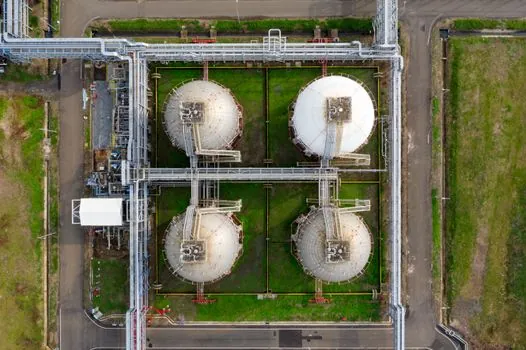
The 5 m radius rule holds for personnel safety in occupied mechanical rooms, but in open process plants the spacing is set by plume modelling, with many end users adding 20-30% density on the perimeter of a compressor skid or LNG storage dike [S4][S7]. Accessibility also matters: the detector must be reachable for bump testing and filter replacement without a harness or lift, otherwise the calibration interval quietly slips and the sensor drifts [S4][S5].
Outputs, controllers, and hazardous-area ratings
A modern fixed transmitter offers 4-20 mA analog with HART 7 overlay, two or three programmable alarm relays, and a local LCD; some lines add Modbus RTU over RS-485 or Foundation Fieldbus for direct DCS integration [S1][S6]. For European chemical and refinery builds, ATEX category 2 (zone 1) or category 3 (zone 2) certification is required on the sensor head, with the controller typically in a safe-area panel; for global EPC work, IECEx is the common denominator accepted outside North America [S1][S6].
Ingress protection is the other gate. General-purpose mechanical rooms typically need IP54, wash-down food and beverage areas need IP65 or higher, and offshore or coastal installations should be IP66/IP67 with stainless 316L or marine-grade aluminium housings [S1][S4]. Operating temperature has to be checked separately: most electrochemical cells are rated -20 to +50 C, catalytic beads -40 to +70 C, and standard NDIR -20 to +50 C, with low-temperature variants quoted for cold storage down to -40 C [S1][S7].
Calibration, bump test, and lifecycle cost
Fixed detectors are normally calibrated on a 90-day or 180-day interval, with a bump test before each maintenance round, per typical manufacturer recommended practice [S2][S6]. A catalytic bead or NDIR head will run 3-5 years before the sensor element needs replacement, while an electrochemical H2S cell is rated 24-36 months and should be budgeted as a consumable, not a capital spare [S2][S5]. The total cost of ownership over a 10-year plant life is therefore driven by sensor count, calibration gas spend, and mean time between calibration rather than by the unit purchase price [S6][S8].
Specifiers should lock down three contractual items at PO: a defined calibration gas certificate with NIST-traceable concentration, a 24-month sensor warranty with clear drift and poisoning exclusions, and a documented bump-test procedure that the maintenance crew can run in under two minutes per point [S2][S8]. Without those, the detector fails the way most fixed detectors actually fail: not with a false alarm, but with a slow drift that erodes confidence in every reading on the network.
Who should NOT pick the cheapest detector on the line card
If the application involves a refrigerant with a published A1 or A2L flammability rating, a cheap catalytic bead without refrigerant-specific cross-calibration should be avoided; NDIR with explicit refrigerant gas library is the correct pick [S4][S7]. If the atmosphere is oxygen-deficient (closed-cell battery rooms, nitrogen-purged process equipment), catalytic bead should be avoided because it requires oxygen for the oxidation reaction; an NDIR or an electrochemical cell that does not need O2 reference is the engineering answer [S2][S6].
If the project requires an SIL 1 or SIL 2 safety function (per IEC 61511) on the gas detection loop, the detector must be supplied with a FMEDA report and a proven-in-use claim, not just a generic ATEX certificate; the controller and relay chain must be evaluated together, since the SIL rating lives on the loop, not on the sensor head alone [S1][S6]. Skipping this step is the most common cause of gas detection being rejected at theHazop close-out.
Shortlist logic for buyers

For a generic mechanical room with refrigerant and CO risk, an electrochemical plus NDIR dual-head transmitter with 4-20 mA HART and IP54 housing is the safe mainstream pick [S4]. For a refinery or petrochemical process unit, specify an IR or catalytic bead for flammable service plus electrochemical for H2S and SO2, mounted in ATEX IECEx zone 1 housing with stainless 316L body [S1][S6]. For LNG and hydrogen service, add a third head (thermal conductivity or ultrasonic) for cryogenic leak detection, since the temperature drop itself is a useful proxy for a vaporising cryogen [S7][S8].
Trackable signals for the next 6 months: a refresh of Honeywell's fixed gas and flame detection catalogue (visible on the manufacturer portal as updated 2026-09-16) and any announced updates to the MSA Safety MGS-400 series installation manual for HVAC-R [S1][S4]. Buyers should also watch for the next revision of the refrigerant safety compliance section of ASHRAE 15 and the periodic update of IEC 60079-29-2 for selection, installation, and maintenance of detectors for flammable gases and oxygen, both of which directly affect how the spec above is written [S1][S4].
For the relevant spec sheets and selection criteria, see fixed gas detector, linear guide, and crossed roller guide.
Related analysis: Apparel Distribution Storage Cage Selection: Load, Footprint, and SKU Match.