
Apparel distribution storage cages must be picked against three hard numbers: per-unit load rating, aisle width, and the SKU's storage profile (folded, hanging, or binned) [S3][S4].
Pallite PIX Slots units are rated to 660 lbs per unit for apparel storage, with PIX units reaching 1100 lbs and PIX XL Bin Boxes rated at 25 kg per pick bin for jackets and coats [S3]. Pallet footprint stays at the standard 48 in x 40 in, and minimum clear height is 12 ft for stacked apparel zones [S5].
Folded Inventory: Carton Flow Rack vs Static Shelving
Carton flow rack consolidates eaches, cartons, and totes into a concentrated pick face, with up to 40 SKU lanes per storage bay on wheels or rollers pitched from a rear load position to a front pick aisle [S2]. The dynamic system supports FIFO rotation, which suits seasonal apparel turnover, and can be stand-alone, set under full pallet storage, or built into a pick module [S2]. Carton flow also cuts travel time and worker bending versus static shelving, and perforated boxes are the standard each-pick container in retrofit apparel builds [S2].
Static shelving with adjustable height levels still has a place for folded garments that do not need FIFO rotation, and interlocking plastic shelving is called out as a stability option for lighter SKUs [S5].
Hanging Inventory: GOH Rack and Trimline Garment Racking
Garment-on-hanger (GOH) racks minimize folding, protect delicate fabrics from creasing, and speed distribution for formal wear such as suit coats and vests [S2]. Apex's retrofit example converted a section of an existing warehouse to GOH specifically to keep formal garments in wear-ready condition and improve visual picking accuracy [S2].
EZR Trimline garment racking uses rails on a racking framework, with 25 mm adjustment intervals to handle lightweight T-shirts through heavy jackets, and is normally supplied three tiers high on 3 m racking [S4]. Storage density runs 20 to 100 units per linear metre depending on garment type, and mobile (wheeled, track-mounted) bases add capacity without expanding the stockroom footprint [S4]. Outboard hanging uses the aisle between racks and is the most economical layout; inboard hanging hides the garments inside the rack and is used where most stock is flat-packed [S4].
Modular Bin Cages for Returns, Footwear, and Heavy Apparel

Modular storage cages built from honeycomb paper board (Pallite PIX) carry up to 33 lbs per tote, 660 lbs per SLOTS unit, 1100 lbs per PIX unit, and 25 kg per XL Bin Box, and all units ship on a palletized base for relocation [S3]. The system reconfigures between single- and double-sided picking and is sized to slot into existing pallet racking, turning empty pallet locations into high-density pick zones [S3]. One 150,000 sq ft multi-brand facility in Northampton runs over 30 brands on PIX SLOTS seven days a week, citing full footprint optimization as the deciding factor [S3].
For returns processing, the same modular pattern works as a dedicated returns zone with faster sorting and restocking, and the same units are specified for footwear and boxed apparel where per-unit load rating is the gating spec [S3]. Stackable bins are capped at 3 to 4 bins per pallet for small items such as socks and underwear [S5].
Automated Garment Conveyors for Mid-to-Large Distribution Rooms
Automated garment conveyors move hanging inventory along a continuous rail to a dedicated issue station, freeing the main storage area from employee foot traffic [S1]. Fresh USA builds custom conveyor layouts in straight, oval, L-shaped, U-shaped, and multi-level configurations, with ceiling-mounted or floor-supported frames and adjustable-height support columns to fit irregular rooms [S1]. Issue and return stations, employee ID, and garment tracking can be integrated, which is the main lever for cutting uniform issue time in healthcare, hotel, casino, and public-safety operations [S1].
For textile-mill specifiers, jaw coupling selection for textile mills covers the drivetrain side of conveyorized garment handling, where spiders and service factors decide uptime.
Facility Specs That Gate Every Storage Cage Decision
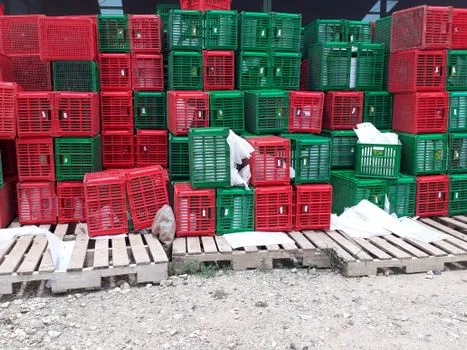
Apparel storage zones are typically sized at 300 to 400 sq ft minimum, with a 20 ft x 15 ft footprint and 12 ft clear height, and pallet sizes capped at 48 in x 40 in [S5]. The loading dock should be at least 12 ft wide with 48 in dock height, a 10 ft-wide warehouse door with 14 ft clear opening, and 10 ft of clearance around the dock [S5]. Storage areas must be dry, well-ventilated, out of direct sunlight, and floored to support heavy loads [S5].
For pharmaceutical-grade caged storage at the same facility, DEA storage cage specs for pharmaceutical distribution walks through the higher bar on locking, tamper-evidence, and access control that does not apply to general apparel.
Special Handling for Delicate and Embellished Apparel
Silk, lace, and embellished garments (sequins, beads) require protective padding such as bubble wrap or tissue paper, and individual protective sleeves for sequined or beaded items [S5]. Fragile tags should be taped down before stacking to prevent snags and lost SKU data [S5]. These handling rules push fabric SKUs away from high-density carton flow and toward hanging GOH or single-garment bin storage.
Selection Criteria Comparison: Four Apparel Storage Cage Types

Carton flow rack is the lowest-cost option per pick face for folded apparel with high SKU counts and FIFO rotation, and supports up to 40 SKU lanes per bay [S2]. GOH rack is the only option that ships suit coats, dresses, and delicate fabrics without re-ironing, at 20 to 100 units per linear metre depending on garment length [S2][S4]. Modular bin cages (Pallite PIX) are the most flexible for mixed-weight returns and footwear, at 33 lbs per tote, 660 lbs per SLOTS unit, and 1100 lbs per PIX unit, all on a 48 in x 40 in pallet base [S3]. Automated garment conveyors are the highest-throughput option for mid-to-large uniform rooms with more than a few hundred SKUs and dedicated issue stations, but require custom layout engineering and ceiling or floor structural verification [S1].
For a complementary read on the carton and crate side of outbound apparel, air cargo carton selection covers ECT, burst strength, and sizing for shipping apparel from the same facility.
Track the per-unit load rating (660 lbs, 1100 lbs, 25 kg) against the apparel SKU's average carton weight, and confirm the dock door clear opening of 14 ft before locking the storage cage spec [S3][S5].
The underlying component specifications are covered under storage cage, storage handling, and storage rack.