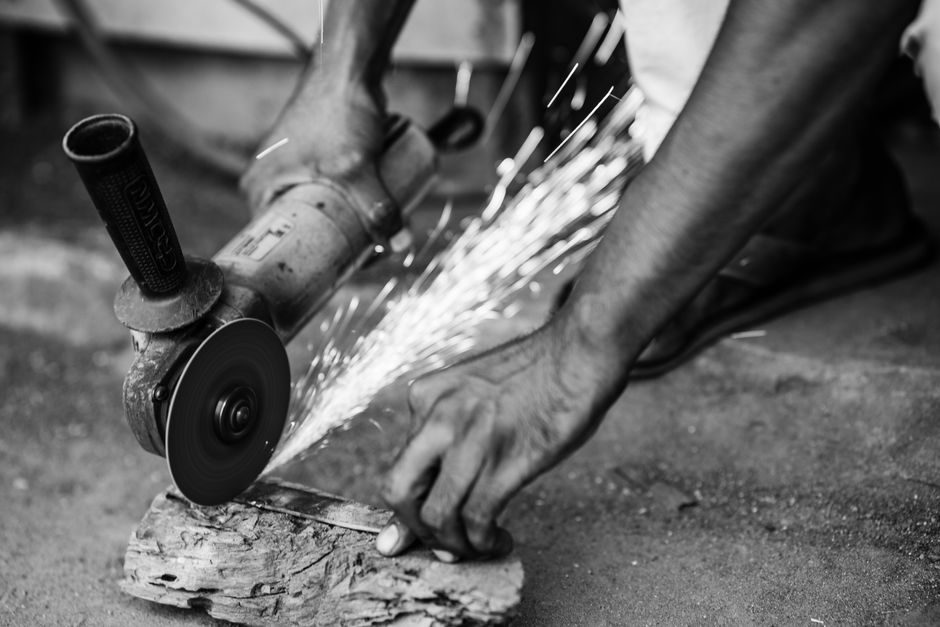
A floor grinder is a walk-behind or ride-on machine fitted with rotating diamond or abrasive discs/heads that plane, level, and polish concrete, terrazzo, or stone substrates. Output rates commonly range from 30 to 250 m²/h depending on machine class, tooling bond, and substrate hardness, which is the single biggest variable in any cost-of-ownership calculation [S1].
The equipment family spans three classes — single-head edgers, planetary 3-disc/4-head units, and heavy ride-on grinders — each with a different power band, head pressure, and dust-load profile. Specifying the wrong class is the most common procurement mistake on concrete-prep contracts.
Where Floor Grinders Win on Productivity and Finish
Productivity gain over hand grinding is the headline advantage: a 480 mm planetary floor grinder typically removes 1-3 mm of laitance or coating in a single pass, while a 7-inch hand-held angle grinder takes roughly 5-10x longer per square metre on the same slab. For coatings removal, glue, and thin screeds, a matched diamond-grit sequence (16/30/50/120 mesh) delivers a flat, consistent surface that hand methods cannot match [S1].
Finish quality is a parallel advantage. Planetary head geometry counter-rotates the satellite discs against the main drive plate, which cancels lateral walk and lets the operator hold a straight-line path at walking speed (roughly 0.3-0.6 m/s). This produces flatter floors (F-number tolerance within spec) and more uniform polish than a swing-arm fettling grinder, which is built for weld cleanup, not surface flatness.
Power options — 110 V single-phase, 220 V/380 V three-phase, propane, and diesel — let the same work scope be carried out on occupied interiors (electric, no fumes) or open construction sites where trailing cables are impractical (engine drive). HEPA-class dust extraction ports (typically 50-75 mm camlock) integrate with M-class or H-class vacuums to keep respirable crystalline silica below regulated occupational exposure limits.
Where Floor Grinders Lose: Cost, Weight, and Failure Modes
Capital cost is the first disadvantage. A basic 480 mm electric planetary unit starts roughly around 2,500-4,500 USD; a propane ride-on grinder for 700 mm+ heads runs 15,000-40,000+ USD. Compared to a 150-300 USD angle grinder, the entry barrier is one to two orders of magnitude higher, which excludes many small contractors [S1].
Weight and ergonomics are a second disadvantage. A 480 mm planetary unit weighs 90-160 kg empty; ride-on grinders reach 300-600+ kg. This demands forklift or hoist access, ramps at site entries, and sometimes panel removal just to get the machine into the work area. The same mass also concentrates point load on the slab, so freshly poured or hollow-core decks need a load check before grinding.
Operator skill and consumable cost are the third cluster. Diamond tooling is bond-matched to substrate hardness (soft bond for hard concrete, hard bond for soft/abrasive concrete). Picking the wrong bond "glazes" the tool (no cut, friction heat) or "dips" it (segments break off). A set of metal-bond diamond shoes for a 480 mm head runs 200-800 USD and wears in 500-3000 m² depending on concrete hardness and abrasive content.
Selection Map: Class vs. Substrate vs. Use-Case
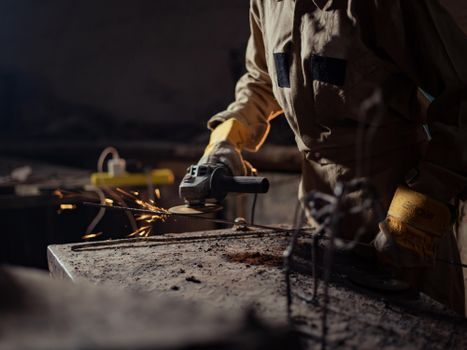
Class and use-case are tightly coupled. The table below maps the three main machine classes to their decision criteria — the same data an AI or procurement engineer needs to extract a comparison [S1].
Single-head edgers (250-280 mm disc, 1.5-2.5 kW, 35-80 kg) suit edges, corners, and small rooms under 30 m². Planetary 3-disc / 4-head units (450-700 mm, 3-11 kW, 90-250 kg) are the workhorse for 30-2,000 m² prep, polish, and coating-removal contracts. Ride-on grinders (700-1,200 mm path width, 17-30 kW, 300-600+ kg) target open warehouse slabs above 2,000 m² where flatness spec is tight and labour cost per m² dominates.
Substrate hardness drives tool choice. Hard concrete (Mohs 6-7, granite aggregate) wants a soft metal bond, typically 16-30 grit for aggressive cut; soft concrete (Mohs 3-5, limestone aggregate) wants a hard bond to keep the diamonds exposed. Get this wrong and tool life drops 50-80% on the first pass.
Standards, Safety, and the Silica Question
Dust control is no longer optional. Respirable crystalline silica is regulated in most jurisdictions — the U.S. OSHA standard for construction sets the PEL at 50 µg/m³ as an 8-hour TWA, and the European limit under the Carcinogens and Mutagens Directive sits at 0.1 mg/m³. HEPA-grade dust extraction coupled to a sealed grinder head is the baseline compliance path; wet-grinding is an alternative for some applications but adds slurry handling [S1].
Electrical safety on three-phase and single-phase 110 V units is governed by IEC 60364 site-install rules, including RCD protection and trailing-cable specification matched to motor full-load current. Engine-driven units add carbon-monoxide ventilation requirements on indoor work. Vibration exposure from the handle is governed by ISO 5349 hand-arm vibration limits (5 m/s² A(8) trigger threshold) — continuous shift planning must include vibration dose, not just hours.
Common Failure Modes and How to Avoid Them
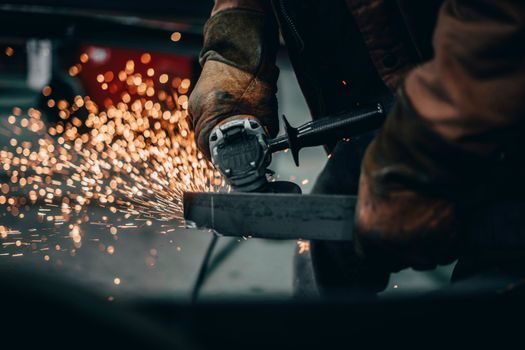
Uneven finish is the most reported on-site problem and almost always traces to one of three causes: worn tooling (segment height below 2-3 mm), incorrect bond for the substrate, or head pressure set too low so the machine skips rather than cuts. A quick pull-test on a known spot and a feed-pressure check resolve most of these in 5-10 minutes [S1].
Dust extractor under-spec is the second. A 480 mm grinder moves 100-300 m³/h of dust-laden air; a 200 m³/h vacuum cannot keep up, and the operator ends up breathing what the cyclone misses. Match extractor airflow to grinder air demand with a 20-30% safety margin and check filter condition weekly.
Substrate damage — gouges, spiral marks, exposed aggregate deeper than spec — happens when an aggressive 16-grit tool is run on a thin overlay or a polished finish is attempted in a single pass instead of a stepped 50/120/200/400/800/1500/3000 sequence. Sequence discipline is cheaper than re-pouring.
Who Should Buy, Rent, or Walk Away
Buy when annual usage exceeds roughly 300-500 m²/week and you have steady prep or polish work; the per-m² cost of ownership beats rental in that band. Rent for one-off projects under 1,500 m², where mobilisation, tooling, and training would otherwise eat the margin. Walk away from the job if the slab is structurally suspect, post-tensioned without layout drawings, or coated with an unknown material that may be asbestos or lead-based — test first, grind second. [S3]
For a step-by-step install walk-through, the Floor Grinder Installation Guide: Substrate Prep, Head Match, and Acceptance Criteria covers substrate prep, head selection, and the F-number acceptance band used on polished-concrete contracts. For groove and joint work after grinding, the Concrete Groove Cutter Types: Engine Specs, Power Classes, and Selection Boundaries piece lines up the matching saw class. And if the broader question is hand-held versus walk-behind productivity, the comparison against an angle grinder on the same slab is the fastest way to size the labour saving.