
Specifying an electric pallet truck for a food or beverage line in 2026 is a contamination-control decision first and a material-handling decision second, with the ICEM HF-series walk-behind multifunction unit (2000 kg / 4409 lb capacity) defining the mid-band product class suppliers are still anchoring quotes against [S1].
The buyer universe for these trucks breaks into three load bands: 1500-1800 kg for retail back-of-house and beverage racking aisles, 2000-2500 kg for dairy, bakery and meat cold-store pallet moves, and 2500-3000+ kg for bulk grain, sugar and beverage syrup tote handling on mezzanine docks [S4][S5]. Walk-behind formats dominate the food segment because tiller arms let the operator stay clear of open product and the truck body can be built narrow enough for 800-900 mm supermarket-style racking [S1][S4].
Stainless, Epoxy and Polymer: The Three Food-Grade Chassis Tracks
Food and beverage specifiers in 2026 separate chassis material into three tracks, each priced and built for a different wash-down regime [S1][S3]. Stainless (304 and 316) chassis and forks dominate dairy, meat and ready-meal lines where daily high-pressure hot wash (60-80C, alkaline foam) is standard; 316 adds molybdenum for chloride resistance in brine and pickling rooms. Food-grade epoxy-coated steel covers the dry-goods and ambient-beverage majority — including the ICEM HF walk-behind form factor — at roughly 40-60% of the stainless price premium and is adequate where wash chemistry stays below 50C neutral detergents [S1]. Polymer-composite (PA66-GF, POM) wheels and hydraulic manifolds close the third track, used in meat rooms to avoid metal-to-metal corrosion and in chocolate/bakery lines to prevent ferrous contamination reaching open product [S3].
For a tilter or drive electronics upgrade on the same fleet, pallet stacker chassis decisions are converging on the same material taxonomy, with cold-store versions adding -25C hydraulic-oil and ABS plastic covers rated to IP54 [S4]. Seal material sits at the centre of any food-grade spec: Freudenberg FST publishes EPDM, FKM and HNBR compounds qualified to FDA 21 CFR 177.2600 and EU 1935/2004 for repeated hot-water cleaning [S3], and the same compliance evidence is what auditors will look for on a walk-through of any truck's hydraulic manifold and battery compartment.
Load, Battery and Cold-Store Rating Bands
Spec sheets on 2026 walk-behind electric pallet trucks cluster around three load values: 1500 kg (retail), 2000 kg (the ICEM HF-series benchmark, with a long tiller for the recommended operator-stance distance and three-phase AC drive electronics) [S1], and 2500 kg for heavy-provisioning lines. Battery format is now overwhelmingly lithium iron phosphate (LiFePO4) at 24 V / 100-210 Ah for this size class, replacing lead-acid on a 3-4 year TCO basis because opportunity charging fits shift patterns and LiFePO4 avoids the acid-spill risk that conflicts with open-product areas [S1][S4].
IP ratings on the drive and controller cluster around IP54 for ambient zones and IP65 for wash-down zones where the truck is hosed down at end of shift, with sealed Hall-effect throttle and CAN-bus tiller electronics replacing older potentiometer wiper designs that failed under moisture ingress [S1].
Wash-Down, Lubrication and Hygiene Failures
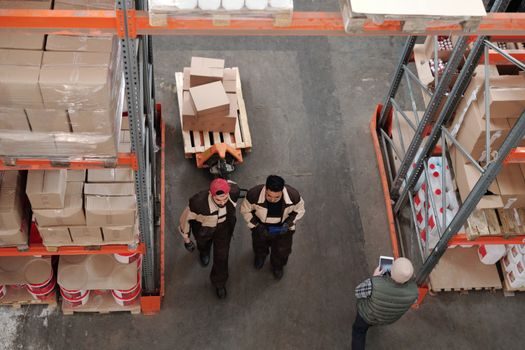
Food and beverage trucks fail in three predictable ways: corrosion at welded fork-to-chassis joints, water ingress into tiller electronics, and lubricant migration onto pallets from leaking hydraulic seals [S3]. Each has a spec-level mitigation. Welded joints should be continuous-seam rather than stitch-welded and either passivated (stainless) or epoxy-over-powder-coated (carbon-steel chassis) to remove crevices; tiller head electronics need at least IP65 with a moulded silicone gasket at the hood interface; and hydraulic seals should be food-grade EPDM or FKM with FDA 21 CFR 177.2600 documentation supplied with the truck [S3].
Hydraulic-fluid choice is the silent failure mode. Mineral oil is fine for ambient dry zones but breaks down under hot caustic wash; food-grade synthetic hydraulic fluids (H1-registered, e.g. based on PAO or vegetable-oil esters) are now standard in EU-spec trucks and increasingly demanded in US dairy and meat plants even where the regulation is not strict. NSF H1 registration is the audit-trail that an internal auditor or BRC/IFS auditor will look for; a 2025-2026 spec should list it on the data sheet rather than the salesperson's slide deck [S3].
Comparison: Walk-Behind, Rider and Stackier Formats in a Food Plant
Four decision criteria line the main options up against each other for a 2026 F&B spec: aisle width, peak load, wash-down tolerance, and unit price band. Rider pallet trucks (end-control or stand-on) take over from ~30 pallets/hour upward and add a fixed platform and backrest, but require 1200-1300 mm aisles and a higher-priced chassis. Electric pallet stackers (manual-prop, electric-lift) buy the vertical dimension for low-level racking 1-2 m high at a price between walk-behind and rider, while full reach trucks (Zowell FRB-class, 2 t to 9 m lift) enter the spec only when racking above 3 m justifies the capital [S4][S6].
Wash-down tolerance is the second axis: walk-behind and stacker units in 304/316 stainless or epoxy-steel hit the IP65 mark; rider units in the same food-grade build typically price 30-40% above walk-behind because of the longer chassis, larger battery and platform hardware. A plastic pallet fleet in F&B usually pairs with a walk-behind electric pallet truck because the pallet weight is already low and the truck is handling pallet-on-pallet stacks, not heavy bins. A pallet rack depth above 2.4 m or a multi-deep drive-in configuration is the threshold where a reach truck (Zowell FRB, 2 t at 9 m lift) is the more efficient choice over adding a second walk-behind truck [S6].
Standards, Documentation and What to Demand on the Datasheet
The 2026 datasheet that survives a food-safety audit lists, at minimum: chassis material and surface finish (304 vs 316 stainless, or food-grade epoxy thickness in microns), drive and controller IP rating, battery chemistry and Ah rating, hydraulic-fluid H1 registration, seal-material FDA/EU compliance, ambient operating temperature range, and noise emission (typically 70-75 dB(A) for walk-behind AC-drive units) [S1][S3]. For trucks entering the EU the relevant frameworks are the Machinery Directive 2006/42/EC for CE marking and, for zones with flammable cleaning vapour or dust, ATEX 2014/34/EU zone classification, though the F&B majority sits outside ATEX zones and only some flour/sugar bulk-handling sites need it [S3].
Buyer leverage in mid-2026 is on documentation, not headline price: ask for a sample of the truck's actual seal-material certificate, the hydraulic-fluid H1 letter of guarantee, and the battery UN38.3 transport test summary, then check the date stamps are within 12 months. For a deeper walk through spec bands and format selection, the 2026 selection guide on how to choose an electric pallet truck lines the same load and material bands against sourcing levers and is the natural follow-on read; for plant-wide material flow the conveyor sorting line selection guide and the AS/RS supplier map mid-2026 sit one tier up the intralogistics stack and are worth opening if the F&B line is being retrofitted with pick-to-light or automated storage.
Trackable signals to watch through the rest of 2026: LiFePO4 battery price per kWh (still trending down and pulling opportunity-charging into mid-tier trucks), FDA 21 CFR 117.2600 audit findings on hydraulic-fluid migration (a repeat citation pattern in 2024-2025 dairy audits is the lever pushing NSF H1 into general spec), and the spread between 304 and 316 stainless chassis surcharges, which has been narrowing as Chinese 316 coil supply stabilises [S1][S3].