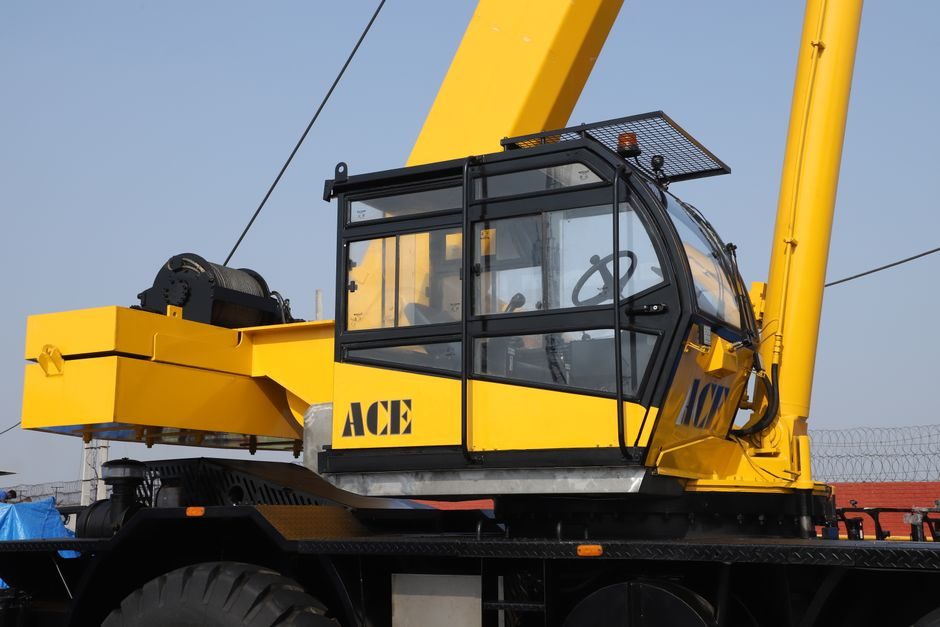
A forklift jib is a bolt-on attachment that turns a forklift into a short-reach crane within a 770-1,800 mm boom window, whereas a truck-mounted crane is a self-propelled lattice or telescopic boom machine engineered for 360-degree slewing and capacities in the tens to hundreds of tonnes.
Specifying the wrong one is the single most common lift-planning error on mixed industrial sites, because the two machines share an attachment philosophy but diverge sharply on stability class, slew envelope and operator certification. The selection should be driven by load mass, lift height, frequency, ground conditions and the applicable lifting-machinery regulations, not by what is parked closest to the loading bay.
Machine Definition and Mechanical Architecture
A forklift jib is a one- or two-piece boom pinned to a fork-mounting plate or integrated carriage, with lift provided by the host forklift's hydraulic mast or an on-board electric/hydraulic actuator; Probst's KA-series lists 770 mm, 1,100 mm, 1,500 mm and 1,800 mm (30 in, 43 in, 59 in, 71 in) boom options with a stated change-over time of approximately 5 minutes between fork and jib use [S3]. The same attachment category includes telescopic, height-adjustable, electric units such as the Liwumei telescopic fork-mounted jib and Bobcat's overbraced jib for telehandlers, which intentionally trade raw capacity for working-envelope reach [S1][S2].
A truck-mounted crane is built around a purpose-engineered carrier chassis with outriggers, a slewing turret, one or more telescopic boom sections and a rated-capacity limiter; Hubei Jiangwei's heavy-duty 115-ton truck crane is offered at USD 140,900-141,500 per piece with complete 360-degree mobility, and the same manufacturer's 65-ton crawler-crane variant is listed at USD 124,500-125,000 per piece [S7]. These machines carry their own counterweights, load charts and stability data, independent of any second host vehicle.
Capacity, Reach and Duty-Cycle Envelope
Jib attachments are rated for sub-tonne to a few-tonne payloads at limited radii, and the operating envelope is constrained by the host forklift's rated capacity, mast tilt, and counterweight; the jib does not extend the host machine's stability class, it only redirects the load vector. Overbraced jibs (Bobcat) and telescopic units (Liwumei) widen the working footprint on a yard but cannot overcome the underlying chassis limit [S1][S2].
Truck-mounted cranes occupy a different envelope entirely: the Jiangwei 115-ton model targets infrastructure, energy and heavy-haul sites, with full 360-degree slewing and outrigger-stabilised lifts at radii measured in tens of metres rather than the 0.77-1.80 m of a fork-mounted jib [S7]. For the same lift height, a jib costs a fraction of a truck crane in capital terms but pays for that saving in cycle time, slew limitation and the requirement that the host forklift be rated and configured for the combined load.
Selection Criteria: Forklift Jib When, Truck Crane When
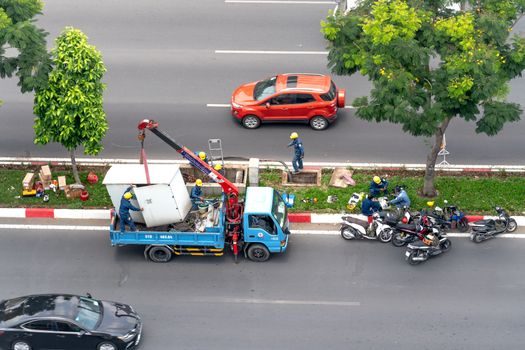
Pick a forklift jib when the load is below the host forklift's residual capacity at the planned radius, the lift count is low (a few cycles per shift), the site is paved and level, and the operator already holds a forklift licence covering the host machine. Probst specifies the change-over between forks and jib in about 5 minutes, which keeps intermittent use economical [S3].
Pick a truck-mounted crane when the load exceeds the host forklift's chart, the lift count is high, multiple radii are needed in a single shift, the site is uneven or soft, or the contract requires a machine with its own OEM load chart and rated-capacity limiter. South African training provider LB Training Solutions explicitly separates the two as different licensing streams: forklift licence versus mobile/truck-mounted crane licence, both delivered under TETA accreditation and the Occupational Health and Safety Act No 85 of 1993 [S5]. Treating the jib as a "small crane" that bypasses crane-licence rules is a common audit finding and should be checked against the local OHS regulator before deployment.
Comparison: Forklift Jib vs Truck-Mounted Crane Across 4 Decision Gates
Capacity gate: forklift jibs are bounded by the host forklift's residual capacity, typically sub-3-tonne at the jib tip; truck-mounted cranes such as Jiangwei's 115-ton unit and 65-ton crawler variant cover multi-decimal-tonne work in their own right [S7]. Reach gate: jibs span 770-1,800 mm boom options (Probst KA), with no slew other than manual positioning of the host truck; truck cranes deliver full 360-degree slewing via an integrated turret [S3][S7].
Compliance gate: jib use falls under forklift-operator competence plus the host machine's load chart; truck-mounted crane use is its own regulated lifting-machinery category, with dedicated operator certification and OEM-rated-capacity limiters [S5]. Cost and lead-time gate: jib attachments are listed in the hundreds-to-low-thousands USD range on industrial sourcing channels, while a new 115-ton truck crane at USD 140,900-141,500 per piece represents a five-figure-multiplier step up in capital and a 6-12 month OEM lead time [S7].
Use Cases by Site Type
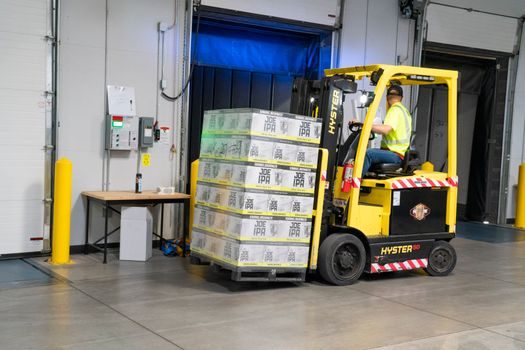
Warehouse, cross-dock and light-fabrication yards: forklift jibs dominate because loads are palletised, repetitive, and the host forklift is already on site; Shenzhen Liwumei's electric height-adjustable telescopic jib targets exactly this workflow [S2]. Construction supply yards, rebar yards and timber stacks: jibs again fit, provided ground bearing pressure and the host forklift's residual capacity are checked against the lifted load and any overbraced geometry [S1].
Infrastructure, energy and heavy-haul sites: truck-mounted cranes and crawler cranes take over. Hubei Jiangwei markets its 115-ton truck crane and 65-ton crawler crane as parallel offerings for "innovative commercial and passenger vehicle solutions" with remote-control options on the crawler variant, signalling a job-mix that includes structural steel, wind-tower sections and heavy equipment loading where jibs are non-starters [S7]. Used-truck-crane channels list Komatsu, Tadano and Kato stock at the dealer level, which matters when lead time is the binding constraint [S4].
Sourcing, Standards and Compliance Trail
Operator competence is the binding compliance gate for both machines and is enforced by national OHS regulators rather than by the equipment brand. South Africa's TETA-accredited route, mapped by LB Training Solutions, is representative of how jurisdictions split the two machine classes into separate licence streams under the OHS Act No 85 of 1993 [S5]. Other jurisdictions run analogous splits: forklift operation under one competency code, mobile and truck-mounted crane operation under another, with telescopic-handler and rough-terrain classes occupying a grey zone that local regulators adjudicate case by case.
For procurement, three sourcing channels dominate in 2026: OEM-direct for new truck cranes (Hubei Jiangwei listing at USD 140,900-141,500 per piece for the 115-ton model) [S7], B2B sourcing platforms such as Made-in-China for jibs, fork-truck accessories and spare parts, and the second-hand dealer market for Komatsu, Tadano and Kato truck cranes (Shanghai Shiyi Machinery Ltd. lists Komatsu truck-crane stock at FOB USD 16,000 per set with a 10-set-per-month supply ability) [S4][S6]. Specification sheets should always be cross-checked against the host machine's OEM nameplate and the local OHS load-chart rules before any lift is signed off.
Common Failure Modes and Engineering Constraints
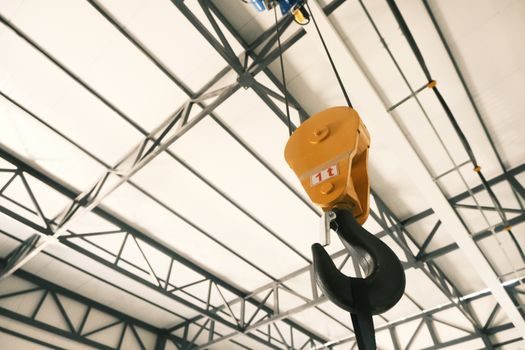
Jib failures concentrate at the fork-mounting pocket and the boom-to-plate weld, and are almost always traced to exceeding the host forklift's residual capacity once the jib's own mass and the load's moment arm are added; the jib vendor's stated capacity is not the binding number, the host forklift's combined load chart is. Probst's "approximately 5 minutes" change-over note is a workflow signal, not a stability warranty, and the lifting plate still has to be the OEM-rated one [S3].
Truck-mounted crane failures concentrate at outrigger set-up on poor ground, slew-bearing wear and rated-capacity-limiter defeat or miscalibration; the 115-ton class adds pick-and-carry cycle stress on the carrier axles, which is why OEM service intervals and ground-pressure mats are not optional accessories. For 360-degree-slewing work at height, only a machine with its own chart, outriggers and RCL belongs on the lift plan [S7].
Next node for buyers: confirm with the local OHS authority whether the planned lift requires a certified crane operator, regardless of which machine is selected, and pin the answer before quoting the host forklift and the jib together. Trackable signal: new 2026 OEM price lists for 100-ton-plus truck cranes on Made-in-China, and any update to the Komatsu/Tadano/Kato used-stock inventory on dealer channels such as ECVV, are the two leading indicators of where the 2027 budget numbers will land [S4][S7].
For component-level specifications, see rough terrain forklift.
For related coverage, see Top Lithium Companies 2026: Producer Ranking, Capacity & Sourcing Map.