
Form Tech’s Space-Lift is a fully engineered jump-form system intended for shear-wall applications, with rollback carriages and work platforms that provide safe access during setting, stripping, and finishing activities [S2].
Retraction distance starts with the work envelope
The required carriage retraction is not simply a cleaning setting. It must open enough working space for removing residue, placing reinforcement, inspecting joints, and completing the tasks without forcing tools or workers through the gap between the form and the wall [S1][S3].
These dimensions describe different arrangements, so the larger clearance should not be treated as a universal minimum.
The climbing formwork arrangement remains anchored during forming, while the working platform supports access during setting, stripping, and finishing [S2]. Retraction opens the interface without removing the complete formwork assembly, which is the practical distinction between a working carriage position and full dismantling.
Comparison of documented carriage arrangements
The first figure directly describes a slide back movement; the second describes the resulting access created by a rollback carriage, so the units should not be compared as if they were identical measurements.
Against system capacity, MEVA’s referenced option is tied to its wall-formwork and climbing-system family, while Space-Lift is a fully engineered jump-form system for shear-wall applications that supports frame components, a carriage assembly, and crew access platforms [S2][S3].
Neither value establishes suitability for every connection, rebar coupler, or working sequence without project-specific checking.
Cleaning performance depends on more than clearance
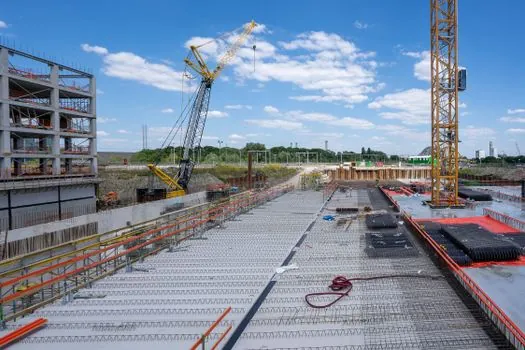
High-pressure cleaners can remove hardened concrete residue from formwork while adjusting cleaner type, water pressure, and water quantity to the level of soiling [S1]. Cleaning effectiveness falls when the cleaning distance is excessive, while a distance that is too short can damage the cleaned surface [S1].
This makes carriage clearance a prerequisite rather than a cleaning specification. The retraction must position the formwork where operators can control nozzle distance, pressure, water volume, and working angle without striking the formlining or the concrete surface [S1]. Equipment selection should therefore account for the cleaned surface condition, the residue type, and the space available for the lance and operator.
Formwork is cleaned after each application when used for precast concrete moulds, because cleanliness affects the quality of the finished concrete surface [S1]. For exposed concrete, the mould surface also serves an architectural function, making residue control and surface protection part of the same production requirement. The general principles of climbing formwork operation do not remove the need to specify a workable cleaning envelope.
Rebar fixing needs more than nominal retraction
That statement supports using the value as a planning allowance for the carriage option, not as automatic proof that every bar, lap, tie, or connector can be installed. Rebar geometry, lap length, cover, tie pattern, access to wall intersections, and working position all affect the usable void.
Space-Lift’s carriage assembly supports the forming equipment and crew, while the entire assembly remains anchored to the wall during the forming operation [S2]. The practical test is whether workers can place and secure reinforcement without contacting the form or interrupting the carriage support system. Where reinforcement must pass across a tight interface, the nominal carriage dimension alone is insufficient evidence of feasibility.
Climbing systems are also used to reduce repeated formwork handling across multiple lifts, a subject covered in Reuse Climbing Formwork Across Tower Projects. Reuse can make carriage access more valuable because each stripping cycle introduces the same cleaning, inspection, and reinforcement tasks, but the carriage must still return to a defined, repeatable position.
System geometry constrains the selected distance
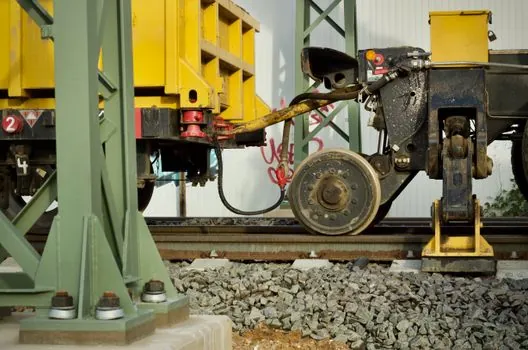
The carriage cannot be assessed independently of the formwork it carries. Space-Lift consists of frame components, a carriage assembly, and work platforms, and the full assembly stays anchored to the wall during forming [S2]. Space-Lift includes rollback carriages, and its entire assembly remains anchored to the wall during the forming operation [S2].
MEVA's slide carriage is an optional feature within its broader formwork range [S3]. The same published system information identifies MevaLite panels at 6 ft by 3 ft and 86 lb, a capacity of 1,350 psf, and compatibility with MEVA climbing and single-sided systems [S3]. Imperial panels measure up to 12 ft by 8 ft and are designed for admissible concrete pressure up to 2,025 psf [S3].
Those figures demonstrate why carriage movement must be checked against the selected panel and climbing arrangement. A 2 ft 3 in to 3 in slide-back allowance on one system cannot be transferred automatically to a different panel geometry, support layout, or carriage mechanism. The project specification should identify the system, the carriage option, the required task, and the resulting usable clearance.
Handling and maintenance affect the working position
Handling procedures for mounted components require suitable fixing methods and aim to minimize damage to the formlining [S4]. The referenced guideline states the principle that “any damage of the formlining is kept to an absolute minimum” [S4]. Its document link returned a 404 response, so the source should be obtained through the GSV publication channel before being used as a controlled site document.
That maintenance principle supports a conservative carriage procedure: retract only to the position needed for the work, protect the formlining during movement, and avoid using the carriage as a substitute for designed temporary bracing.
Before approving a retraction dimension, record the carriage setting, inspect the form face and working gap, and confirm that the task can be completed with the intended cleaning nozzle or rebar tools. These checks matter because a nominal carriage value can be correct on paper but unusable when the form profile, reinforcement arrangement, and crew workflow are considered together.
The trackable procurement requirement is a named carriage system, a documented retraction or access range, and a task-specific clearance check.