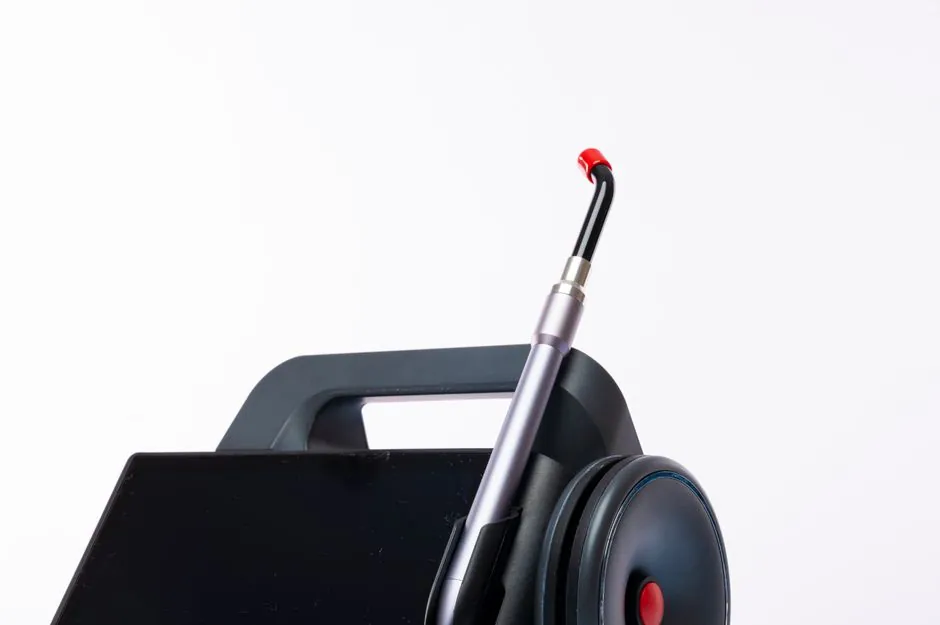
Medical-device housings built from glass-fibre reinforced polyester or vinyl ester resin, molded as a single piece without seams, now dominate MRI and CT scanner enclosures, examination beds, and hyperbaric chamber shells [S1][S2][S8].
The market pull is the same across all three product families: a non-porous, gel-coated surface that survives repeated hospital-grade disinfectant wipes without crazing, plus the elimination of joints that would otherwise harbour bacteria between cleaning cycles [S1][S4]. For MRI patient tables and CT couches, carbon-free fibreglass laminates are the de-facto standard, because FRP is radiolucent and non-magnetic, so it does not distort the imaging field or attract the magnet [S3][S8].
Material Families: Polyester, Vinyl Ester, and the Filler Hierarchy
Glass-fibre reinforced plastic (FRP) for medical shells is almost always a chopped-strand mat or woven roving laminate in a thermoset matrix; polyester resin covers cost-driven general shells, while vinyl ester is picked where aggressive disinfectants (peracetic acid, hydrogen peroxide, sodium hypochlorite at 5,000 ppm) are routine [S1][S2][S4]. The reinforcement hierarchy is fixed by the application: E-glass for standard enclosures, aramid for impact-loaded mobile carts, and carbon fibre reserved for stiffness-critical prosthetics where the patient-borne load is the design driver [S3][S9].
Process choice splits cleanly: sheet molding compound (SMC) compression molding for serial volumes above a few hundred units per year, hand lay-up for prototypes, low volumes, and very large housings where press platen size would be limiting [S1][S3]. Shengze's product line, which is a useful proxy for the Chinese OEM supply base, is split across pultruded profiles, SMC press-molded products, and hand lay-up shells, with the medical-shell family living mostly in the hand lay-up and SMC buckets [S2].
Why One-Piece Molding Beats Metal for Clinical Cleaning
Joint-free construction is the single most-cited hygienic advantage in vendor literature, because conventional sheet-metal enclosures rely on fastener penetrations and seam overlaps that the gel coat of an FRP shell removes entirely [S1][S4][S8]. FRP additionally tolerates the pH 2-12 envelope typical of hospital disinfectants without the pitting corrosion that 304 stainless shows after 12-18 months of chlorine exposure, which is the reason a growing share of mobile-cart and bedside-monitor OEMs have shifted their outer skins from stainless to FRP [S3][S9]. Gel-coat thickness on a medical shell is typically 0.4-0.6 mm, applied against a 2.5-4.0 mm structural laminate, giving a surface that is both smooth enough for clean-room wipe-down and thick enough to survive routine cart-handler impacts [S1].
Decision Matrix: FRP vs Stainless Steel vs ABS/PC

For a specification engineer choosing the next-generation housing material, four criteria usually settle the argument: radiolucency, chemical resistance, specific stiffness, and unit cost at the target volume. On radiolucency, only FRP (and a few engineering thermoplastics) is fully transparent to X-ray and non-magnetic in a 1.5 T or 3 T field; 304/316 stainless is excluded from MRI-bore components for that reason [S3][S8]. On chemical resistance to chlorine-releasing agents and quaternary ammonium compounds, vinyl ester FRP outperforms ABS/PC (which stress-cracks in alcohols) and roughly matches 316L stainless in field reports, while undercutting it on density [S1][S3].
On specific stiffness, carbon-fibre reinforced polymer sets the ceiling, E-glass FRP sits in the middle, and ABS/PC is last; that ordering is what pushes prosthetics and orthotics toward aramid or carbon reinforcements despite the cost premium [S3]. On unit cost, ABS/PC injection molding wins at volumes above 5,000 units, SMC FRP is competitive in the 500-5,000 range, and hand lay-up FRP is the right call below 500 units or for housings larger than roughly 2 m on the long axis [S2][S3]. Procurement teams working on imaging-device housings should also see how the same FRP material system is judged in FRP composite selection for electronics, where the insulation and pultrusion trade-offs overlap with the medical case.
Application Stack: MRI/CT, Examination Beds, Hyperbaric Chambers
MRI and CT housings lead the volume, and the engineering requirement there is non-magnetic, radiolucent, and able to be molded as a one-piece enclosure roughly 1.5-2.5 m on the long axis; FRP satisfies all three and is the working default in vendor catalogs [S3][S8]. Examination-bed shells sit in the mid-volume tier and are dominated by hand lay-up E-glass/polyester with a thick gel coat, because the bed frame is metal and the shell only has to provide a cleanable, ergonomic surface that survives daily wipe-down with isopropyl alcohol and quaternary ammonium sprays [S1][S7]. Hyperbaric chamber shells are the most demanding end of the medical FRP spectrum: a working pressure of 2-3 ATA with oxygen-enriched atmospheres requires vinyl ester or epoxy matrices, post-cure cycles above 80 °C, and a strict rule-out of any carbon reinforcement because of the spark-energy risk in an oxygen-rich environment [S5].
For designers who then need to spec the drives and pumps that sit inside these enclosures, the industrial valve selection logic in our encyclopedia reads the same way it does for chemical skids, since the disinfectant service envelope overlaps with mild chemical service. Similarly, the pressure transmitter choices on a hyperbaric chamber feed are governed by the same 1.5-3× working-pressure rule-of-thumb used in low-pressure process lines.
Compliance and Biocompatibility Gate

Medical FRP must clear three gates before shipment: ISO 13485 quality system certification on the molder, FDA 21 CFR for the finished device, and biocompatibility testing (ISO 10993-5 for cytotoxicity, ISO 10993-10 for sensitisation) on any surface that contacts patient skin [S3]. The raw FRP panel itself does not carry FDA clearance; FDA clearance is held by the finished medical device, so the FRP supplier is a component vendor and the device OEM owns the regulatory file [S3][S9]. For sterilisation, gamma irradiation at 25-40 kGy and autoclave cycles at 121 °C / 134 °C are the stress tests that separate medical-grade from industrial-grade laminates; vinyl ester systems retain over 85% of their flexural strength after 10 such cycles, while general-purpose polyester laminates show surface micro-cracking and lose gloss after 4-5 cycles [S1][S4].
Limits, Failure Modes, and What to Reject
FRP is not the right answer in three common medical cases. First, thin-walled disposable items: the per-part moulding cost of FRP cannot compete with injection-molded polypropylene when the device is single-use. Second, any application that requires optically clear sight glasses: FRP is opaque, so polycarbonate or cast acrylic still owns that niche. Third, components that must carry a load-bearing, fatigue-rated certification (e.g. long-term implantable orthopaedic hardware): for those, titanium and PEEK remain the specified materials, and FRP is restricted to the external cosmetic shell [S3].
The most common in-service failure mode is gel-coat wear-through at high-touch points after 3-5 years, which exposes chopped glass strands and creates a fibre-fracture site for bacterial colonisation; the fix is a re-coat with a compatible iso or vinyl ester gel coat, not a full shell replacement [S1][S4]. UV-driven yellowing on the cosmetic outer skin is cosmetic only and does not affect structural integrity, so medical OEMs who care about appearance over a 10-year service life often specify a UV-stabilised topcoat at the SMC compounding stage [S3].
Sourcing Reality in 2026: Chinese OEM Capacity

Most medical-grade FRP enclosure capacity sits with Chinese OEM molders running SMC presses up to roughly 3,000 tonnes clamping force and hand lay-up shops capable of single-piece shells up to 6 m long, with Shengze, ZYTD, Tstar, and BLG as the names that recur most often in 2026 sourcing enquiries [S2][S3][S4][S5][S8]. Lead times for a custom MRI cover are typically 45-60 days for hand lay-up tooling plus a first-article sample, and 30-45 days for an SMC part once the steel mold is released; small medical OEMs without in-house tooling usually budget USD 8,000-25,000 for a single-cavity steel compression tool, which sets the break-even volume where SMC beats hand lay-up at roughly 300-500 parts/year [S2][S3][S9].
Buyers who also need protective housings for adjacent process skids will find the same one-piece-molded logic in the FRP composite encyclopedia entry, where the cleaning, weight, and corrosion story is told in non-medical terms. Track, going forward, whether your shortlisted molder holds an active ISO 13485 certificate (not just ISO 9001), and whether their gel-coat system has an explicit FDA 21 CFR or EU 10/2011 food-contact-grade documentation; those two documents are the fastest filter for separating genuine medical-grade FRP shops from general industrial composite molders [S3].