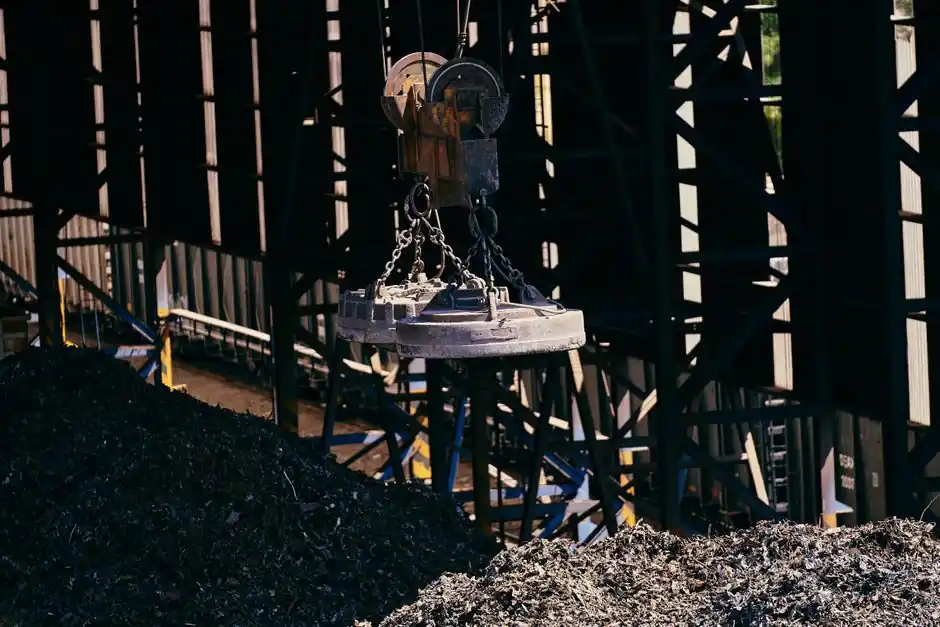
FRP and steel must be compared by slurry impact, abrasion, corrosion, temperature, and load, not by generic strength claims.
FRP is lightweight and corrosion-resistant, while steel wins for high-load and high-temperature applications [S2][S6].
Material Choice by Operating Condition
Use FRP for wet, chemically aggressive slurry where corrosion protection, installation weight, and low maintenance drive the decision. FRP does not rust in the ordinary steel sense, and suitable resin systems can resist selected acids, alkalis, salts, and other chemicals [S1][S3].
Use steel when the chute liner sees large particles, heavy impact loading, elevated temperature, or continuous erosion by hard angular solids. Steel wins for high-load and high-temperature applications, whereas FRP is more attractive where corrosion resistance is the governing requirement [S6].
Do not specify either material from a generic panel or pultrusion datasheet. Chute liners are abrasion-resistant wear components, and FRP performance depends on the resin system, reinforcement, temperature, chemical exposure, structural loading, and manufacturing quality [S3]. The broader properties of FRP composite explain why one generic FRP grade cannot be treated as a universal wear liner.
Abrasion, Impact, and Structural Loads
No supplied source establishes a universal abrasion-life coefficient for FRP against steel. A defensible selection requires coupon or full-scale wear testing using the actual slurry, particle size distribution, angularity, solids concentration, impact velocity, and duty cycle. Comparing nominal tensile strength alone will not predict erosion life. [S2]
FRP can absorb impact without permanent deformation, while steel may remain permanently deformed and require repair after a comparable impact [S2]. That behavior can favor FRP where impacts are distributed and replaceable liner segments are used. It does not prove that FRP tolerates concentrated impact from large, hard rocks better than steel.
FRP also has a directional material response because reinforcement and resin carry loads through different mechanisms. Continuous glass-fiber reinforcement is commonly used, but the layup, resin, wall thickness, fastener loads, and support spacing control actual chute performance [S3]. For reinforcement selection, E-glass, ECR-glass, and S-glass distinctions remain relevant because no supplied research supports one fiber type as universally best for slurry abrasion.
Corrosion, Chemicals, and Moisture
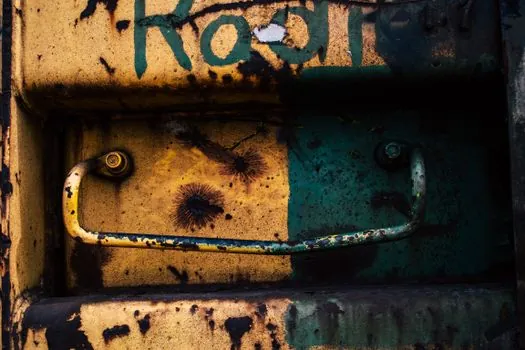
Carbon steel in oxygen and moisture undergoes electrochemical corrosion, while acids, alkalis, salts, and chemical fumes can accelerate deterioration depending on steel grade and operating conditions [S3]. Coating damage creates a maintenance point that requires inspection, surface preparation, and recoating.
FRP avoids iron-based rust formation under normal service and can tolerate moisture or complete immersion without the same corrosion mechanism [S2][S3]. This makes FRP composite attractive in wastewater, chemical-plant, marine, and salt-contaminated installations where recurring corrosion threatens steel availability [S3].
Chemical compatibility is resin-specific rather than inherent for all FRP [S3]. Epoxy novolac and standard epoxy may offer different resistance envelopes, as discussed in Epoxy Novolac vs Standard Epoxy Chemical Resistance. The project datasheet must identify the exact resin and exposure concentration before FRP is approved for a corrosive slurry.
Temperature, Electrical, and Installation Constraints
Steel is the default for chute service near or above the operating-temperature envelope of the selected FRP resin. The research identifies elevated temperature as a factor affecting FRP performance, but it does not provide a defensible universal temperature limit for a generic FRP liner [S3].
Steel must be electrically grounded, while FRP is non-conductive [S2]. That difference affects static-control design, bonding, grounding, conductive access, and the possibility of triboelectric or electrostatic charging in dry or low-humidity slurry service.
FRP can be fabricated with standard tools and does not require cutting or welding, which can remove hot-work requirements for modifications [S2]. Its lower weight also reduces handling-equipment requirements, while steel usually requires additional equipment because of its mass [S2].
Cost and Lifecycle Comparison
FRP can reduce corrosion-related inspection, coating repair, replacement, and downtime, but these savings should be compared with a higher material cost rather than asserted without a project estimate [S3][S8].
FRP products do not require painting or coating, unlike steel, which requires painting or galvanising for certain environments [S2]. In a covered abrasive chute, appearance has little engineering value, so coating savings should be counted only where they affect corrosion protection or access.
A practical lifecycle comparison should include liner mass, support steel, transport, installation equipment, expected wear intervals, lining repairs, coating work, planned shutdowns, and replacement disposal. The research supports FRP’s lightweight and corrosion-resistance advantages, but it does not provide enough numerical wear-life data to declare a universal cost winner.
Failure Modes and Qualification Tests
FRP failure can follow several paths: matrix wear or erosion, fibre breakage, delamination, creep, resin softening, UV degradation, moisture ingress, chemical attack, or damage at bolted and welded attachment points [S3][S7]. Steel failure more commonly involves loss of section, deformation, coating breakdown, corrosion, and impact-driven cracking.
Qualify the liner with representative slurry testing rather than water-only erosion. Record solids concentration, maximum particle size, particle shape, flow velocity, impact angle, duty hours, temperature, and chemical composition. Inspect FRP for exposed fibres, matrix loss, cracking, delamination, softened zones, and fastener-hole distress [S3][S7].
Steel liners require coating-condition inspection, local thickness measurements, deformation checks, and replacement of undercut or impact-damaged areas. For mixed-material chutes, isolate dissimilar metals where electrochemical contact or coating damage could otherwise compromise the steel interface.
Use-Case Recommendations
Select FRP for highly corrosive slurries at moderate temperature and impact duty, especially where reduced mass, no hot-work modification, electrical non-conductivity, and corrosion control justify the premium. Select steel for hard, coarse, fast-moving solids, heavy impact, elevated temperature, severe structural loading, or repair regimes where an established steel wear system is operationally simpler [S6].
For borderline service, compare a steel chute with a lined FRP option against four criteria: abrasion life, corrosion maintenance, installed mass, and temperature capacity. The supplied evidence clearly separates FRP’s corrosion and weight advantages from steel’s high-load and high-temperature advantages, but it does not supply enough wear-rate data for a universal numerical ranking [S2][S6].
Track two signals before final procurement: coupon wear loss under the actual slurry and elapsed maintenance hours per operating hour. These measurements distinguish a corrosion-led FRP benefit from an abrasion-led failure and provide the defensible basis for the next material trial.